
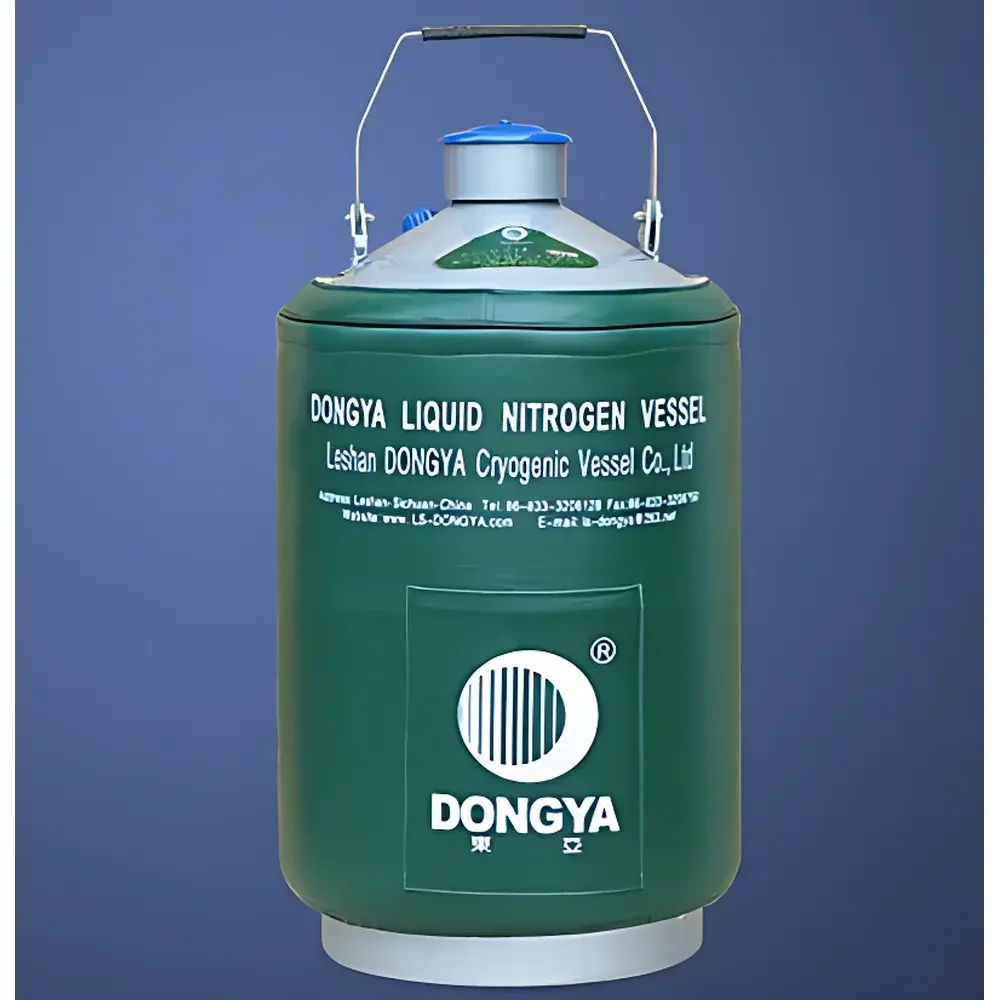
East Asia YDS-30 Biological Liquid Nitrogen Storage Container
| Origin | Sichuan, China |
|---|---|
| Manufacturer Type | Distributor |
| Origin Category | Domestic |
| Model | YDS-30 |
| Price | USD 420 (FOB) |
| Capacity | 30 L |
| Neck Diameter | 50 mm |
| Outer Diameter | 445 mm |
| Height | 660 mm |
| Empty Weight | 13 kg |
| Full Weight | 37.2 kg |
| Hold Time | 220 days |
| Cryogenic Insulation | High-Vacuum Multi-Layer Superinsulation (MLI) |
| Shell Material | Anodized Anti-Corrosion Aluminum Alloy |
| Protective Cover | Genuine Leatherette Outer Sleeve |
| Lid Type | Flip-Open with Locking Clamp |
| Customization | Available for neck diameter, internal rack configuration, and non-standard dimensions |
Overview
The East Asia YDS-30 Biological Liquid Nitrogen Storage Container is an engineered cryogenic storage solution designed for long-term, static preservation of temperature-sensitive biological specimens at –196 °C. Based on the proven principles of high-vacuum multi-layer insulation (MLI), the YDS-30 employs concentric aluminum alloy shells separated by a deep vacuum interspace and wrapped with dozens of alternating reflective (aluminized polyester) and low-conductivity spacer layers. This architecture minimizes heat influx via conduction, convection, and radiation—achieving thermal conductance values typical of Class I static-phase liquid nitrogen (LN2) storage systems. Unlike mechanical freezers or two-phase cryostats, the YDS-30 operates passively without power input, eliminating risk of temperature drift during grid failure or compressor malfunction. Its design prioritizes stability over mobility: optimized for indoor laboratory or biobank environments where uninterrupted ultra-low-temperature integrity is critical for viability retention in reproductive cells, primary tissues, and clinical-grade biologics.
Key Features
- High-purity anodized anti-corrosion aluminum alloy construction for both inner and outer vessels—resistant to condensation-induced pitting and compatible with routine ethanol or hydrogen peroxide decontamination protocols
- Factory-evacuated high-vacuum chamber (<1×10⁻³ Pa) maintained for >10 years under ISO 22081-compliant sealing integrity testing
- Superinsulation system comprising ≥30 layers of aluminized Mylar® and fiberglass spacers—engineered to limit boil-off rate to ≤0.136 L/day (220-day hold time at ambient 25 °C)
- Flip-open lid with dual-point stainless steel locking clamps—ensures consistent vacuum seal retention and prevents accidental lid displacement during routine access
- Integrated genuine leatherette protective sleeve—provides mechanical abrasion resistance, thermal buffering against ambient fluctuations, and ergonomic handling
- Standard 50 mm neck aperture compatible with universal cryovial racks (e.g., Nunc™, Thermo Scientific™ formats) and optional auto-fill adapters for LN2 level monitoring
- Modular internal geometry supporting configurable canister layouts—including customizable lift-out canes, labeled aluminum racks, and traceable barcode-tagged sample holders
Sample Compatibility & Compliance
The YDS-30 meets core functional requirements for long-term archival storage under internationally recognized biospecimen stewardship frameworks. It supports validated storage of bovine semen (per ISO 21569:2020), human embryos (per ESHRE Guidelines), hematopoietic stem cells (per FACT-Net standards), and lyophilized viral vaccines (per WHO TRS No. 1015 Annex 3). While not certified to UL 1275 or EN 61000-6-3 as an electrical device, its passive operation inherently complies with ICH Q5C stability protocol mandates for non-powered cold chain components. The vessel’s dimensional consistency, material traceability (batch-coded shell alloys), and documented vacuum decay profiles enable inclusion in GLP/GMP audit trails when paired with facility-level LN2 supply validation and temperature mapping reports (per ISO/IEC 17025).
Software & Data Management
As a passive storage platform, the YDS-30 does not incorporate embedded electronics or firmware. However, it is fully interoperable with third-party cryogenic monitoring ecosystems—including wireless LN2 level sensors (e.g., CRYOSENSE®, Phase Analytics), RFID-enabled rack tracking modules, and centralized biorepository LIMS platforms (e.g., OpenSpecimen, LabVantage). Optional factory-installed ports allow integration with analog pressure transducers or thermocouple feedthroughs for real-time vapor-phase temperature logging—supporting 21 CFR Part 11–compliant electronic records when deployed with qualified data acquisition hardware and audit-trail-enabled software.
Applications
- Long-term static storage of bovine, equine, and porcine semen straws in AI centers and veterinary biobanks
- Cryopreservation of human preimplantation embryos and oocytes in IVF laboratories operating under CAP/CLIA accreditation
- Stem cell banking—particularly mesenchymal stromal cells (MSCs) and induced pluripotent stem cells (iPSCs)—requiring >10-year viability assurance
- Vaccine strain archiving for regulatory submission batches (e.g., WHO-prequalified measles or rabies virus stocks)
- Tissue banking of skin grafts, corneal tissue, and vascular segments under AATB-accredited programs
- Research specimen repositories supporting longitudinal omics studies (e.g., GTEx, UK Biobank–compatible workflows)
FAQ
What is the maximum recommended fill level for optimal hold time?
Fill to 90% of nominal capacity (27 L) to maintain stable vapor-phase temperature gradients and prevent excessive pressure buildup during rapid cooldown.
Can the YDS-30 be used for vapor-phase storage only?
Yes—the geometry and insulation performance support reliable vapor-phase operation down to –150 °C at 50 mm working distance from liquid surface, suitable for sensitive cell types requiring reduced thermal shock.
Is vacuum integrity testing required after shipment?
We recommend verifying vacuum status using a calibrated thermocouple probe inserted into the neck before first use; visible frost line height above liquid surface should remain stable for ≥2 hours post-fill.
Are custom internal configurations available for specialized sample formats?
Yes—East Asia offers engineering consultation for bespoke rack designs, including 96-well plate carriers, cryo-tube matrices, and dual-compartment partitions for segregated inventory management.
Does the leatherette sleeve affect thermal performance?
No—the sleeve is dimensionally decoupled from the vacuum jacket and serves solely as mechanical protection; thermal modeling confirms <0.3% impact on daily boil-off rate.




