
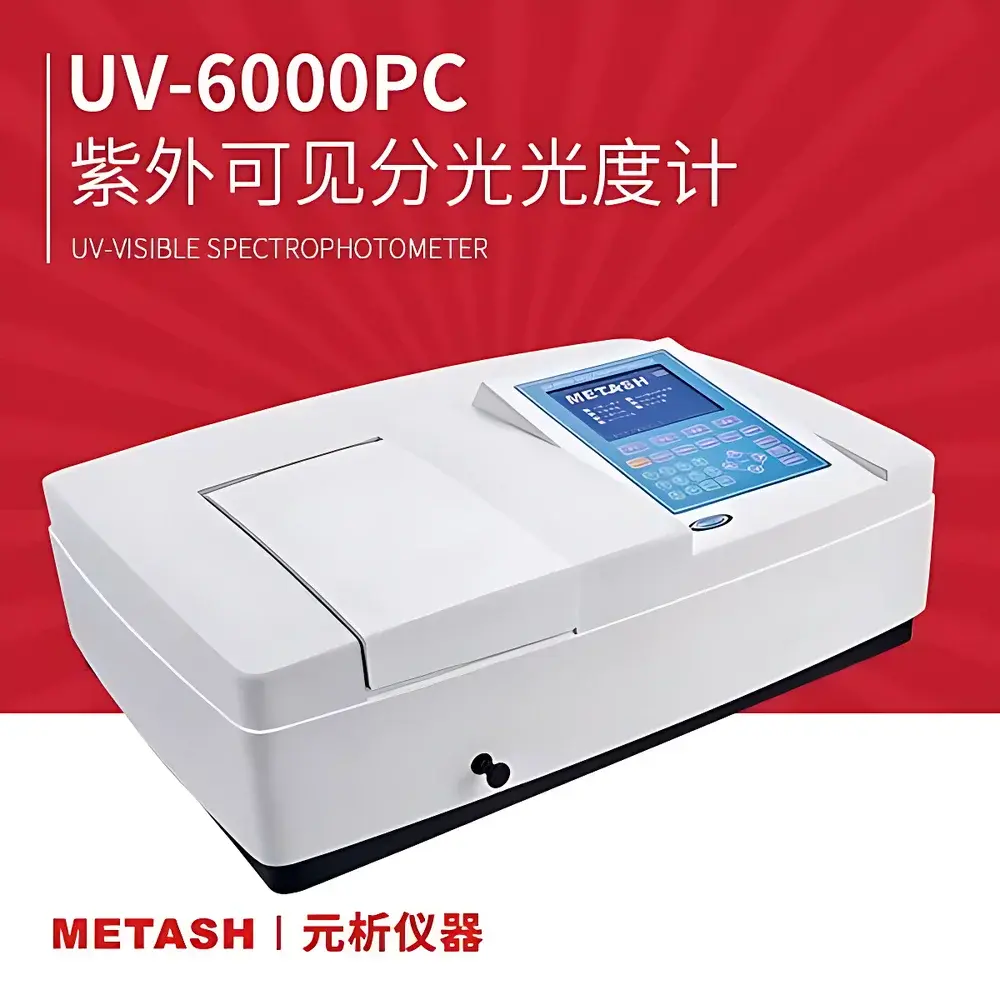
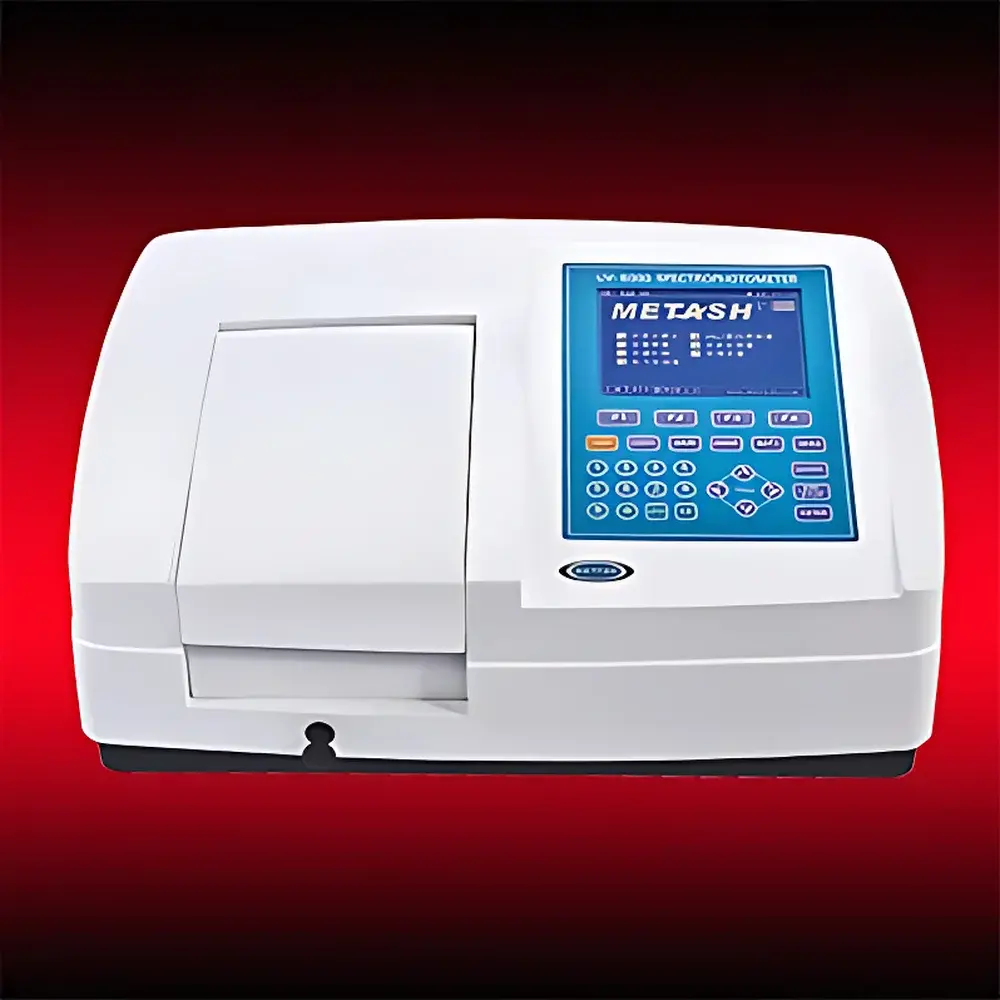
Metash UV-6000PC Dual-Beam UV-Vis Spectrophotometer
| Brand | Metash Instruments |
|---|---|
| Origin | Shanghai, China |
| Manufacturer Type | Original Equipment Manufacturer (OEM) |
| Product Category | Domestic |
| Model | UV-6000PC |
| Optical System | Dual-beam ratio-monitoring |
| Detector Type | Silicon photodiode |
| Wavelength Range | 190–1100 nm |
| Wavelength Scanning Mode | Automatic |
| Spectral Bandwidth | 1.8 nm |
| Wavelength Accuracy | ±0.5 nm |
| Wavelength Repeatability | ≤0.2 nm |
| Stray Light | ≤0.05% T |
| Display | 6-inch full-color LED LCD |
| Data Interface | USB port |
| Software | PC-based analytical software with GLP/GMP-compliant audit trail |
Overview
The Metash UV-6000PC is a dual-beam ratio-monitoring ultraviolet-visible spectrophotometer engineered for high-stability quantitative and qualitative analysis in routine QC laboratories, academic research settings, and pharmaceutical development environments. It operates on the principle of Beer–Lambert law-based absorbance measurement, utilizing a split-beam optical architecture where sample and reference beams are simultaneously monitored by a single silicon photodiode detector. This real-time ratio correction compensates for source intensity drift—particularly critical during extended spectral scans or kinetic assays—thereby ensuring long-term photometric stability without manual recalibration. The instrument’s optical path is mechanically isolated via a suspended design mounted on an 8-mm-thick aerospace-grade aluminum optical baseplate, minimizing sensitivity to environmental vibration and thermal expansion-induced misalignment. Its wavelength coverage spans 190–1100 nm, supporting applications from nucleic acid quantification at 260 nm to visible-range colorimetric assays and near-IR solvent characterization.
Key Features
- Dual-beam ratio-monitoring optical system with real-time reference beam compensation for enhanced photometric stability and reduced baseline drift
- 6-inch full-color LED LCD display providing intuitive graphical interface, real-time spectrum visualization, and standalone operation without external PC
- Self-contained functionality: absorbance/transmittance measurement, fixed-wavelength quantitation, full-spectrum scanning (190–1100 nm), time-resolved kinetics, multi-wavelength analysis, and biomolecular assays (DNA/RNA and protein A280/A260 ratio)
- Suspended optical assembly rigidly anchored to a precision-machined 8-mm aluminum baseplate, decoupling the optical train from mechanical stress and ambient vibration
- Imported deuterium and tungsten-halogen lamps ensure broad spectral output and low-noise performance across UV and visible ranges
- Optimized optical design achieving ≤0.05% T stray light at 220 nm and 340 nm—critical for high-dynamic-range measurements in low-transmittance samples
Sample Compatibility & Compliance
The UV-6000PC supports standard 10-mm rectangular cuvettes (quartz, glass, or plastic), as well as optional accessories including an automated 8-position cell changer, micro-volume cuvette holders (down to 50 µL pathlength), Peltier-controlled temperature-regulated sample compartments, and diffuse reflectance attachments for solid-state analysis. All hardware and firmware comply with fundamental electromagnetic compatibility (EMC) and electrical safety standards per IEC 61010-1. The embedded software architecture adheres to Good Laboratory Practice (GLP) and Good Manufacturing Practice (GMP) requirements: user role-based access control (administrator/operator), tamper-proof electronic logbook with timestamped entries, full data audit trail, and exportable PDF/CSV reports traceable to instrument ID, operator, date/time, and method parameters. While not pre-certified for FDA 21 CFR Part 11, the system provides the foundational controls—including electronic signatures, session lockout, and immutable data storage—required for regulated environments undergoing internal validation.
Software & Data Management
The bundled PC software is a Windows-native application offering comprehensive method development, execution, and post-processing capabilities. It enables creation of custom calibration curves (linear, quadratic, or polynomial), automatic concentration calculation with error propagation, kinetic curve fitting (zero-, first-, or second-order models), and spectral overlay/multi-sample comparison. Raw absorbance data is stored in vendor-neutral .csv format; processed results include metadata headers compliant with LIMS integration protocols. Audit logs record all user actions—including method edits, data deletions, and parameter overrides—with SHA-256 hashed integrity verification. Data backups can be scheduled to network drives or external USB storage, and report templates conform to ISO/IEC 17025 documentation expectations for accredited testing laboratories.
Applications
- Pharmaceutical QC: Assay of active pharmaceutical ingredients (APIs), excipient purity screening, dissolution testing, and stability-indicating methods per USP and
- Biochemistry: Quantification of nucleic acids (A260) and proteins (A280, Bradford/Lowry assays), enzyme kinetics (e.g., NADH oxidation at 340 nm), and ligand-binding studies
- Environmental analysis: Nitrate/nitrite determination (EPA 353.2), phosphate (ascorbic acid method), and heavy metal chelation assays (e.g., Fe2+ with 1,10-phenanthroline)
- Materials science: Bandgap estimation of semiconductor nanoparticles via Tauc plot analysis, dye degradation kinetics under UV irradiation, and thin-film transmittance profiling
- Food & beverage: Color index (CIE L*a*b*) assessment, antioxidant capacity (FRAP assay), and preservative (e.g., sulfite) quantification
FAQ
What is the minimum detectable absorbance change supported by the UV-6000PC?
The instrument achieves a photometric noise level of ≤0.001 Abs at 546 nm (1 sec response time), enabling reliable detection of sub-0.002 Abs changes under optimal conditions.
Can the UV-6000PC be validated for GxP use?
Yes—the system supports IQ/OQ/PQ protocol execution through documented operational checks, wavelength accuracy verification (using holmium oxide and didymium filters), photometric linearity testing (neutral density filters), and software configuration control per Annex 11 guidance.
Is remote operation possible?
The USB-connected PC software allows full instrument control and data acquisition from a host computer up to 5 m away; network-enabled operation requires third-party VNC or LabVIEW integration.
What maintenance is required for long-term reliability?
Annual lamp replacement (deuterium: ~1,000 h lifetime; tungsten: ~2,000 h), quarterly cleaning of optical windows with spectroscopic-grade methanol, and biannual verification of wavelength accuracy using certified reference materials.
Does the UV-6000PC support compliance with ISO 6425 or ASTM E275?
While not pre-tested to these specific standards, its optical specifications—including stray light, bandwidth, and wavelength accuracy—meet or exceed the minimum requirements defined in ASTM E275-22 (Standard Practices for Describing and Measuring Performance of UV-Vis Spectrophotometers).





