
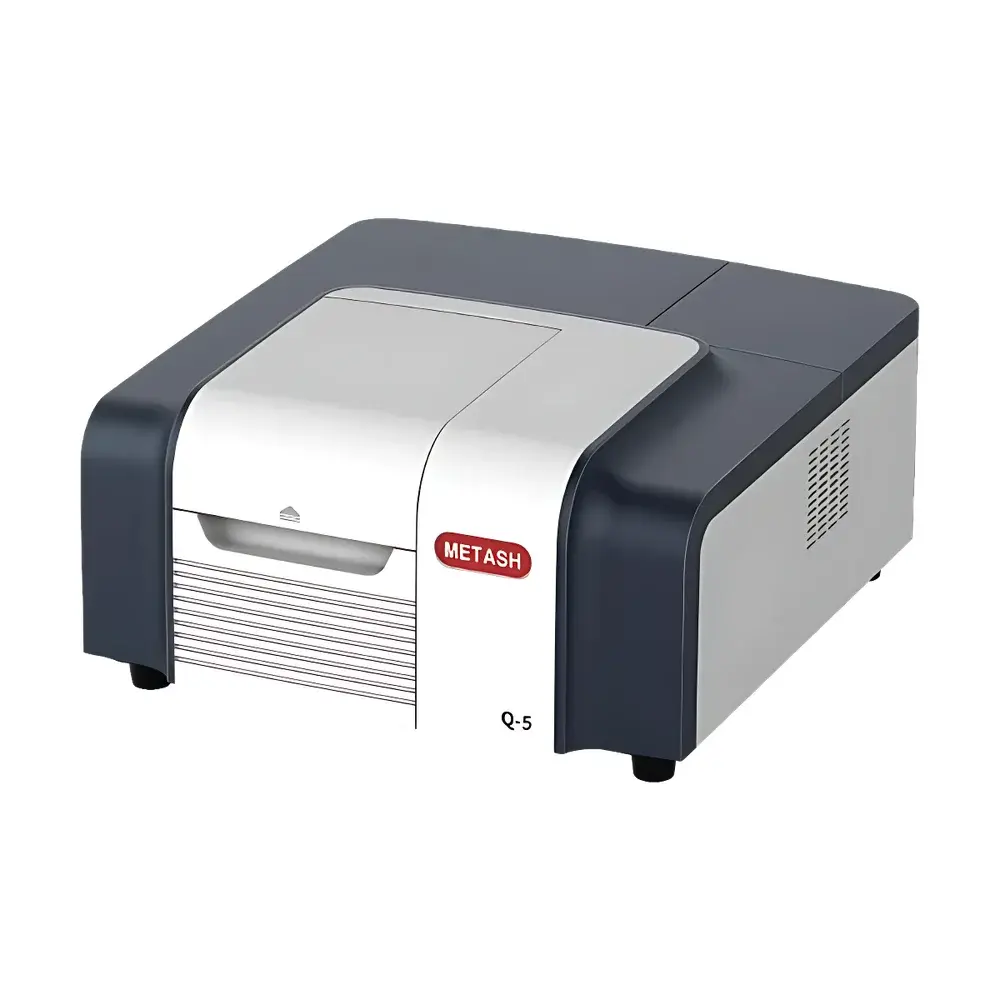
Metash Q-5S Dual-Beam Ultraviolet-Visible Spectrophotometer
| Brand | Metash Instruments |
|---|---|
| Origin | Shanghai, China |
| Manufacturer Type | Direct Manufacturer |
| Model | Q-5S |
| Optical System | Dual-Beam |
| Detector | Photomultiplier Tube (PMT) |
| Wavelength Range | 190–900 nm |
| Wavelength Accuracy | ±0.3 nm |
| Wavelength Repeatability | ≤0.1 nm |
| Spectral Bandwidth | 0.1–5.0 nm (continuously adjustable in 0.1 nm increments) |
| Stray Light | ≤0.01% T |
| Photometric Accuracy | ±0.3% T |
| Photometric Repeatability | ≤0.1% T |
| Baseline Drift | ≤0.0003 Abs/h |
Overview
The Metash Q-5S is a high-performance dual-beam ultraviolet-visible (UV-Vis) spectrophotometer engineered for precision quantitative and qualitative analysis across research laboratories, quality control environments, and regulatory-compliant production facilities. Based on the fundamental principle of Beer–Lambert law absorption spectroscopy, the instrument employs a single-monochromator optical architecture with true dual-beam compensation—splitting the light path into reference and sample channels in real time to eliminate source intensity drift and environmental fluctuations. This design ensures exceptional baseline stability and measurement reproducibility over extended acquisition periods. The Q-5S operates across a broad spectral range from 190 nm to 900 nm, covering deep UV through near-infrared, enabling versatile applications including nucleic acid quantification, enzyme kinetics, colorimetric assays, and thin-film transmittance characterization.
Key Features
- Dual-beam optical system with real-time reference beam correction for enhanced photometric stability and reduced baseline drift (≤0.0003 Abs/h).
- High-sensitivity photomultiplier tube (PMT) detector with wide dynamic gain range and rapid response—optimized for low-light detection in trace analyte quantification and weak-absorbance samples.
- Continuously variable spectral bandwidth from 0.1 nm to 5.0 nm in 0.1 nm increments, supporting resolution-critical applications such as narrow-band absorbance peak deconvolution and high-fidelity spectral profiling.
- Integrated mercury lamp for automated wavelength calibration—enabling routine verification and adjustment without external standards or manual intervention.
- Modular lamp housing design with plug-in deuterium and tungsten-halogen sources, facilitating field-replaceable maintenance with minimal downtime and no optical realignment.
- Precision-molded polymer chassis with reinforced structural integrity, ensuring long-term mechanical stability and resistance to ambient vibration and thermal expansion effects.
Sample Compatibility & Compliance
The Q-5S accommodates standard 10 mm pathlength cuvettes (quartz, glass, or plastic), micro-volume cells, and solid-sample configurations via optional accessories—including integrating spheres for diffuse reflectance/transmittance, variable-angle solid sample holders, and thermostatted cell jackets compliant with ASTM E275 and ISO 6224 standards. All optical components meet RoHS directives, and the instrument’s firmware architecture supports audit-trail-enabled operation aligned with GLP and GMP requirements. Data integrity controls—including user authentication, electronic signatures, and immutable activity logging—facilitate compliance with FDA 21 CFR Part 11 when deployed in regulated pharmaceutical or clinical testing environments.
Software & Data Management
Bundled Metash SpectraPro software provides a comprehensive analytical platform compatible with Windows OS. It supports six core operational modes: photometric measurement, quantitative analysis (single/multi-point calibration, coefficient method), full-spectrum scanning (up to 3200 data points per scan), kinetic time-course monitoring, DNA/protein concentration calculation (A260/A280 ratio, extinction coefficients), and derivative spectroscopy. Raw spectral data are stored in vendor-neutral ASCII format; processed results include annotated spectra, calibration curves, and statistical summaries (R², SD, CV%). Software modules implement role-based access control, session-level audit logs, and export-ready reports conforming to ISO/IEC 17025 documentation standards.
Applications
- Pharmaceutical QC: Assay validation, excipient interference screening, and dissolution profile analysis per USP .
- Life sciences: Nucleic acid purity assessment (A260/A280 ≥1.8), protein quantification (Bradford/Lowry/BCA), and enzyme activity kinetics (NADH/NADPH monitoring at 340 nm).
- Environmental testing: Nitrate/nitrite determination in water via diazotization, COD estimation, and heavy metal chelation assays.
- Materials science: Bandgap estimation of semiconductor thin films, pigment dispersion analysis, and UV-stability evaluation of polymers.
- Food & beverage: Color index (CIE L*a*b*) derivation, antioxidant capacity (FRAP/DPPH), and adulterant detection via spectral fingerprinting.
FAQ
What is the maximum scan speed supported by the Q-5S?
The instrument performs full-range scans (190–900 nm) in under 12 seconds at 1.0 nm spectral bandwidth and 2 nm/s scan velocity, with configurable step resolution down to 0.1 nm.
Is the Q-5S compatible with third-party automation systems?
Yes—via RS-232 and USB virtual COM port interfaces, the Q-5S supports integration with robotic liquid handlers and LIMS platforms using ASCII command protocol (SCPI-compatible subset).
How often does the internal mercury lamp require recalibration?
The built-in Hg lamp enables daily self-checks; full wavelength calibration is recommended after lamp replacement or every 1000 operating hours, whichever occurs first.
Can the Q-5S perform simultaneous multi-wavelength kinetic measurements?
It acquires full spectra at user-defined time intervals; post-acquisition extraction of multiple wavelengths (e.g., 260 nm + 280 nm + 320 nm) is supported within SpectraPro software.
Does the system support 21 CFR Part 11 compliance out-of-the-box?
Audit trail, electronic signature, and user permission modules are enabled by default; configuration templates for Part 11 implementation are included in the software installation package.
Related Products






