
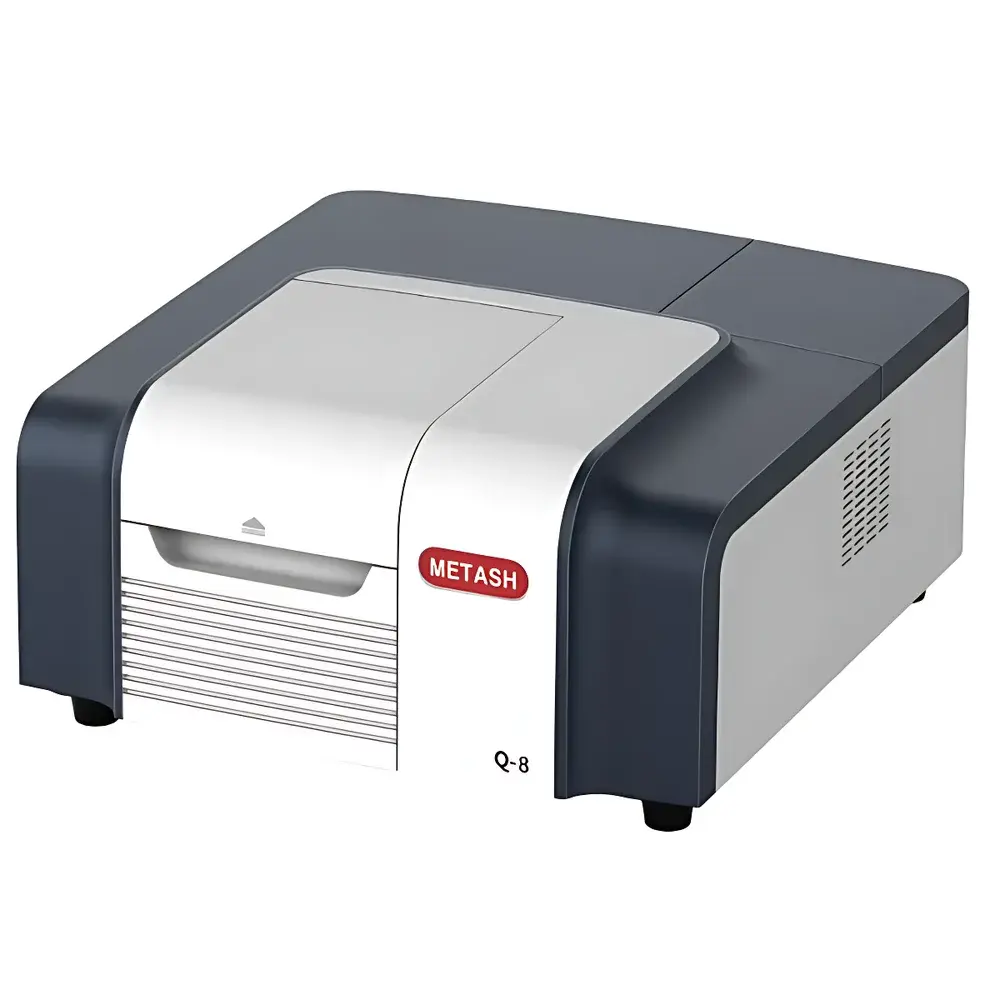
Metash Q-8 Dual-Beam UV-Vis Spectrophotometer
| Brand | Metash Instruments |
|---|---|
| Origin | Shanghai, China |
| Manufacturer | Yes |
| Type | Domestic |
| Model | Q-8 |
| Optical Design | Dual-beam, dual-monochromator |
| Detector | Photomultiplier Tube (PMT) |
| Wavelength Range | 190–900 nm (extendable to 185 nm) |
| Wavelength Accuracy | ±0.2 nm |
| Wavelength Repeatability | ≤0.05 nm |
| Spectral Bandwidth | 1.8 nm |
| Stray Light | ≤0.00005% T |
| Photometric Accuracy | ±0.3% T |
| Photometric Repeatability | ≤0.1% T |
| Baseline Drift | ≤0.0001 Abs/h |
Overview
The Metash Q-8 Dual-Beam UV-Vis Spectrophotometer is an engineered analytical instrument designed for high-fidelity absorbance and transmittance measurements across the ultraviolet, visible, and near-infrared spectral regions. Utilizing a dual-beam optical architecture with a hybrid Czerny-Turner (C-T) dual-monochromator configuration, the Q-8 achieves exceptional wavelength isolation and signal stability—critical for trace-level quantitation and high-resolution spectral profiling. The system employs a thermally stabilized deuterium lamp (185–400 nm), tungsten-halogen lamp (340–900 nm), and optional mercury lamp for wavelength calibration verification. Its extended spectral coverage from 185 nm to 900 nm supports applications ranging from nucleic acid and protein analysis at low UV wavelengths to pigment characterization and colorimetric assays in the visible domain. The inclusion of a high-gain, low-noise photomultiplier tube (PMT) detector ensures superior signal-to-noise ratio—particularly essential for low-transmittance or dilute-sample measurements where stray light suppression becomes decisive.
Key Features
- Dual-beam, dual-monochromator optical path minimizes baseline drift and enhances photometric stability during long-duration scans or kinetic studies.
- Ultra-low stray light performance (≤0.00005% T) enabled by precision grating alignment, optimized baffling, and high-efficiency order-sorting filters—meeting stringent requirements for high-dynamic-range applications such as pharmaceutical impurity detection per ICH Q2(R2).
- Modular lamp housing design with plug-in D2 and W lamps enables rapid field replacement without optical realignment or recalibration.
- High-precision stepper motor-driven monochromator delivers ≤0.05 nm wavelength repeatability—supporting compliance with ASTM E275, ISO 6223, and USP spectrophotometer verification protocols.
- Thermally isolated optical bench and active temperature compensation reduce thermal-induced wavelength shift, contributing to ≤0.0001 Abs/h baseline drift under ambient conditions.
- Robust injection-molded chassis provides mechanical rigidity and electromagnetic shielding, ensuring consistent performance in shared laboratory environments.
Sample Compatibility & Compliance
The Q-8 accommodates standard 10 mm cuvettes (quartz, glass, or plastic), micro-volume cells (down to 50 µL), and solid samples via optional accessories including integrating spheres (for diffuse reflectance), variable-angle sample holders (for thin-film or coated substrate analysis), and thermostatted cell holders (±0.1 °C control). All hardware and firmware comply with CE marking directives and meet essential safety and EMC requirements per IEC 61010-1. Software operation adheres to GLP/GMP principles: user access levels (administrator/operator/auditor), full electronic audit trail (including method changes, data modifications, and instrument events), and secure data export in CSV, PDF, and XML formats compatible with LIMS integration. The system supports 21 CFR Part 11-compliant configurations when deployed with validated software modules and network authentication infrastructure.
Software & Data Management
The Q-8 is operated via Metash SpectraPro™ — a Windows-based application engineered for scientific rigor and regulatory readiness. Core modules include photometric measurement, quantitative analysis (single/multi-point calibration, linear/non-linear regression), full-spectrum scanning (with smoothing, derivative, peak identification), kinetic time-course monitoring (up to 10,000 data points per run), and dedicated nucleic acid/protein analysis workflows (A260/A280, A260/A230, extinction coefficient-based concentration calculation). Data processing features include baseline correction (polynomial, rubberband), spectral subtraction, overlay comparison, and customizable report templates with embedded metadata (operator ID, timestamp, instrument serial number, calibration status). Raw data files are stored in proprietary binary format with SHA-256 checksums to ensure integrity; export options preserve full traceability without loss of precision.
Applications
- Pharmaceutical QC: Assay validation, dissolution testing, excipient interference screening, and residual solvent quantification using UV absorption.
- Life sciences: DNA/RNA purity assessment, Bradford/Lowry/BCA protein assays, enzyme kinetics (e.g., NADH/NADPH monitoring at 340 nm), and cell culture density estimation.
- Environmental analysis: Nitrate/nitrite, phosphate, and heavy metal (e.g., Cr(VI), Fe(II)) determination via colorimetric methods compliant with APHA Standard Methods.
- Materials science: Bandgap estimation of semiconductors, dye degradation kinetics, and thin-film optical thickness modeling using transmission/reflection spectra.
- Food & beverage: Color index (CIE L*a*b*), antioxidant capacity (FRAP/DPPH), and adulterant screening (e.g., melamine detection via derivatization).
FAQ
What wavelength calibration standards are recommended for routine verification?
NIST-traceable holmium oxide and didymium filters are recommended for daily wavelength accuracy checks per ISO/IEC 17025 guidelines.
Can the Q-8 be integrated into automated laboratory workflows?
Yes—via RS-232, USB, or optional Ethernet interface, supporting SCPI command set for integration with robotic liquid handlers and LIMS platforms.
Is the PMT detector replaceable by the end user?
No—detector replacement requires factory recalibration and optical alignment verification; contact Metash Service for authorized service procedures.
Does the system support multi-cuvette sequential measurement?
Yes—when equipped with the optional 8-position automatic sample changer, the Q-8 executes unattended batch analysis with programmable delay times and auto-zeroing between positions.
How is photometric linearity verified across the dynamic range?
Linearity assessment follows ASTM E169–19 using neutral density filters or serial dilutions of potassium dichromate in 0.005 M H2SO4, covering 0.01–2.5 Abs range.
Related Products



