
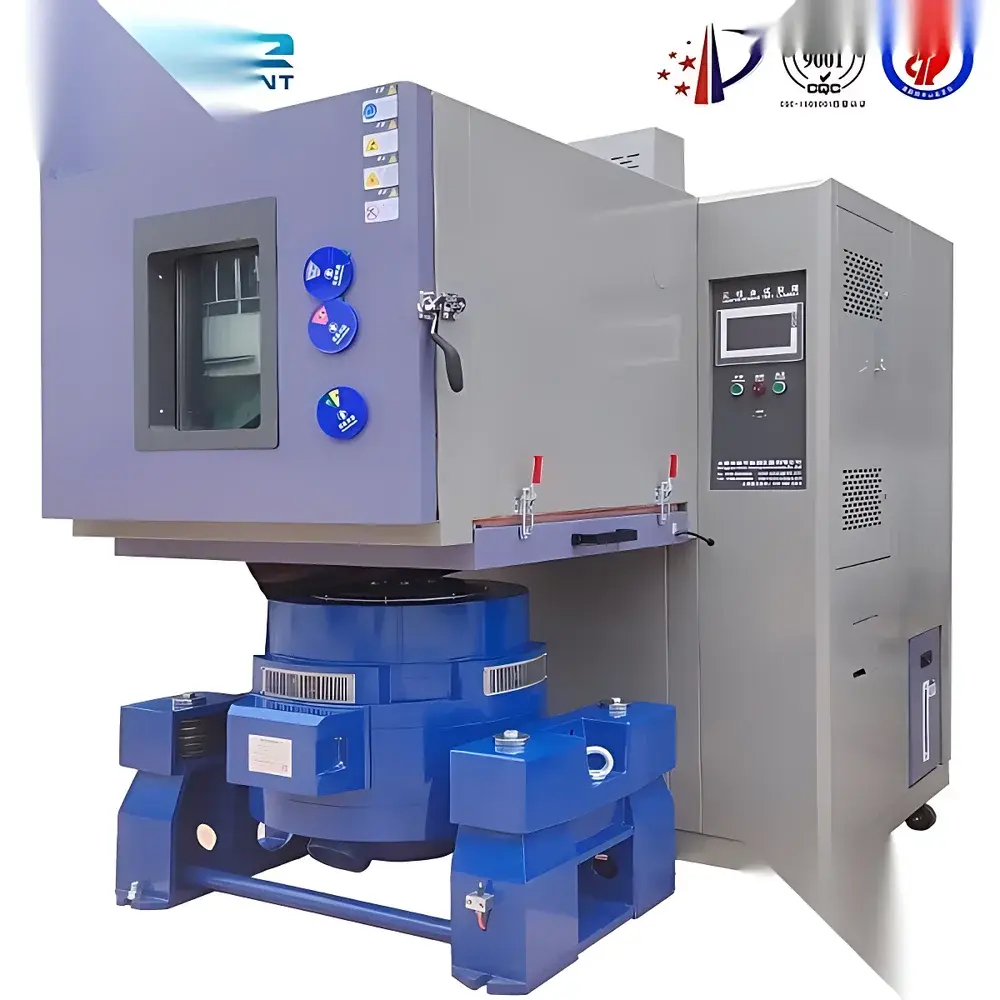
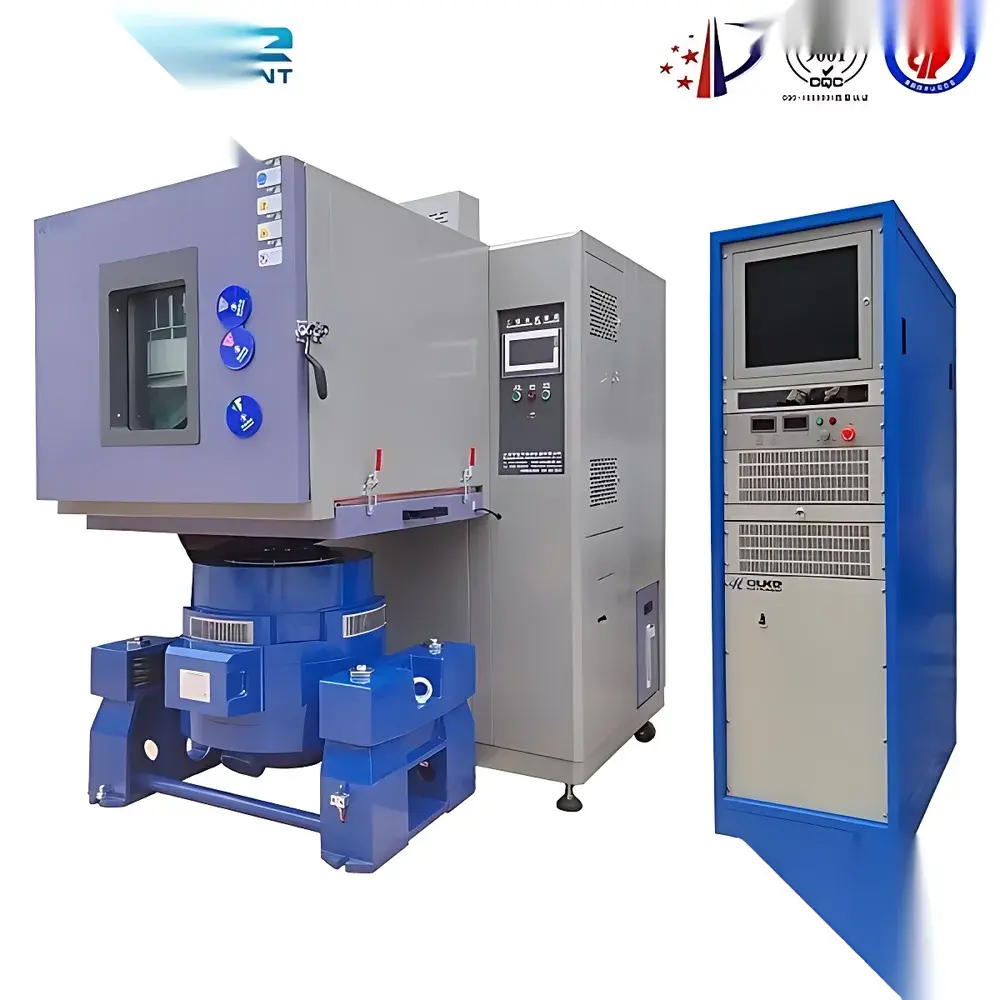
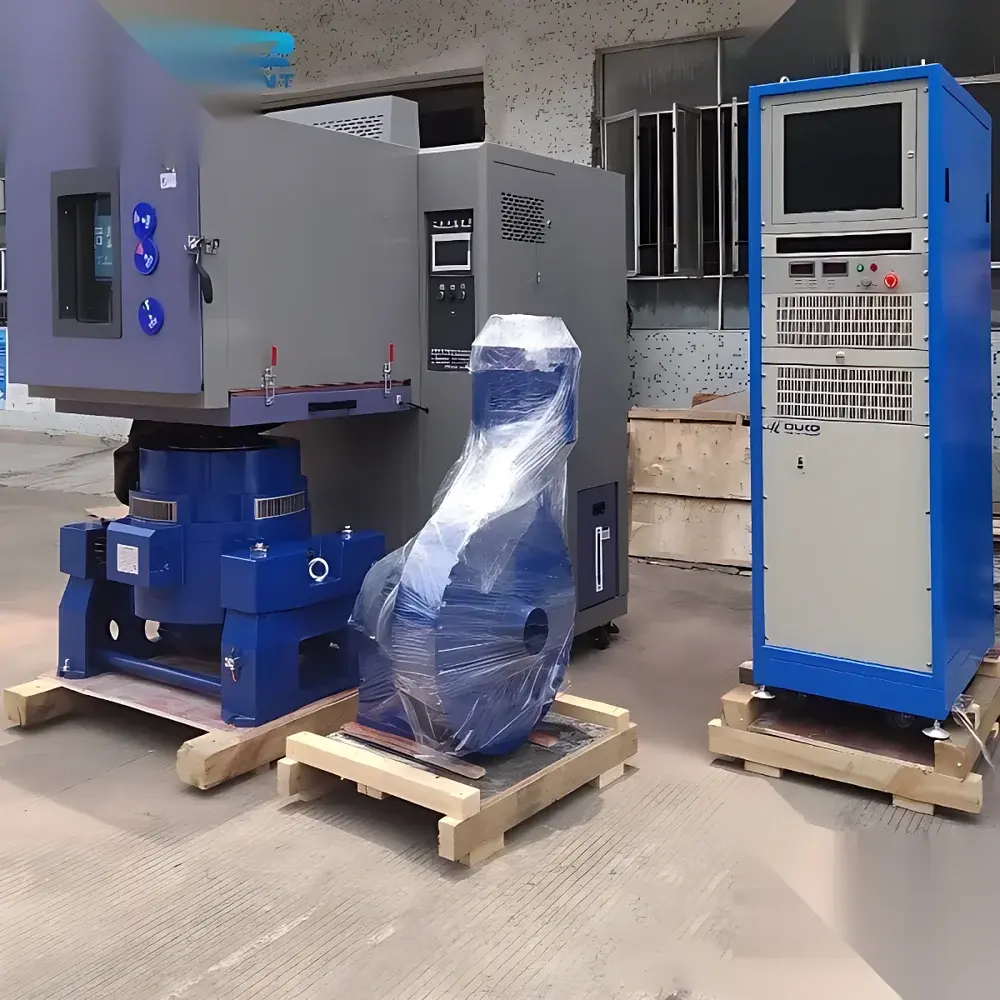
Combined Environmental Test Chamber – Triple-Combination Temperature, Humidity & Vibration System
| Brand | OEM / Custom-Built |
|---|---|
| Origin | Imported |
| Manufacturer Type | Authorized Distributor |
| Price | USD 21,500 (FOB) |
| Internal Chamber Material | SUS304 Stainless Steel |
| External Casing | Cold-Rolled Steel with Electrostatic Powder Coating |
| Insulation | Rigid Polyurethane Foam or Ultra-Fine Glass Wool |
| Sealing | High-Temperature Silicone Gasket |
| Control Method | BTHC (Balanced Temperature & Humidity Control) |
| Controller | Korean-Made 7" Touchscreen HMI with PID Auto-Tuning, 0.1°C/0.1%RH Resolution |
| Heating | Stainless Steel Finned Air Heater |
| Humidification | Shallow-Water Tank Steam Generator |
| Refrigeration | Hermetic Compressor(s), Single-Stage or Cascade Cryogenic Circuit |
| Air Circulation | Custom Aluminum Impeller with AC Inverter Motor |
| Observation Window | Reinforced Double-Layer Low-E Glass with LED Illumination |
| Safety System | Redundant Over-Temp/Over-Humidity/Vibration-Interlock Protection |
| Vibration Interface | Motorized Vertical Lift Platform for Precise Alignment with External Shaker Table |
Overview
The Combined Environmental Test Chamber (Triple-Combination Temperature, Humidity & Vibration System) is an integrated reliability validation platform engineered for simultaneous and synchronized application of thermal, hygroscopic, and dynamic mechanical stressors. Unlike sequential or standalone environmental chambers, this system implements true concurrent testing—enabling accelerated life cycle assessment of electronic assemblies, automotive ECUs, aerospace avionics, and medical device enclosures under realistic field conditions. Its core architecture follows the ASTM D4332, IEC 60068-2-60, and MIL-STD-810H methodologies for combined stress testing, where temperature cycling (−70°C to +180°C), relative humidity control (10–98% RH), and broadband vibration excitation (5–2000 Hz, up to 100 gpk) operate under unified time-synchronized profiles. The chamber’s BTHC (Balanced Temperature & Humidity Control) algorithm ensures thermodynamic equilibrium between heating, cooling, humidifying, and dehumidifying subsystems—minimizing condensation risk during rapid transitions and preserving sample integrity across multi-step test sequences.
Key Features
- Robust dual-layer chamber construction: interior SUS304 stainless steel for corrosion resistance and cleanroom compatibility; exterior cold-rolled steel with electrostatic powder coating for mechanical durability and ESD-safe grounding.
- High-efficiency insulation using rigid polyurethane foam (λ ≤ 0.022 W/m·K) or ultra-fine glass wool (density ≥ 48 kg/m³), achieving thermal loss < 0.8 K/h at −40°C ambient.
- Korean-manufactured 7-inch capacitive touchscreen HMI with embedded real-time OS, supporting up to 100 programmable segments per profile, user-defined ramp rates (0.1–10°C/min), and humidity slew control (0.5–5% RH/min).
- Independent actuation of heating (stainless finned air heater), humidification (shallow-tank steam generator with auto-water-level feedback), and refrigeration (hermetic scroll compressors with cascade low-temp stage for sub-zero capability).
- Integrated water purification module (reverse osmosis + activated carbon + UV sterilization) ensuring feedwater conductivity < 5 µS/cm—critical for preventing mineral deposition on steam nozzles and sensor drift.
- Motorized vertical lift mechanism (±150 mm travel, ±0.1 mm repeatability) enabling precise coaxial alignment between chamber baseplate and external electrodynamic or hydraulic shaker tables (e.g., LDS V875, TIRA TV 51120).
- Redundant safety architecture: triple independent temperature sensors (PT100 Class A), humidity sensor with automatic dew-point compensation, vibration amplitude limiter, and emergency power-off via hardware watchdog circuit.
Sample Compatibility & Compliance
This chamber accommodates samples up to 1200 mm (W) × 1000 mm (D) × 1000 mm (H), with maximum payload mass of 150 kg on the integrated vibration interface plate. It supports standard test fixtures compliant with ISO 16750-4 (road vehicles), IPC-9701A (printed board reliability), and JEDEC JESD22-A108F (temperature-humidity-bias). All control firmware and data logs conform to FDA 21 CFR Part 11 requirements—including electronic signatures, audit trail with immutable timestamps, and role-based access control. Calibration certificates traceable to NIST or PTB are provided upon installation, and the system meets CE (EMC Directive 2014/30/EU and LVD Directive 2014/35/EU) and RoHS 3 compliance.
Software & Data Management
The embedded controller runs proprietary firmware with native Modbus TCP and Ethernet/IP communication protocols, enabling seamless integration into factory MES or LabVantage LIMS environments. Optional PC-based software (Windows 10/11 compatible) provides full remote monitoring, real-time waveform overlay (temperature/humidity/vibration acceleration), statistical process control (SPC) charting, and automated report generation in PDF/CSV formats. All test data—including raw sensor streams at 10 Hz sampling rate—are stored locally on encrypted SD card and mirrored to network-attached storage (NAS) via configurable FTP/SFTP push. Audit trails record every parameter change, operator login/logout, and alarm event with SHA-256 hashing for GLP/GMP validation readiness.
Applications
- Automotive: Validation of ADAS radar housings under thermal shock + humidity soak + road-spectrum vibration per ISO 16750-4 Clause 7.3.
- Aerospace: Moisture ingress testing of satellite PCBAs subjected to vacuum-desiccation preconditioning followed by combined temp/humidity/vibe per RTCA DO-160G Section 25.
- Medical Devices: Accelerated aging of polymer-based infusion pump casings per ISO 10993-12, including cyclic condensation exposure at 40°C/93% RH with 5–500 Hz random vibration.
- Consumer Electronics: Drop-impact resilience assessment of smartphone modules after 96-hour damp heat (85°C/85% RH) plus 20 gpk sine sweep from 10–2000 Hz.
- Energy Storage: Thermal runaway propagation studies in Li-ion battery packs under controlled humidity and mechanical boundary conditions simulating crash-induced deformation.
FAQ
Does the system support fully synchronized vibration profiles with temperature/humidity ramps?
Yes—the controller synchronizes all three stress domains at 100 ms time resolution using a deterministic real-time scheduler. Vibration spectra (sine, random, or transient) can be triggered conditionally based on temperature thresholds or elapsed time within a segment.
Can the chamber be calibrated independently for temperature, humidity, and vibration axes?
Yes—each subsystem features dedicated calibration ports and traceable reference sensors. Third-party calibration services are supported per ISO/IEC 17025-accredited laboratories.
Is remote diagnostics and firmware update capability available?
Yes—via secure TLS 1.2 VPN tunnel. Firmware updates include cryptographic signature verification and rollback protection.
What is the typical lead time for custom configuration (e.g., extended low-temp range or high-g shaker integration)?
Standard configurations ship within 12 weeks; custom integrations require engineering review and typically deliver in 20–24 weeks from PO confirmation.
Are spare parts and service contracts available globally?
Yes—authorized service centers operate in North America, EU, APAC, and Middle East regions, with 48-hour response SLA for critical failures under Gold Support contract.



