
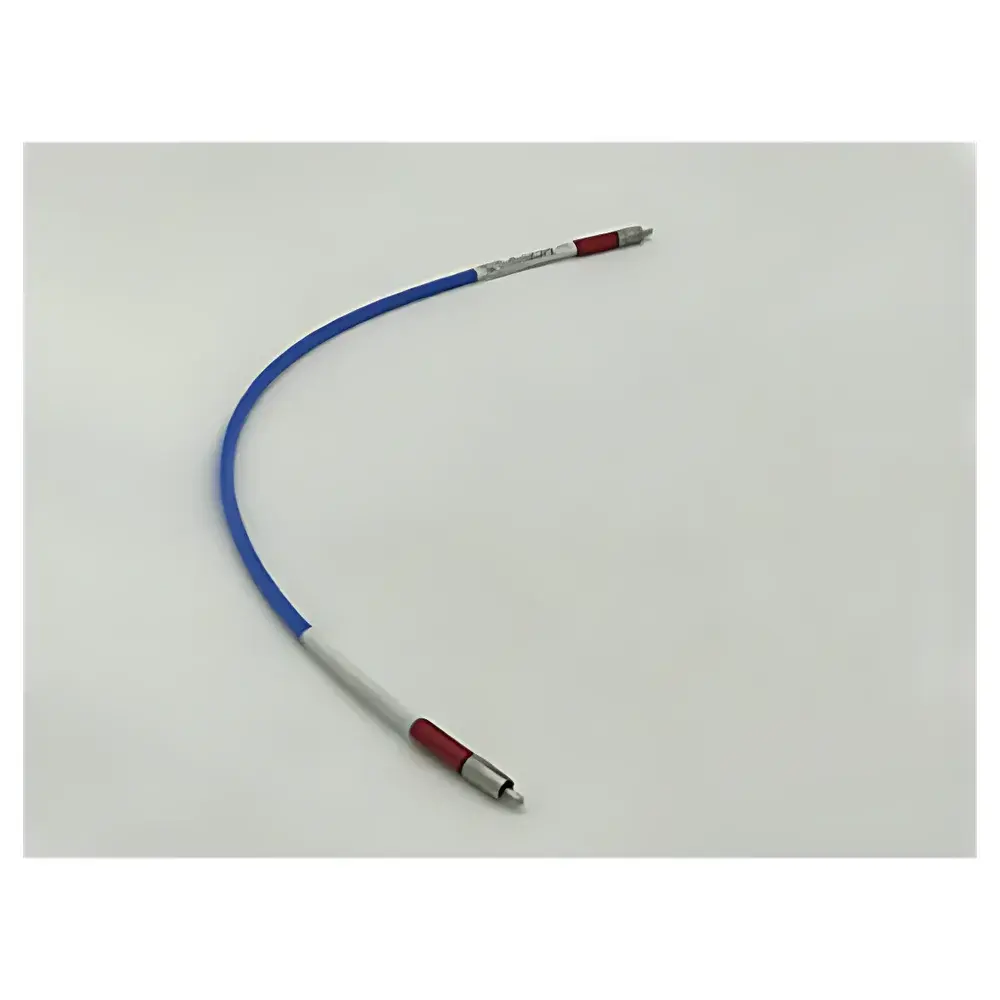
Jingfei FLG1012 Quartz Fiber Optic Cable
| Brand | Jingfei Technology |
|---|---|
| Origin | Zhejiang, China |
| Manufacturer Type | OEM/ODM Producer |
| Country of Origin | China |
| Model | FLG1012 |
| Pricing | Available Upon Request |
| Connector Type | SMA905 |
| Core Diameter | 600 µm (customizable) |
| Numerical Aperture | 0.22 |
| Spectral Range | 180–2500 nm (customizable) |
| Standard Lengths | 0.5 m, 1.5 m (custom lengths available) |
| Fiber Type Options | UV-grade quartz, VIS-grade quartz, UV-VIS fused silica, armored fiber assembly |
Overview
The Jingfei FLG1012 Quartz Fiber Optic Cable is a high-performance optical transmission component engineered for demanding spectroscopic applications requiring stable, low-loss light delivery between integrating spheres, light sources, detectors, and spectrometers. Constructed from high-purity fused silica, the FLG1012 leverages the intrinsic material properties of synthetic quartz—including exceptional UV transparency, low autofluorescence, and thermal/mechanical stability—to maintain spectral fidelity across a broad wavelength range from deep ultraviolet (180 nm) to near-infrared (2500 nm). Unlike polymer or multimode glass fibers, this quartz-based design minimizes photobleaching, solarization, and wavelength-dependent attenuation—critical for quantitative reflectance, transmittance, and fluorescence measurements under rigorous laboratory or industrial QC conditions. The cable is optimized for use in benchtop and OEM-integrated spectroscopy systems where reproducibility, long-term calibration stability, and compatibility with standardized optical interfaces are essential.
Key Features
- High-purity fused silica core with precisely controlled 600 µm diameter (±5 µm tolerance), enabling high throughput while maintaining modal consistency across UV-VIS-NIR bands
- Numerical aperture of 0.22 ensures efficient coupling with common collimated and focused optical paths, including those from deuterium-halogen lamps, LEDs, and CCD/PMT-based spectrometers
- UV-grade quartz composition provides <0.1 dB/m attenuation at 200 nm and <0.03 dB/m at 400 nm—verified per IEC 61280-4-1 test methodology
- SMA905 terminations meet ISO 80000-7 mechanical and optical interface specifications, ensuring repeatable insertion loss (<0.3 dB typical) and angular alignment repeatability (±0.5°)
- Optional armored jacket (stainless steel braid + ETFE outer sheath) enhances crush resistance, bend durability, and EMI shielding—certified to IEC 60529 IP67 when terminated
- Custom configurations supported: dual-fiber bundles for reference/sample routing, angled physical contact (APC) polishing for reduced back-reflection, and hermetic sealing for vacuum or humid environments
Sample Compatibility & Compliance
The FLG1012 is compatible with all major commercial integrating spheres (e.g., Labsphere, SphereOptics, Avantes) and modular spectrometer platforms (Ocean Insight, Hamamatsu, StellarNet, and Thermo Fisher OMNIC-enabled systems). Its spectral transmission profile complies with ASTM E275 for UV-VIS spectrophotometer validation protocols and supports traceable calibration workflows aligned with ISO/IEC 17025 requirements. When integrated into GxP-regulated environments, the fiber’s lot-specific certification documentation—including spectral transmittance curves, NA verification reports, and connector end-face inspection images—facilitates audit readiness under FDA 21 CFR Part 11 and EU Annex 11 guidelines. Batch-to-batch consistency is maintained through in-house preform drawing and jacket extrusion processes validated per ISO 9001:2015.
Software & Data Management
While the FLG1012 is a passive optical component, its performance directly impacts data integrity in software-driven acquisition workflows. It is fully interoperable with industry-standard spectroscopy control platforms—including OceanView, AvaSoft, SpectraSuite, and custom LabVIEW or Python (PyVISA, seabreeze) implementations—where consistent signal-to-noise ratio and minimal baseline drift are prerequisites for multivariate analysis (PLS, PCA), chemometric modeling, and real-time process monitoring. Optional factory-measured spectral response files (.csv or .spc format) can be imported into instrument calibration databases to correct for wavelength-specific throughput variations—supporting compliance with USP and EP 2.2.25 photometric accuracy standards.
Applications
- Integrating sphere–spectrometer interconnection for diffuse reflectance (DRIFTS), total hemispherical transmittance (THT), and bidirectional reflectance distribution function (BRDF) measurements
- UV-VIS-NIR process analytical technology (PAT) probes in pharmaceutical wet granulation, lyophilization, and API crystallization monitoring
- Remote excitation and emission light routing in fluorescence lifetime (FLIM) and time-resolved spectroscopy setups
- OEM integration into handheld Raman analyzers, portable NIR moisture sensors, and environmental gas analyzers requiring ruggedized optical pathways
- Calibration transfer between master and field instruments via matched fiber pairs with documented spectral equivalence
FAQ
What is the minimum bend radius for the standard FLG1012 fiber?
For non-armored versions, the recommended static bend radius is ≥30 mm; armored variants support ≥25 mm without measurable increase in insertion loss.
Can the FLG1012 be used in vacuum chambers?
Yes—upon request, we provide vacuum-compatible versions with metal-sealed SMA905 connectors and low-outgassing ETFE or polyimide jackets compliant with NASA SP-R-0022A.
Is spectral calibration data provided with each shipment?
Standard orders include a certificate of conformance; full spectral transmittance characterization (200–2500 nm, 1 nm resolution) is available as an optional add-on with NIST-traceable reference standards.
Do you offer multi-fiber configurations for simultaneous reference and sample channels?
Yes—dual-core, bifurcated, and 1×N fanout assemblies are available with matched path lengths and synchronized polishing for <±0.02 dB inter-channel intensity deviation.
What is the expected service life under continuous UV exposure at 254 nm?
When operated below 10 mW average power and shielded from ozone-generating environments, UV-grade FLG1012 fibers demonstrate >10,000 hours of stable transmission at 254 nm per IEC 60793-2-40 accelerated aging testing.
Related Products






