
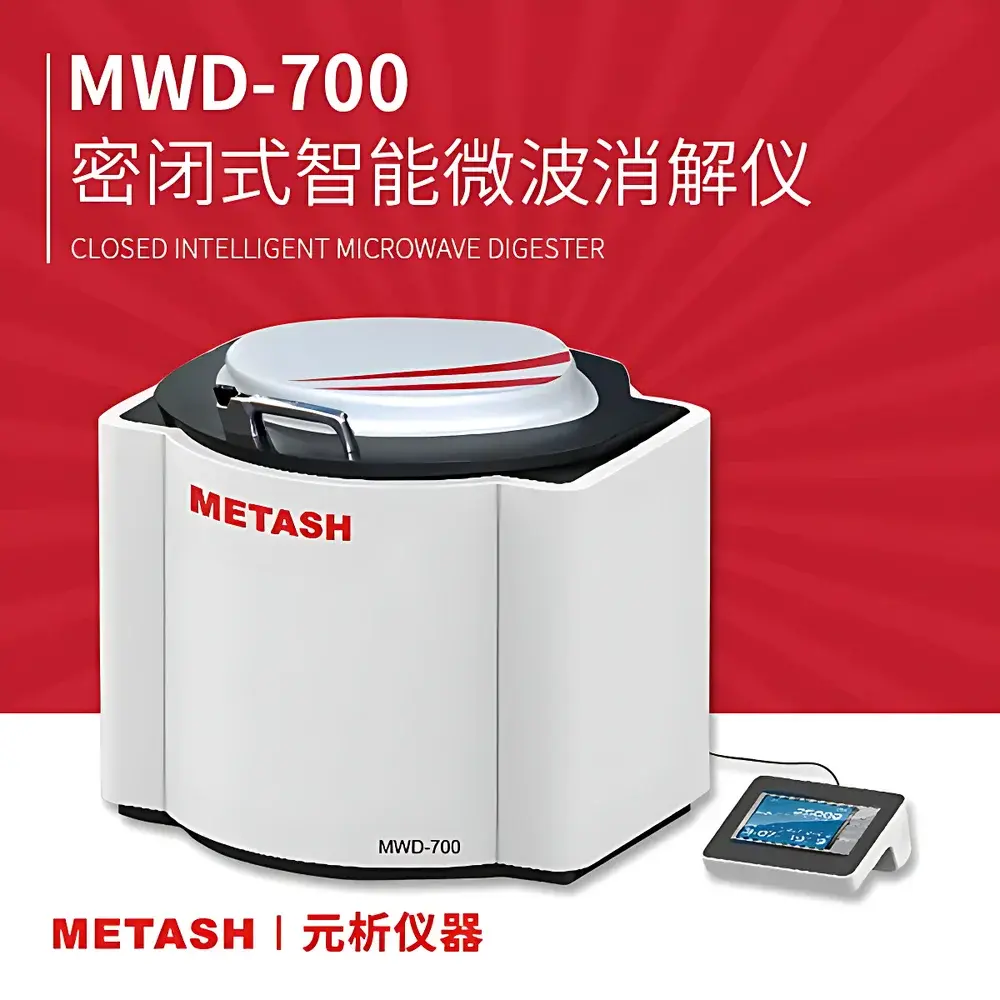
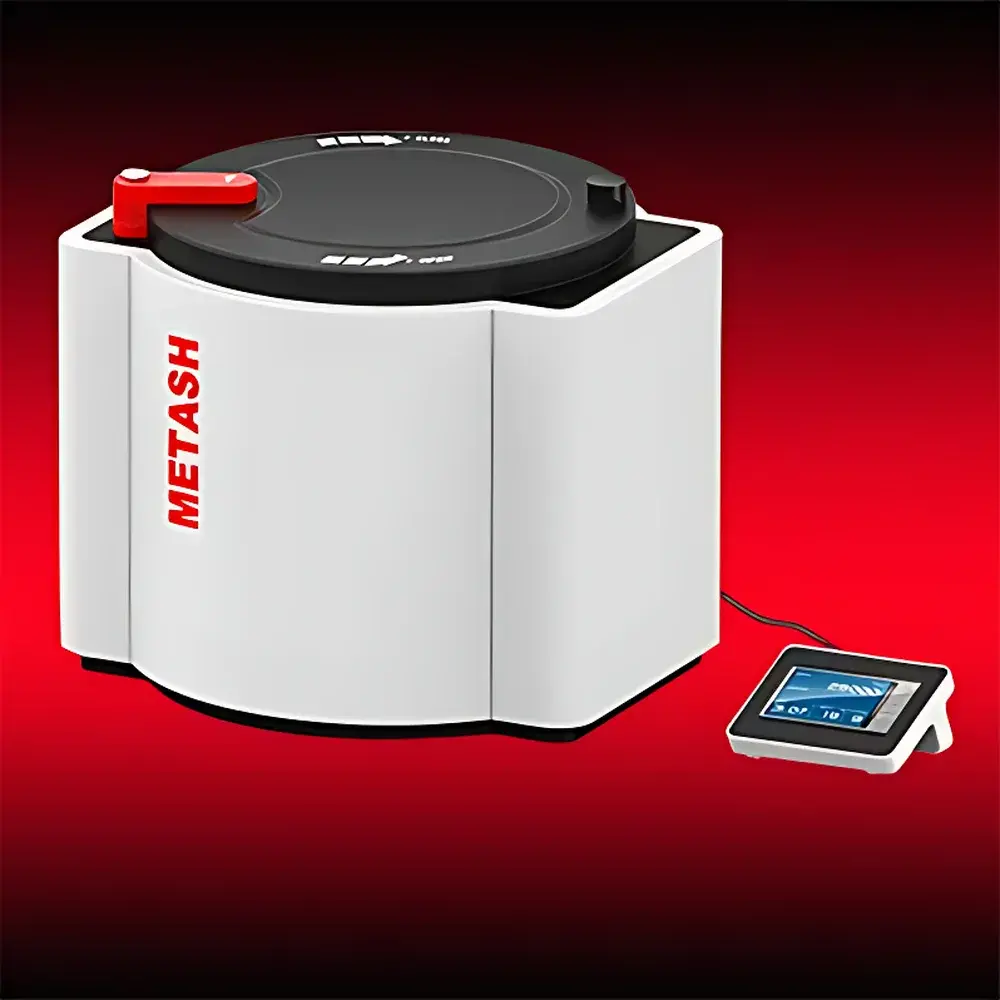
Metash MWD-700 Industrial-Grade Closed-Vessel Microwave Digestion System
| Brand | Metash Instruments |
|---|---|
| Origin | Shanghai, China |
| Manufacturer Type | Direct Manufacturer |
| Product Category | Domestic |
| Model | MWD-700 |
| Price Range | USD 2,800 – 7,000 (FOB) |
| Cavity Class | Industrial Grade |
| Max. Sample Capacity | 15 vessels |
| Microwave Source | Dual Magnetron |
| Max. Temperature | 250 °C |
| Max. Pressure | 6 MPa |
| Temperature Control | Non-contact mid-infrared scanning |
| Pressure Control | Multi-channel fiber-optic pressure sensing |
| Vessel Volume | 100 mL |
| Inner Vessel Material | TFM (perfluoroalkoxy alkane, imported) |
| Outer Vessel Material | PEEK-glass fiber composite |
| Microwave Power Output | 0–2000 W |
| Display | 8-inch external touch panel |
| Dimensions (W×D×H) | 640 × 630 × 590 mm |
| Safety Compliance | GB/T 26814–2011 (microwave leakage ≤5 mW/cm² at 5 cm), ISO/IEC 17025-aligned operational safeguards |
Overview
The Metash MWD-700 is an industrial-grade, closed-vessel microwave digestion system engineered for high-throughput, reproducible sample preparation in environmental, geological, pharmaceutical, and food testing laboratories. It operates on the principle of controlled microwave dielectric heating—where polar molecules (e.g., HNO₃, HCl, HF) absorb electromagnetic energy at 2.45 GHz, generating rapid, volumetric thermal excitation within sealed reaction vessels. Unlike open-vessel or hot-block methods, the MWD-700 maintains precise pressure–temperature coupling under inert, oxygen-free conditions, enabling complete mineralization of refractory matrices—including silicates, alloys, and biological tissues—without analyte loss or contamination. Its dual-magnetron architecture delivers continuous, non-pulsed, frequency-modulated microwave output, minimizing standing-wave interference and ensuring uniform field distribution across all 15 positions. The system is designed for compliance with routine QA/QC workflows under GLP and ISO/IEC 17025 frameworks, supporting trace-metal analysis by ICP-MS, ICP-OES, and AAS.
Key Features
- 14-layer integrated safety architecture validated per GB/T 26814–2011 and aligned with international microwave equipment best practices.
- Dual magnetron system (0–2000 W) with real-time power modulation for consistent energy delivery and minimized thermal gradients.
- Non-contact mid-infrared temperature monitoring: scans all 15 vessels simultaneously at ≥10 Hz sampling rate; triggers automatic microwave cutoff if preset limits are exceeded.
- Fiber-optic pressure sensing array: independent, calibrated optical transducers monitor each vessel’s internal pressure in real time, enabling dynamic feedback control.
- Vertical-directional explosion containment design: outer vessels fabricated from PEEK-glass fiber composite engineered to channel overpressure along the axial direction—preserving lateral integrity and operator safety.
- 316L stainless steel monolithic cavity with multi-layer PFA coating: provides corrosion resistance against aggressive acid mixtures (e.g., aqua regia, HF-containing digests) and structural reinforcement against cyclic pressure loading.
- Self-recovering high-pressure sealing mechanism: TFM inner vessels feature zero-consumable, elastomer-free gasketing that reseals automatically after pressure release—eliminating cross-contamination and reducing consumable cost per batch.
- External 8-inch touchscreen interface positioned ≥2 m from cavity: ensures operator exposure remains below 5 mW/cm² (measured at 5 cm), satisfying radiation safety requirements for continuous operation.
- Multi-stage active cooling: integrated turbulent airflow system reduces post-digestion cooldown time by >2× compared to passive or single-fan designs—enabling turnaround times under 15 minutes per batch.
Sample Compatibility & Compliance
The MWD-700 accommodates a broad spectrum of solid and semi-solid samples—including soils, sediments, plant tissues, animal organs, polymers, and metal alloys—using standardized EPA Method 3051A, 3052, and ASTM D5511 protocols. All digestion vessels conform to ISO 17025 documentation standards for calibration traceability, with pressure and temperature sensors certified to NIST-traceable reference points. The system supports method validation per USP , FDA 21 CFR Part 11 (when paired with compliant LIMS), and EU Directive 2014/30/EU (EMC). Vessel materials comply with FDA 21 CFR 177.1550 (TFM) and ASTM D5000 (PEEK composites), ensuring leachate-free digestion for sub-ppt elemental quantification.
Software & Data Management
The embedded controller runs a deterministic real-time OS with audit-trail functionality: every parameter change, safety event, and run log is timestamped, user-ID tagged, and immutably stored. Data export supports CSV, XML, and PDF formats compatible with ELN integration. Optional software modules include method library management, QC charting (X-bar/R), and automated report generation aligned with ISO/IEC 17025 clause 7.8. All firmware updates undergo regression testing per IEC 62304 Class B medical-device software standards—ensuring stability in regulated environments.
Applications
- Environmental labs: total digestion of EPA SW-846 Methods 3051A/3052 for Pb, Cd, As, Hg in contaminated soils and sludges.
- Clinical & pharmaceutical QA: residual catalyst metal analysis (Pd, Pt, Rh) in API intermediates per ICH Q2(R2).
- Geochemical research: complete dissolution of zircon and monazite for U–Pb geochronology by MC-ICP-MS.
- Food safety testing: determination of toxic elements (e.g., inorganic As in rice, Cd in cocoa) per EU Commission Regulation (EU) No 2023/915.
- Materials science: liberation of dopants from ceramic precursors prior to XRF or ICP-OES quantification.
FAQ
What safety certifications does the MWD-700 meet?
It complies with GB/T 26814–2011 for microwave leakage, ISO 13857 for mechanical safeguarding, and incorporates design principles consistent with IEC 61000-4-3 (EMC immunity) and IEC 62471 (LED display photobiological safety).
Can the system be integrated into a LIMS environment?
Yes—via RS-232, USB, or optional Ethernet interface; raw data files include metadata required for 21 CFR Part 11-compliant electronic signatures when used with validated middleware.
Is HF digestion supported?
Yes—TFM inner vessels and PEEK-glass outer vessels are chemically resistant to hydrofluoric acid up to 40% concentration at 220 °C and 5 MPa, provided proper procedural controls are followed.
What maintenance is required for long-term reliability?
No routine magnetron replacement is needed; the dual-magnetron design extends service life. Annual verification of IR sensor calibration and fiber-optic pressure transducer drift is recommended using NIST-traceable reference standards.
Does the system support method development beyond preloaded protocols?
Yes—the controller allows full customization of ramp/hold profiles, power modulation curves, and safety thresholds, with version-controlled method archiving and rollback capability.



