
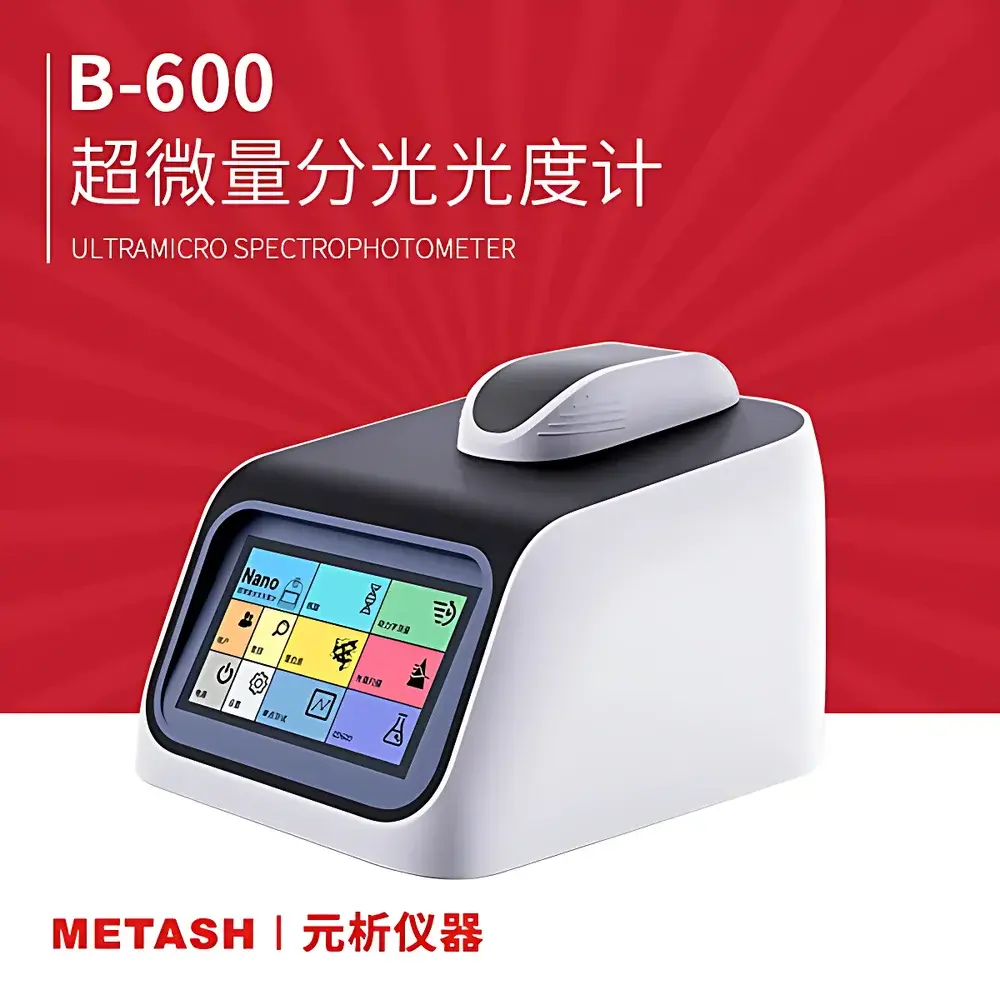
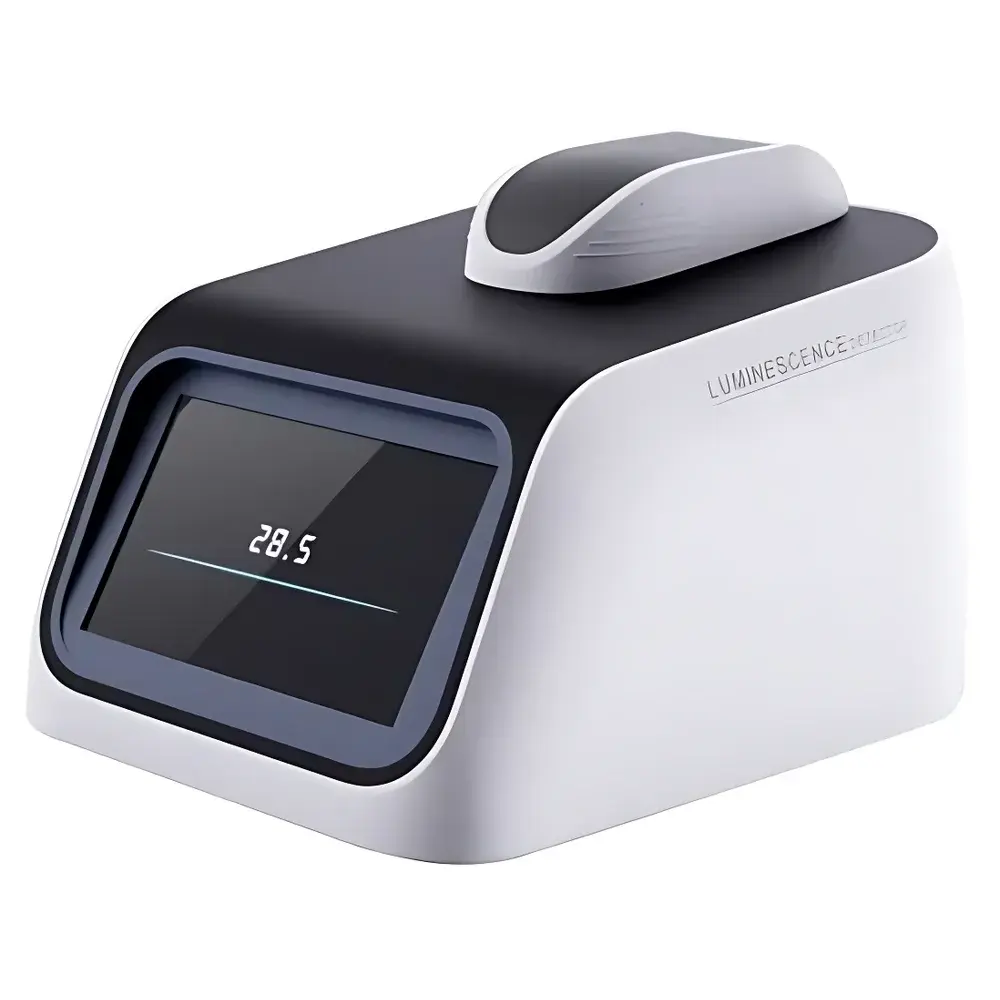
Metash B-600 Ultra-Micro Spectrophotometer
| Brand | Metash Instruments |
|---|---|
| Origin | Shanghai, China |
| Manufacturer Type | Original Equipment Manufacturer (OEM) |
| Model | B-600 |
| Detection Time | 3 s (cuvette mode), 5 s (ultra-micro mode) |
| Wavelength Accuracy | ±1 nm |
| Wavelength Range | 190–1100 nm |
| Wavelength Resolution | 0.3 nm |
| Absorbance Range | 0–300 Abs (10 nm pathlength equivalent) |
| Detection Limit | 2 ng/µL (dsDNA) |
| Upper Detection Limit | 15,000 ng/µL (dsDNA) |
| Sample Volume | 1–2 µL |
| Pathlength Range | 0.01–1.2 mm (auto-adjusting) |
| Detector | 2048-pixel CCD array |
| Light Source | Xenon flash lamp |
| Dimensions | 220 × 280 × 220 mm |
| Weight | 3 kg |
| Power Supply | 100–240 V, 50–60 Hz |
| Power Consumption | 80–100 W |
| Compatible Samples | dsDNA, ssDNA, RNA, proteins (BSA), cell cultures (OD₆₀₀) |
Overview
The Metash B-600 Ultra-Micro Spectrophotometer is an integrated, benchtop UV-Vis spectrophotometric analyzer engineered for rapid, high-fidelity quantification and quality assessment of nucleic acids and proteins in life science laboratories. Utilizing a pulsed xenon flash lamp and a high-resolution 2048-pixel linear CCD array detector, the instrument delivers full-spectrum acquisition (190–1100 nm) with 0.3 nm optical resolution and ±1 nm wavelength accuracy—meeting core performance requirements for routine QC in molecular biology, genomics, and biopharmaceutical development. Its dual-mode optical architecture supports both ultra-micro volume analysis (1–2 µL, auto-adjusting pathlength from 0.01 to 1.2 mm) and standard 10 mm cuvette-based measurements, enabling direct quantification without dilution across a dynamic absorbance range of 0–300 Abs (10 nm equivalent). Designed for walk-up operation, the B-600 eliminates dependency on external PCs, reducing setup time and minimizing cross-contamination risk in high-throughput environments.
Key Features
- Integrated 7-inch capacitive LCD touchscreen interface with intuitive graphical workflow—enabling standalone operation for sample measurement, spectral scanning, kinetic assays, and OD600 turbidity analysis
- Auto-adjusting microfluidic pathlength technology: dynamically calibrates optical path (0.01–1.2 mm) based on sample concentration, ensuring optimal signal-to-noise ratio and eliminating manual dilution steps
- Xenon flash lamp with >10⁹ shot lifetime: cold-start capable, zero warm-up delay, and stable spectral output across UV-C to NIR regions
- On-device data management: USB-A ports support direct export to USB drives; hierarchical storage with timestamped, assay-tagged, and title-indexed files for GLP-compliant traceability
- Real-time spectral capture and screenshot functionality: preserves raw absorbance traces and processed results in PNG format for audit-ready documentation
- Firmware updates via USB drive: no software installation or IT support required—ensuring long-term maintainability and regulatory consistency
- Compact footprint (220 × 280 × 220 mm) and lightweight design (3 kg): optimized for biosafety cabinets, laminar flow hoods, and shared core facility benches
Sample Compatibility & Compliance
The B-600 is validated for quantitative analysis of double-stranded DNA (dsDNA), single-stranded DNA (ssDNA), RNA, bovine serum albumin (BSA), and whole-cell suspensions (OD600). Its detection limit of 2 ng/µL dsDNA and upper limit of 15,000 ng/µL align with ISO 15195:2018 (clinical laboratory testing—requirements for reference measurement systems) and ASTM E275-22 (standard practices for ultraviolet-visible spectrophotometry). The instrument’s optical path calibration protocol complies with NIST-traceable verification procedures for absorbance linearity and photometric accuracy. While not certified under FDA 21 CFR Part 11 out-of-the-box, its audit trail capabilities—including immutable timestamped logs, user-defined assay naming, and version-controlled firmware—support validation pathways for GMP/GLP-regulated workflows when deployed with documented SOPs.
Software & Data Management
All operations are managed through the embedded Linux-based firmware interface. No third-party drivers or runtime dependencies are required. Measurement data—including raw spectra, concentration values, purity ratios (A260/A280, A260/A230), and OD600 kinetics—are stored locally in CSV and PNG formats. File structure follows a three-tier indexing system: by assay type (e.g., “DNA_Quant”), date (YYYY-MM-DD), and custom title—facilitating rapid retrieval during regulatory audits or peer review. USB export maintains folder hierarchy and metadata integrity. Optional CSV batch export enables seamless integration with LIMS platforms via standardized column headers (e.g., “Sample_ID”, “A260”, “Conc_ng_uL”, “A260_A280”, “Timestamp”).
Applications
- Routine nucleic acid quantification pre-NGS library prep, qPCR, and CRISPR editing workflows
- Protein concentration determination and purity screening (e.g., recombinant expression lysates)
- Cell culture density monitoring via OD600 endpoint or time-series measurements
- UV-Vis spectral profiling for contaminants (e.g., phenol, guanidine, EDTA) using A230/A260 ratios
- Kinetic enzyme assays requiring rapid, low-volume sampling (e.g., NADH oxidation at 340 nm)
- Educational labs where robustness, ease of use, and minimal consumable cost are critical
FAQ
Does the B-600 require external calibration standards for daily use?
No—factory-calibrated optical path and detector response eliminate routine recalibration. Users may perform optional verification using NIST-traceable neutral density filters or dsDNA reference standards.
Can the instrument measure samples with high viscosity or particulate content?
Ultra-micro mode is optimized for clear, low-viscosity solutions. For turbid or viscous samples (e.g., lysates), cuvette mode with 10 mm pathlength and appropriate blank subtraction is recommended.
Is spectral data export compatible with third-party analysis tools like GraphPad Prism or Python pandas?
Yes—CSV exports contain wavelength (nm) and absorbance columns with header metadata, supporting direct ingestion into common scientific computing environments.
What is the expected lifetime of the xenon flash lamp?
Rated for ≥1 × 10⁹ flashes under typical usage (50–100 measurements/day), corresponding to >10 years of service life with no degradation in spectral stability.
Does the B-600 support multi-user access control or electronic signatures?
Not natively—but all measurement records include embedded user ID fields and immutable timestamps, enabling integration with external identity management systems during IQ/OQ/PQ validation.
Related Products




