
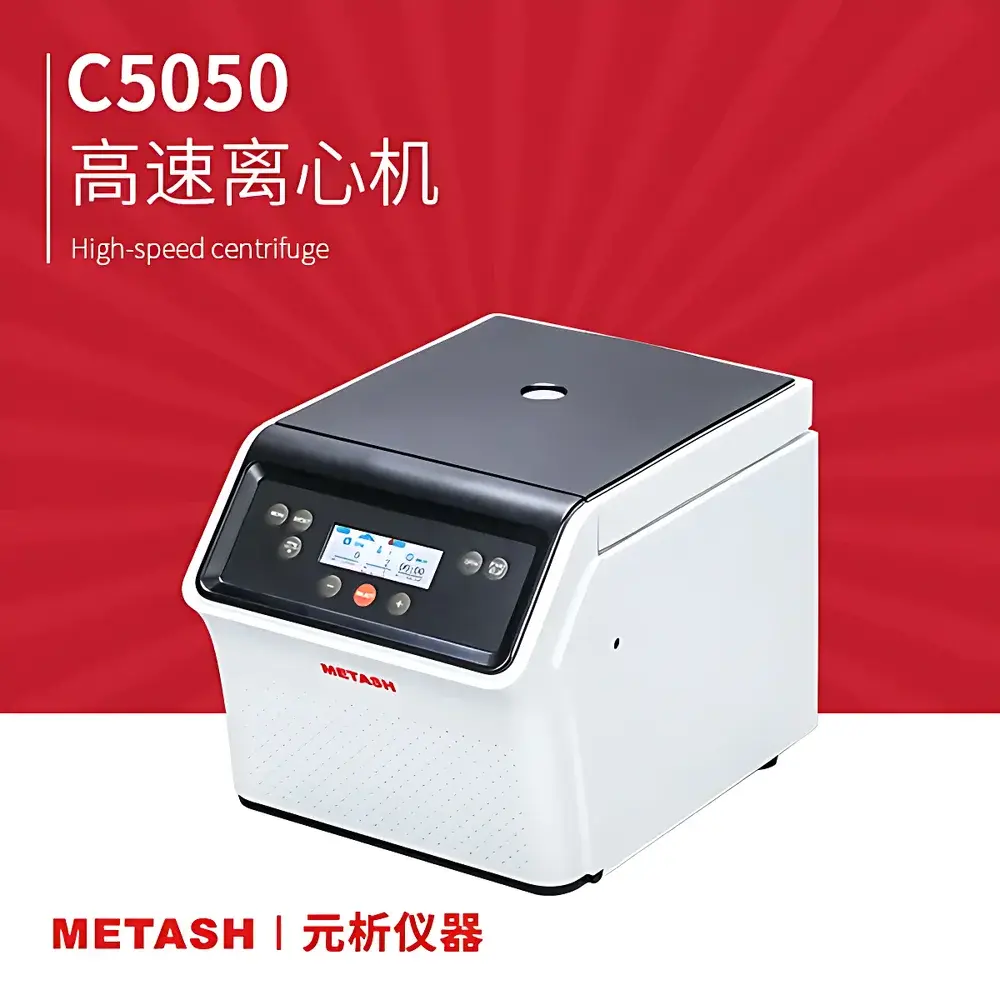
Metash C5050 High-Speed Benchtop Centrifuge
| Brand | Metash Instruments |
|---|---|
| Origin | Shanghai, China |
| Manufacturer Type | Original Equipment Manufacturer (OEM) |
| Instrument Type | Benchtop Centrifuge |
| Speed Range | High-Speed (10,000–30,000 rpm) |
| Max. Speed | 18,000 rpm |
| Max. RCF | 30,427 × g |
| Max. Capacity | 18 × 5 mL |
| Dimensions (L×W×H) | 392 × 290 × 300 mm |
| Net Weight | 22 kg |
| Drive Motor | Brushless AC Frequency-Controlled Motor |
| Acceleration Steps | 9 |
| Deceleration Steps | 10 |
| Timer Range | 1 min – 99 min (continuous operation supported) |
| Cooling | Air-Cooled (R-134a refrigerant-free |
| Noise Level | ≤52 dB(A) |
| Display | Color LCD Screen |
| Power Supply | 220 V ±10%, 50 Hz ±1 Hz, 500 VA |
| Rotor Autoclavable | Yes (121°C, 20 min, steam sterilization compatible) |
| Safety Features | Dual interlock system (electronic feedback + mechanical latch), real-time imbalance detection, overspeed protection, overtemperature monitoring, self-diagnostic status reporting, free-deceleration mode |
Overview
The Metash C5050 is a high-performance benchtop centrifuge engineered for precision and reliability in life science laboratories requiring consistent high-speed separation of biological samples. Operating on the principle of sedimentation under controlled centrifugal force, the C5050 delivers reproducible RCF (Relative Centrifugal Force) up to 30,427 × g at its maximum rotational speed of 18,000 rpm — sufficient for pelleting subcellular organelles, viral particles, nucleic acids, and small-volume protein precipitates. Designed for ambient-temperature operation without active refrigeration, it employs optimized airflow dynamics and acoustic dampening architecture to maintain low operational noise (<52 dB[A]) while ensuring thermal stability during extended runs. Its compact footprint (392 × 290 × 300 mm) and lightweight chassis (22 kg) make it suitable for shared lab benches, biosafety cabinets, or mobile laboratory configurations where space and portability are critical.
Key Features
- Brushless AC frequency-controlled motor with high starting torque, wide speed regulation range, and extended service life — engineered for >20,000 hours of continuous operation under routine laboratory conditions.
- V0-rated flame-retardant composite housing offering exceptional impact resistance, corrosion tolerance, and dimensional stability across operating temperatures from 5°C to 40°C.
- Integrated acoustic insulation using environmentally compliant damping and thermal barrier composite material — provides simultaneous sound attenuation, moisture resistance, mold inhibition, and thermal isolation.
- Dual-lock door mechanism combining electronic position feedback and mechanical latching ensures fail-safe containment during high-speed operation.
- Real-time imbalance sensing system continuously monitors rotor dynamics; automatically halts rotation and triggers audible/visual alarm if mass asymmetry exceeds ISO 15863-compliant thresholds.
- Free-deceleration mode prevents sample resuspension by allowing gradual rotor coast-down — essential for preserving pellet integrity in sensitive applications such as RNA extraction or exosome isolation.
- 30 programmable protocols stored in non-volatile memory support rapid recall and one-touch execution, reducing procedural variability across users and shifts.
Sample Compatibility & Compliance
The C5050 accommodates standard conical-bottom microcentrifuge tubes (0.2–5 mL), including polypropylene and PCR-grade variants. Its angular rotor configuration supports up to 18 × 5 mL tubes per run, conforming to IEC 61010-1:2010 safety standards for electrical equipment used in laboratory environments. All rotors are certified autoclavable at 121°C for 20 minutes per ISO 17664, enabling full decontamination between infectious or cross-contamination-sensitive workflows. While not a refrigerated unit, its air-cooled design meets ASTM E2912 requirements for ambient-temperature centrifugation stability under continuous duty cycles. The instrument’s firmware implements self-diagnostics aligned with GLP documentation expectations, including event logging of error codes, runtime duration, and setpoint deviations.
Software & Data Management
The C5050 operates via an embedded microcontroller with color LCD interface supporting intuitive parameter navigation and visual feedback. Though standalone (no external PC connectivity), its internal memory retains user-defined protocols with timestamped execution history accessible via display menu. All safety-critical events — including imbalance detection, overspeed fault, or door interlock failure — are logged with millisecond-resolution timestamps and retained across power cycles. This audit-ready behavior supports compliance with FDA 21 CFR Part 11 Annex 11 principles when integrated into validated laboratory workflows, particularly where traceability of centrifugation parameters is required for QC release testing or regulatory submissions.
Applications
- Routine nucleic acid purification (plasmid DNA, genomic DNA, total RNA) from bacterial lysates or mammalian cell suspensions.
- Preparative isolation of extracellular vesicles, exosomes, and microvesicles from conditioned media or plasma.
- Clarification of crude protein extracts prior to chromatography or electrophoresis.
- Cell fractionation workflows involving nuclear, mitochondrial, and cytosolic subpopulations.
- High-throughput sample preparation for next-generation sequencing library construction.
- Quality control testing of vaccine formulations, monoclonal antibody intermediates, and sterile filtration validation studies.
FAQ
Is the C5050 suitable for use with hazardous or biohazardous samples?
Yes — its sealed rotor chamber, autoclavable rotors, and dual-door interlock meet BSL-2 containment prerequisites when operated within appropriate secondary containment infrastructure.
Can the C5050 be integrated into automated liquid handling platforms?
No native Ethernet/USB/RS-232 interface is provided; however, external relay-based start/stop triggering may be implemented via optional dry-contact accessory module (sold separately).
What rotor types are compatible with the C5050?
Five angular rotor configurations are available, including fixed-angle 12 × 1.5/2.0 mL, 18 × 0.5/0.2 mL, and 18 × 5 mL variants — all balanced to ISO 21501-4 specifications.
Does the instrument support timed ramping or gradient acceleration profiles?
No — acceleration and deceleration are preset across nine and ten discrete steps respectively, but not programmable as continuous ramps.
Is firmware update capability available?
Firmware updates require authorized service technician intervention using proprietary diagnostic hardware; no end-user field-upgrade path is supported.



