
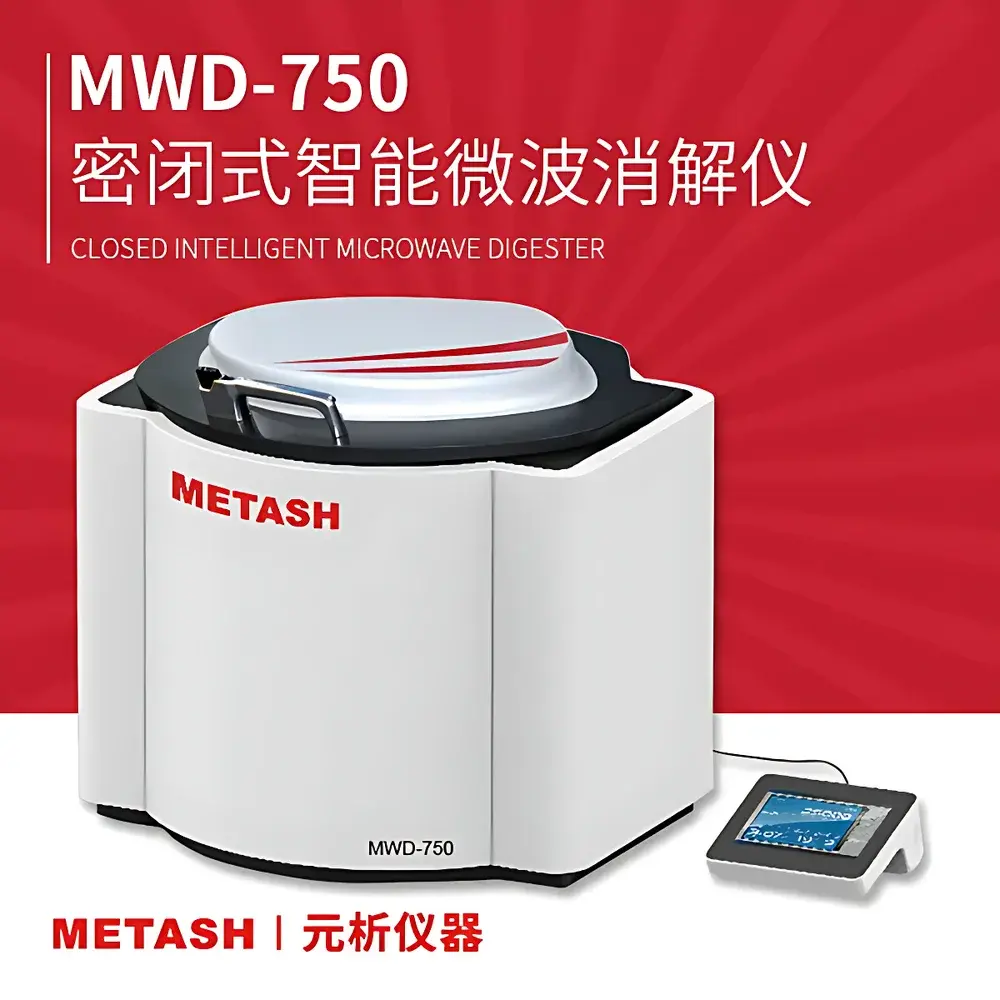
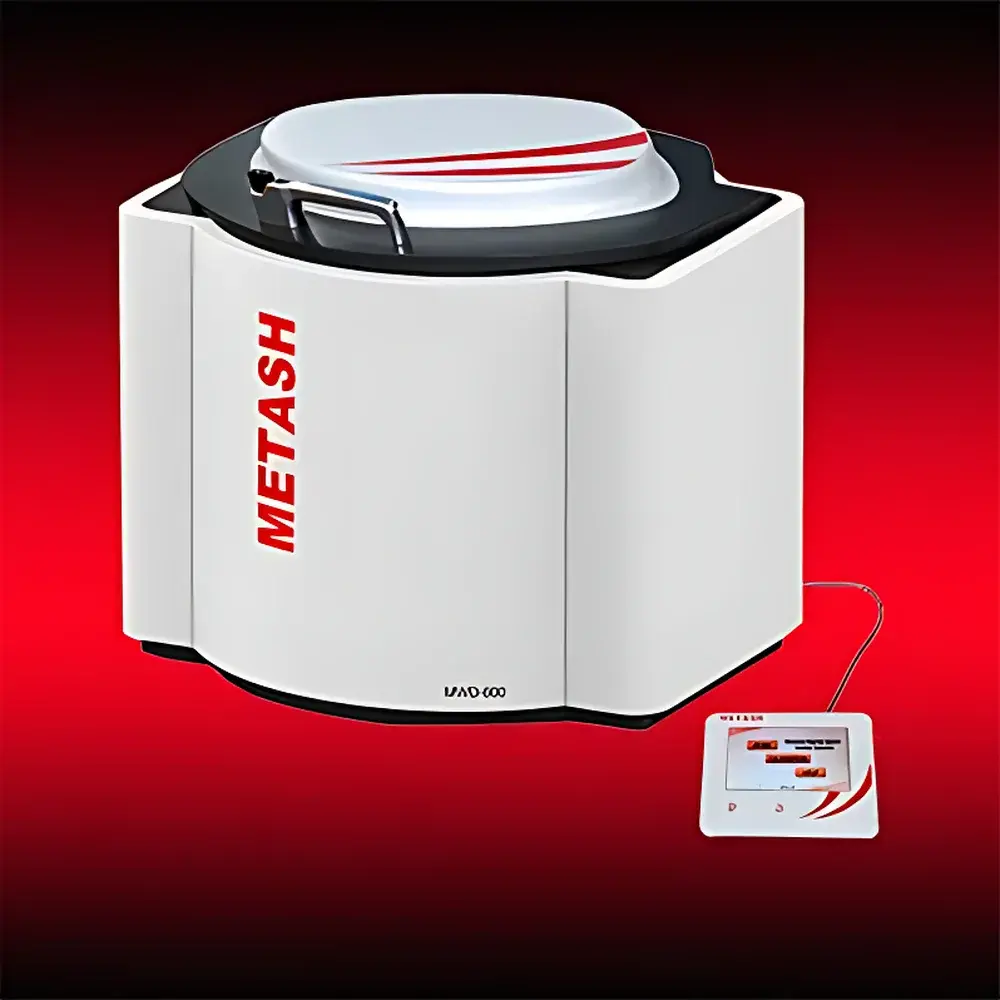
Metash MWD-750 Industrial-Grade Sealed Intelligent Microwave Digestion System
| Brand | Metash Instruments |
|---|---|
| Origin | Shanghai, China |
| Manufacturer Type | Direct Manufacturer |
| Product Category | Domestic |
| Model | MWD-750 |
| Price Range | USD 28,000–42,000 (FOB Shanghai) |
| Cavity Class | Industrial-Grade |
| Max. Sample Capacity | 18 vessels |
| Microwave Source | Dual Magnetron |
| Max. Temperature | 250 °C |
| Max. Pressure | 6 MPa |
| Temperature Control | Non-contact mid-infrared scanning |
| Pressure Control | Multi-channel optical fiber pressure sensing |
| Vessel Volume | 100 mL |
| Inner Vessel Material | TFM (PFA-modified PTFE) |
| Outer Vessel Material | PEEK-glass fiber composite |
| Microwave Power Output | 0–3000 W |
| Display | 8-inch external touchscreen |
| Dimensions (W×D×H) | 640 × 630 × 590 mm |
| Safety Compliance | GB/T 26814–2011 (microwave leakage ≤5 mW/cm² at 5 cm) |
Overview
The Metash MWD-750 is an industrial-grade sealed microwave digestion system engineered for high-throughput, reproducible sample preparation in regulated analytical laboratories. It operates on the principle of controlled microwave energy absorption by polar molecules—primarily nitric acid and hydrogen peroxide—in closed-vessel configurations, enabling rapid thermal decomposition of organic matrices and refractory inorganic compounds under elevated temperature and pressure. Designed for compliance with ISO/IEC 17025, ASTM D5681, EPA Method 3052, and USP , the MWD-750 delivers precise, trace-metal-clean digestion for subsequent analysis by ICP-OES, ICP-MS, AAS, or HG-AFS. Its dual-magnetron architecture ensures stable, non-pulsed frequency-modulated microwave output, minimizing hot-spot formation and maximizing inter-vessel temperature uniformity across all 18 positions.
Key Features
- 14-layer integrated safety architecture validated per GB/T 26814–2011 and aligned with IEC 61000-4-3 electromagnetic compatibility requirements
- Dual magnetron system (0–3000 W total output) with real-time power modulation for consistent energy coupling and minimized thermal gradient deviation (<±1.5 °C between vessels at 220 °C)
- Non-contact mid-infrared temperature monitoring: 10 Hz sampling rate per vessel, enabling dynamic thermal feedback control and automatic microwave power reduction upon threshold exceedance
- Fiber-optic pressure sensing array: independent real-time pressure acquisition from all 18 vessels with ±0.05 MPa accuracy; triggers immediate microwave cutoff if any vessel exceeds user-defined setpoint
- Vertical-directional explosion containment design: outer vessels fabricated from PEEK-glass fiber composite engineered per 3D directional blast theory—energy discharge constrained to axial vector, eliminating lateral fragmentation risk
- Monolithic 316L stainless steel cavity with multi-layer PFA coating: corrosion-resistant, thermally insulated, and structurally reinforced via cylindrical load-distribution geometry
- External 8-inch capacitive touchscreen interface: mounted ≥2 m from cavity front face to ensure operator exposure remains below 5 mW/cm² (measured at 5 cm per GB/T 26814–2011), eliminating need for additional shielding
- Self-recovering TFM inner vessels with integrated pressure-release sealing rings: automatic resealing post-ventilation without manual intervention or consumable replacement
- Turbulent forced-air cooling system: reduces post-digestion cooldown time to 35 minutes in conventional single-fan systems)
Sample Compatibility & Compliance
The MWD-750 supports digestion of diverse sample types including environmental soils (EPA SW-846 3052), biological tissues (AOAC 999.10), pharmaceutical excipients (USP ), geological silicates (ASTM D5681), and polymer composites. All vessel materials comply with FDA 21 CFR 177.1550 (TFM) and ISO 10993-5 (cytotoxicity). The system’s pressure/temperature logging meets GLP/GMP data integrity requirements: audit-trail enabled, time-stamped, non-erasable records stored locally and exportable in CSV/PDF formats. Full compliance with IEC 61010-1 (safety) and IEC 61326-1 (EMC) is certified by SGS Shanghai.
Software & Data Management
The embedded control firmware provides intuitive method programming with up to 20 customizable digestion protocols, each supporting multi-step ramp-hold sequences with independent temperature/pressure/power profiles. All operational parameters—including real-time IR temperature curves, fiber-optic pressure traces, microwave power history, and fault logs—are timestamped and archived with SHA-256 hash verification. Data export supports LIMS integration via USB 3.0 or optional Ethernet module (IEEE 802.3). Software complies with FDA 21 CFR Part 11 requirements: electronic signatures, role-based access control, and immutable audit trails are fully implemented.
Applications
- Environmental testing labs performing heavy metal quantification (Pb, Cd, As, Hg) in soil, sludge, and sediment per EPA 6010D/6020B
- Clinical and forensic toxicology labs digesting hair, blood, and tissue for trace element profiling
- Pharmaceutical QC departments validating elemental impurities per ICH Q3D guidelines
- Geochemical research facilities preparing rock and ore samples for REE analysis
- Food safety laboratories analyzing canned goods, spices, and infant formula for contaminant metals
FAQ
What safety certifications does the MWD-750 hold?
The system is certified to IEC 61010-1 (electrical safety), IEC 61326-1 (EMC), and complies with GB/T 26814–2011 for microwave leakage. Third-party validation reports are available upon request.
Can the MWD-750 be integrated into a laboratory information management system (LIMS)?
Yes—via USB 3.0 mass storage mode or optional Ethernet interface, supporting structured data export (CSV, PDF) with embedded metadata for seamless LIMS ingestion.
Is method validation support provided for regulatory submissions?
Metash supplies IQ/OQ documentation templates aligned with ISO/IEC 17025 and GMP Annex 15, plus application notes demonstrating recovery studies per EPA 3052 and USP .
How is calibration traceability maintained for temperature and pressure sensors?
Mid-infrared sensors are factory-calibrated against NIST-traceable blackbody sources; fiber-optic pressure transducers are calibrated using dead-weight testers with UKAS-accredited reference standards.
What maintenance is required for long-term operational reliability?
No routine consumables: TFM vessels are reusable >500 cycles; PEEK outer vessels require no replacement under normal use. Annual preventive maintenance includes cavity coating inspection, magnetron output verification, and sensor recalibration verification.



