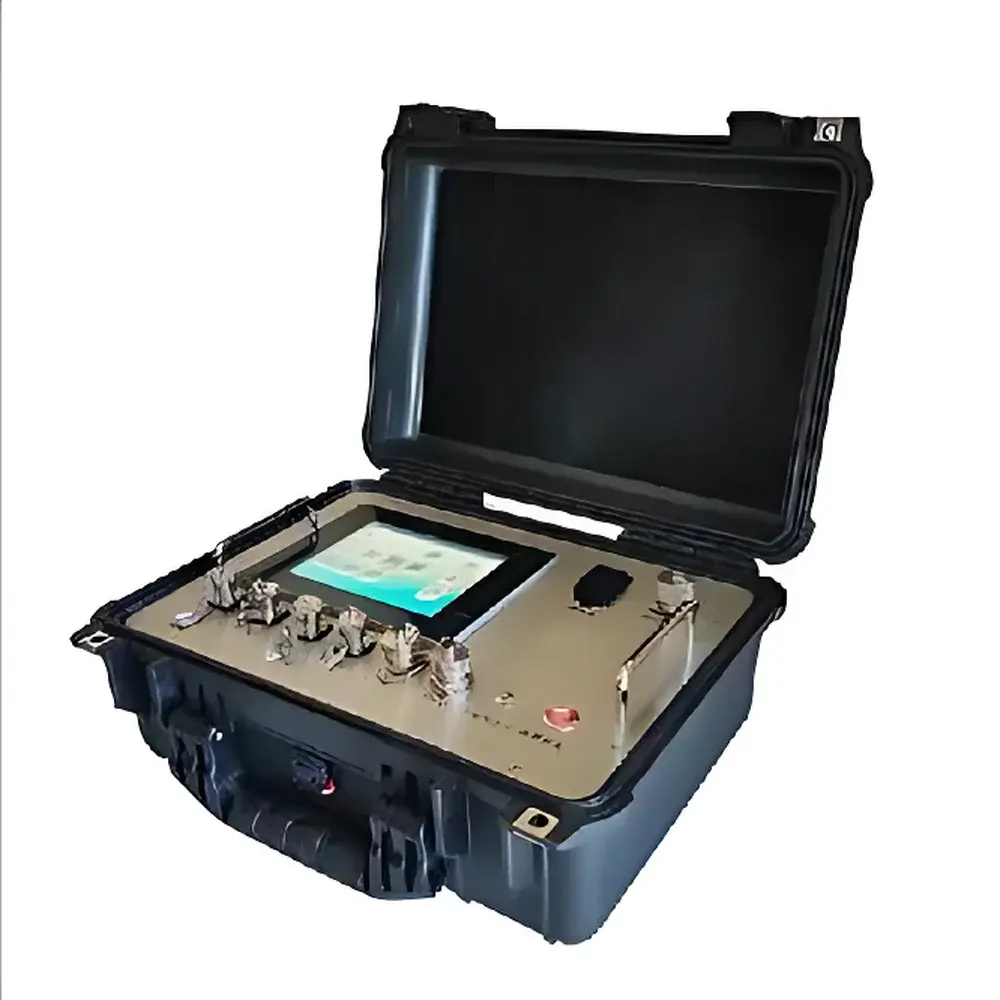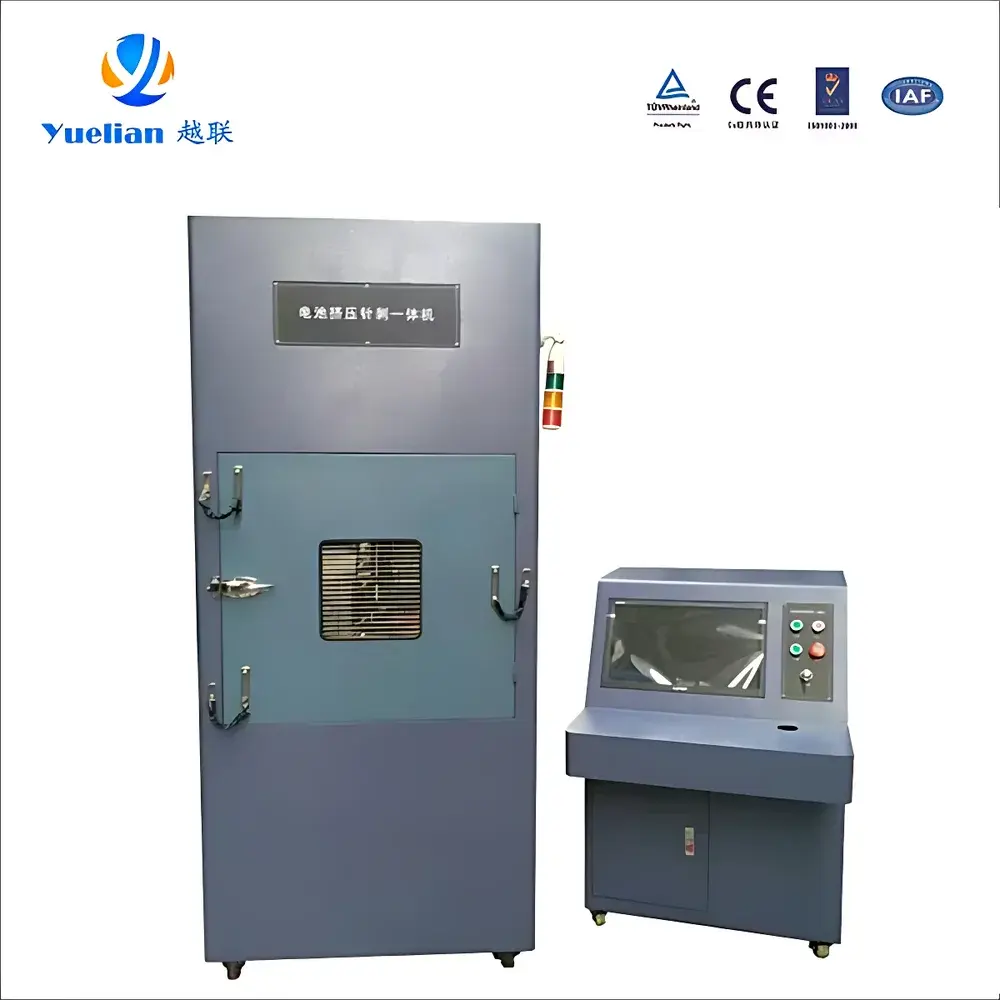
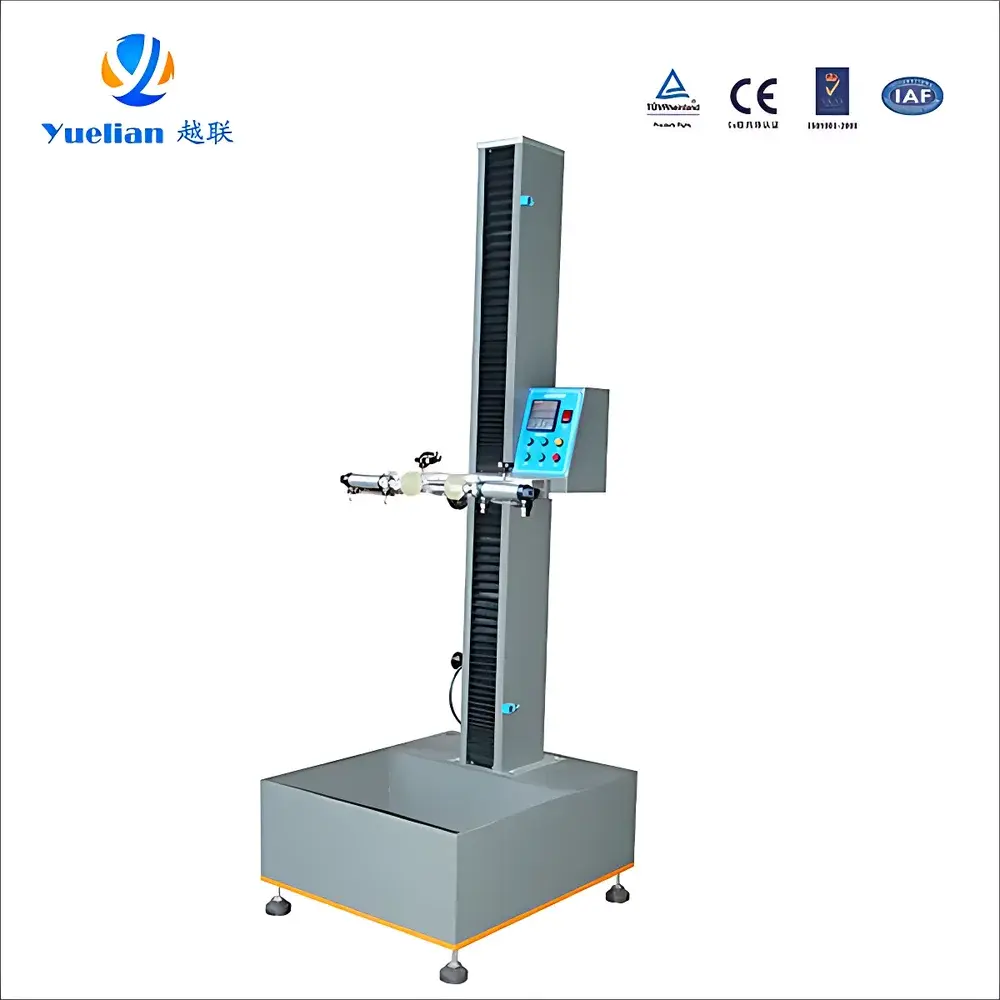
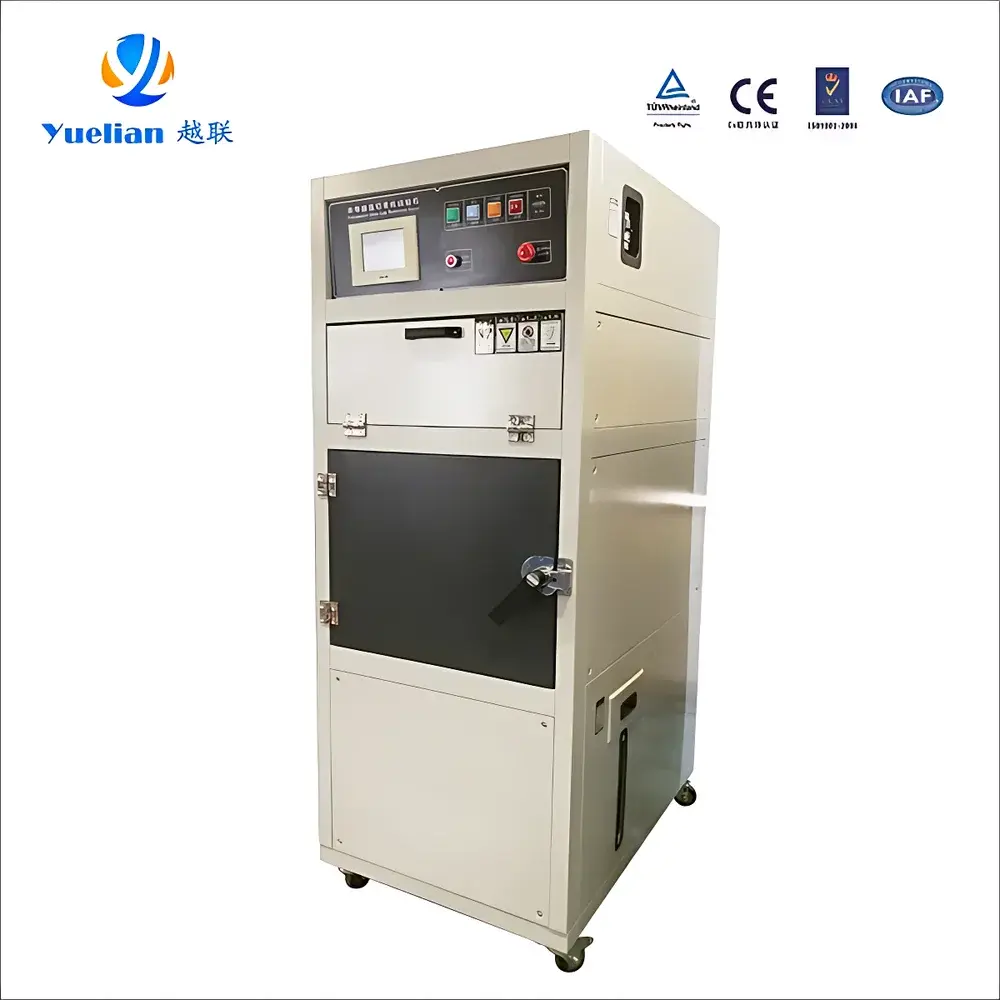
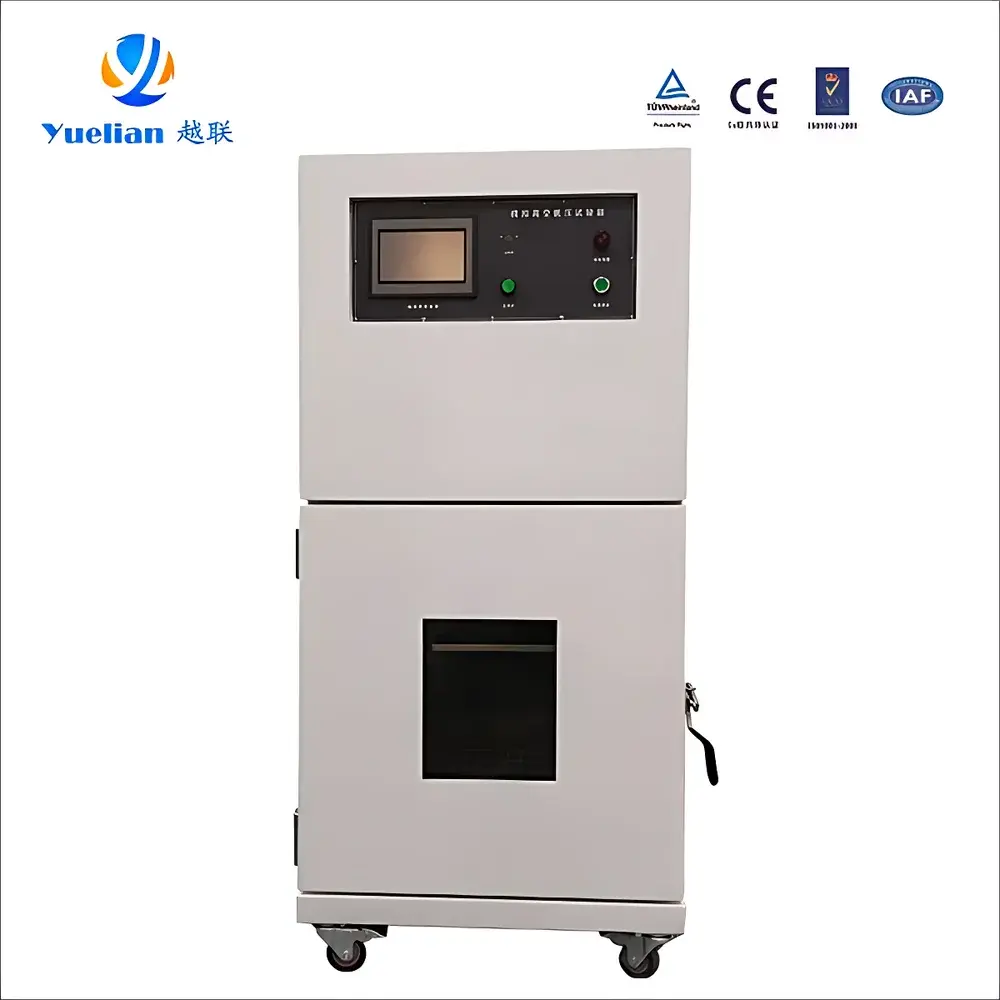
Yuelian YLB-SA20C Computer-Controlled Battery Crush & Nail Penetration Tester
| Brand | Yuelian |
|---|---|
| Origin | Guangdong, China |
| Model | YLB-SA20C |
| Force Range | 1–30 kN (Crush), 1–300 kg (Penetration) |
| Crush Load Accuracy | ±0.1 N |
| Penetration Force Accuracy | ±1% |
| Crush Speed | (5 ± 1) mm/s |
| Penetration Speed | 10–40 mm/s |
| Crush Stroke | 200/300 mm |
| Penetration Stroke | 200/300 mm |
| Test Chamber Dimensions | 250 × 300 × 250 mm (L×W×H) |
| Maximum Crush Load | 20 kN (default test setpoint: 13 ± 0.2 kN, held for 60 s) |
| Standard Crush Platen Area | 150 mm² or 200 mm² |
| Needle Diameters | φ3 / φ5 / φ8 mm stainless steel, 100 mm length |
| Chamber Material | Interior – 304 stainless steel |
| Viewing Window | 300 × 300 × 20 mm tempered blast-resistant glass + removable stainless-steel wire mesh guard |
| Interface | RS-232 and USB 2.0 |
| Power Supply | AC 380 V, 50 Hz |
| Net Weight | ~220 kg |
| Compliance | GB 31241-2014, GB/T 8897.4-2008 (IEC 60086-4:2007), YD/T 2344.1-2011, GB/T 21966-2008, YD 1268-2003, GB/T 19521.11-2005, UL 1642, UL 2054, IEC 62281:2004 |
Overview
The Yuelian YLB-SA20C Computer-Controlled Battery Crush & Nail Penetration Tester is an integrated safety evaluation system engineered for standardized mechanical abuse testing of lithium-based batteries and battery packs. It implements two fundamental safety assessment protocols defined in international regulatory frameworks: uniaxial compressive loading (crush) and controlled metallic penetration (nail test). The device operates on a servo-motor-driven dual-axis actuation architecture—separate high-resolution force actuators govern crush and penetration independently—ensuring traceable, repeatable, and programmable application of mechanical stress under ambient thermal conditions (20 ± 5 °C). Unlike generic compression testers, the YLB-SA20C embeds battery-specific test logic: automatic pressure ramping to 13 ± 0.2 kN followed by 60-second dwell, real-time surface temperature monitoring via thermocouple input, and synchronized data capture of force-displacement-temperature time-series. Its design conforms strictly to the physical test boundary conditions specified in GB 31241-2014 for cylindrical, prismatic, pouch, and coin-cell formats—including orientation rules for axial vs. lateral compression and center-point needle insertion geometry.
Key Features
- Servo-controlled dual-test architecture: Independent crush and penetration modules eliminate cross-axis interference and support concurrent method validation.
- Precision load control: Crush force range 1–30 kN with resolution of 0.1 N; penetration force range 1–300 kg with ±1% full-scale accuracy.
- Configurable test profiles: User-defined crush dwell pressure (1–20 kN), displacement limit (up to 300 mm), and penetration speed (10–40 mm/s) via intuitive Windows-based software interface.
- Integrated environmental safety: Explosion-proof test chamber with 304 stainless-steel interior, 20 mm-thick laminated blast-resistant viewing window, secondary stainless-steel wire mesh guard, rear-mounted pressure-relief vent, and Teflon-lined base pan for electrolyte containment and decontamination.
- Comprehensive data acquisition: Simultaneous logging of force (N/kg/lb), displacement (mm), surface temperature (°C), and time-stamped event markers; exportable to CSV/PDF per ISO/IEC 17025-compliant reporting templates.
- Regulatory-grade hardware: Standardized crush platens (150 mm² or 200 mm² contact area); calibrated stainless-steel needles (φ3/φ5/φ8 mm, 100 mm length, heat-resistant grade); RS-232 and USB 2.0 digital interfaces for audit-trail-capable instrument connectivity.
Sample Compatibility & Compliance
The YLB-SA20C accommodates all commercially relevant lithium electrochemical formats: cylindrical (18650, 21700, etc.), prismatic, pouch, and coin-type cells. Sample positioning fixtures comply with orientation mandates in GB 31241-2014—e.g., axial alignment for cylindrical cells, broad-face loading for pouch cells, and planar parallelism for button cells. The system satisfies technical requirements across 12 major safety standards, including mandatory Chinese national standards (GB series), telecommunications industry specifications (YD/T, YDB), UN transport regulations (GB/T 21966, IEC 62281), and globally recognized UL/IEC benchmarks (UL 1642, UL 2054, IEC 60086-4). All mechanical parameters—including crush speed tolerance (±1 mm/s), dwell duration accuracy (±1 s), and needle alignment repeatability—are validated against standard reference loads and dimensional gauges per ISO/IEC 17025 calibration protocols.
Software & Data Management
The embedded Windows-compatible test software provides full IEC 62304-compliant lifecycle management: user-level access control (admin/operator modes), electronic signature support, configurable test method libraries, and automated pass/fail decision logic based on real-time thresholds (e.g., “fire or explosion detected → abort + alarm”). Raw data streams are timestamped with microsecond resolution and stored locally with SHA-256 hash integrity verification. Export functions generate GLP/GMP-auditable reports containing test ID, operator, date/time, environmental conditions, parameter settings, force-displacement-temperature curves, and annotated event logs—including automatic annotation of peak force, dwell stabilization, and thermal excursion events. Data files conform to ASTM E2500-13 Annex A3 for raw dataset archiving and support FDA 21 CFR Part 11-compliant electronic record retention when deployed on validated IT infrastructure.
Applications
This instrument serves as a core qualification tool in battery cell development labs, quality assurance departments of OEMs and pack integrators, third-party certification bodies (e.g., CNAS-accredited labs), and regulatory submission workflows. Typical use cases include pre-production safety gate testing per UN 38.3 Section 5.1.1, design verification against GB/T 36276-2018 for energy storage systems, root-cause analysis of thermal runaway propagation in multi-cell modules, and comparative evaluation of separator mechanical robustness across electrolyte formulations. Its programmable architecture also supports custom abuse protocols—for example, staged crush-to-failure mapping, variable-rate penetration kinetics studies, or coupled mechanical-electrothermal stress profiling using external potentiostat synchronization.
FAQ
Does the YLB-SA20C support automated pass/fail judgment per GB 31241-2014 criteria?
Yes—the software applies built-in logic to classify outcomes as “pass” (no fire, no explosion, surface temperature ≤150 °C) or “fail” based on real-time sensor inputs and user-configurable thresholds.
Can test parameters be locked to prevent unauthorized modification during routine QA testing?
Yes—administrator-mode password protection enables parameter locking, method versioning, and read-only report generation for GMP-aligned environments.
Is calibration documentation provided with the system?
Each unit ships with a factory calibration certificate traceable to NIM (National Institute of Metrology, China) for force, displacement, and temperature channels, plus a calibration interval recommendation aligned with ISO/IEC 17025 Clause 6.5.
What maintenance is required to ensure long-term measurement stability?
Biannual verification of load cell linearity, needle tip geometry inspection, and chamber seal integrity check are recommended; full recalibration every 12 months or after 5,000 test cycles.
Can the system interface with LIMS or MES platforms?
Yes—via TCP/IP socket communication or OPC UA server module (optional add-on), enabling bidirectional data exchange with laboratory information management systems and manufacturing execution systems.