
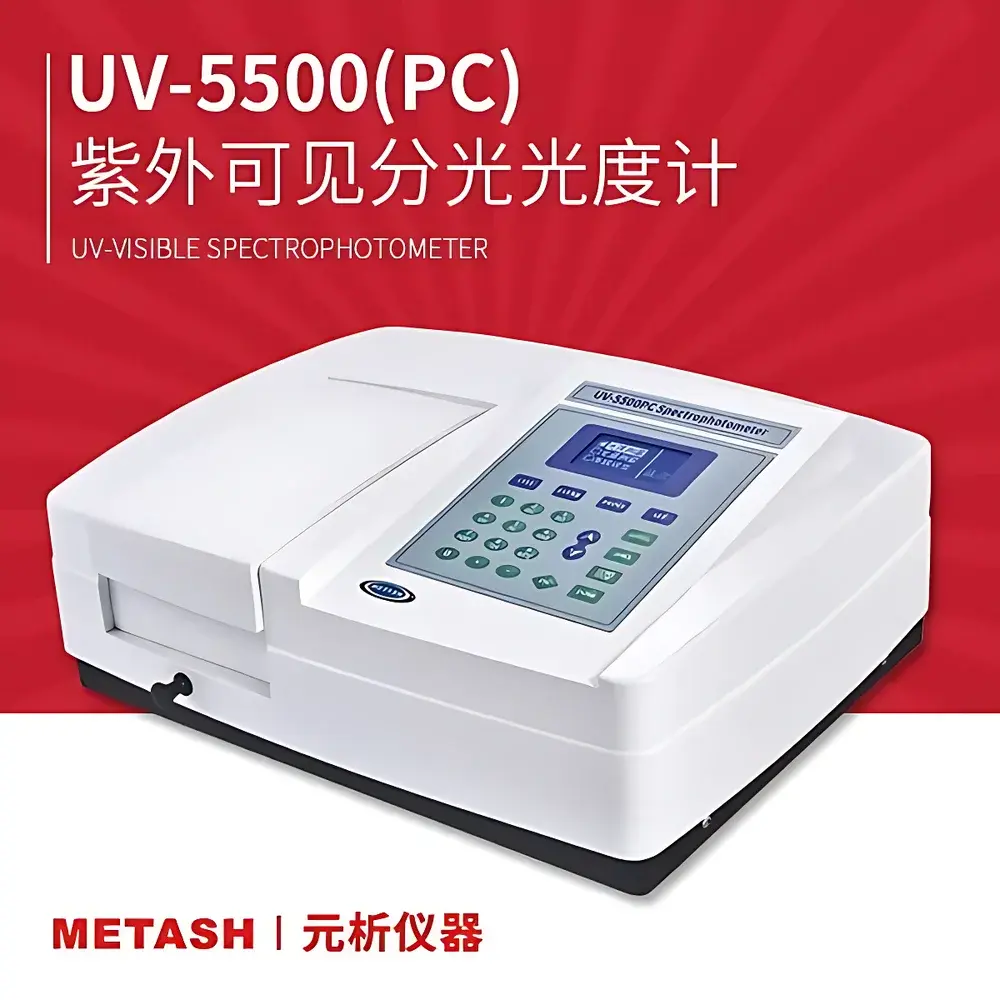
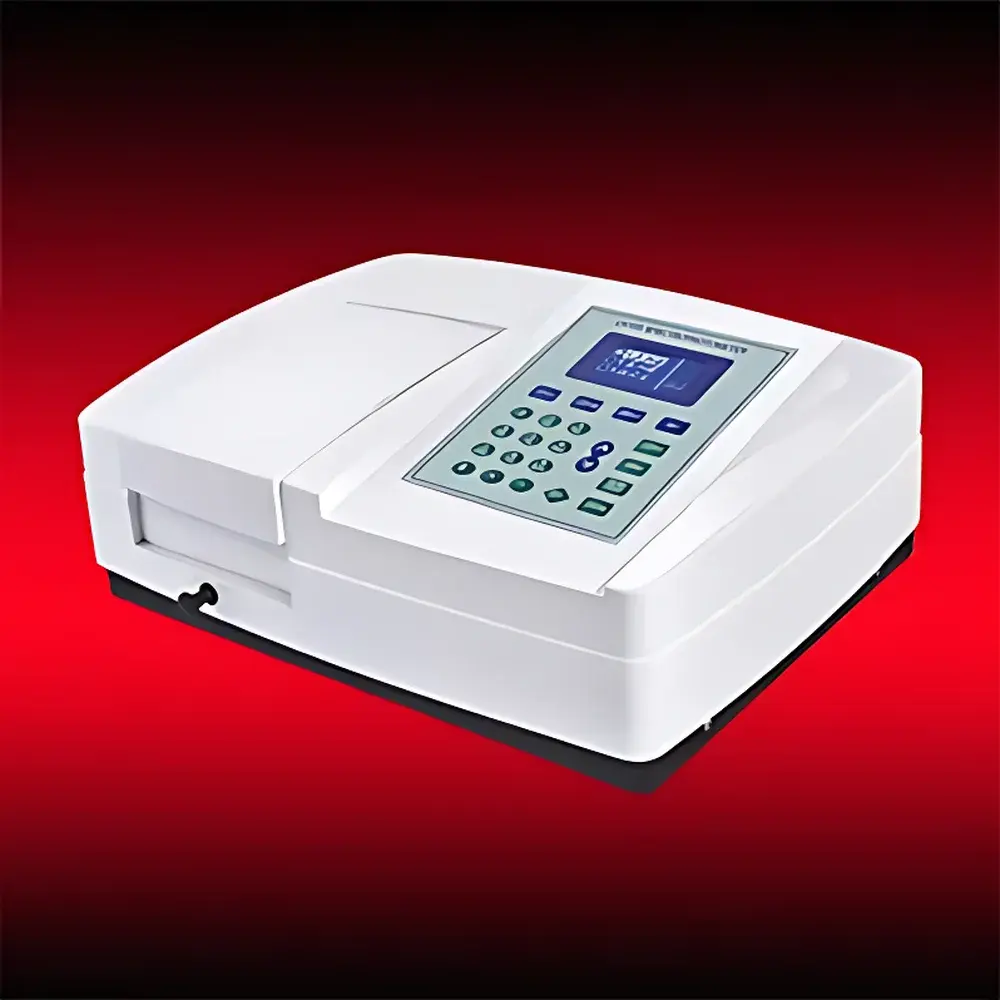
Metash UV-5500PC Dual-Beam Scanning Ultraviolet-Visible Spectrophotometer
| Brand | Metash Instruments |
|---|---|
| Origin | Shanghai, China |
| Manufacturer | Yes |
| Domestic Product | Yes |
| Model | UV-5500PC |
| Optical System | Dual-beam ratio-monitoring |
| Detector Type | Silicon photodiode |
| Wavelength Range | 190–1100 nm |
| Wavelength Accuracy | ±0.5 nm |
| Spectral Bandwidth | 2 nm |
| Stray Light | ≤0.05% T at 220 nm and 360 nm |
| Wavelength Scanning Mode | Automatic |
| Display | 128×64 dot-matrix LCD |
| Data Storage | 200 measurement sets and 200 calibration curves |
| Interface | USB port for PC connectivity |
| Software | Optional Metash SpectraScan Suite (GLP/GMP-compliant) |
Overview
The Metash UV-5500PC is a dual-beam scanning ultraviolet-visible (UV-Vis) spectrophotometer engineered for precision absorbance, transmittance, and reflectance measurements across the spectral range of 190–1100 nm. Its core optical architecture employs a ratio-monitoring dual-beam design, wherein reference and sample beams are simultaneously directed through matched optical paths and detected by a single silicon photodiode. This configuration dynamically compensates for source intensity drift—particularly critical during extended kinetic or temperature-dependent experiments—ensuring high photometric stability and long-term repeatability. The instrument integrates a high-stability deuterium lamp (for UV) and tungsten-halogen lamp (for visible/NIR), both mounted in a flange-base configuration that eliminates post-replacement optical realignment. The entire optical train—including collimating mirrors, monochromator grating, and beam splitter—is rigidly suspended on an 8 mm thick aerospace-grade aluminum optical baseplate, decoupling the system from mechanical vibration and thermal expansion-induced misalignment.
Key Features
- Dual-beam ratio-monitoring optical system with real-time source fluctuation correction
- Automated wavelength scanning and self-calibration with auto-zero and auto-background correction routines
- 2 nm spectral bandwidth optimized for resolution–sensitivity balance in routine QC and research applications
- 128×64 dot-matrix LCD display supporting multi-parameter readout per screen (e.g., λ, A, %T, concentration, kinetics timepoint)
- Onboard data management: stores up to 200 measurement datasets and 200 user-defined calibration curves, each retrievable by numeric ID
- USB interface enabling direct communication with Windows-based PCs; supports firmware updates and data export in CSV format
- Modular accessory compatibility: automated 8-cell changer, micro-volume cuvette holders (down to 50 µL pathlength), Peltier-controlled thermostatted sample compartment, integrating sphere for diffuse reflectance, and fiber-optic probes
Sample Compatibility & Compliance
The UV-5500PC accommodates standard 10 mm square quartz, glass, or plastic cuvettes (pathlengths 1–50 mm), as well as specialized cells for turbid, viscous, or low-volume samples. Its optical design meets fundamental requirements for compliance with ISO 9001 quality management systems and supports adherence to analytical validation frameworks outlined in USP , EP 2.2.25, and ASTM E275. When operated with the optional SpectraScan software, the system implements full audit-trail functionality—including user authentication, timestamped action logging, electronic signature support, and immutable data archiving—aligning with FDA 21 CFR Part 11 and GLP/GMP documentation standards. All stored spectra and quantitative results retain full traceability to instrument configuration, calibration history, and operator identity.
Software & Data Management
The optional Metash SpectraScan software suite provides a validated, Windows-native platform for method development, execution, and reporting. It supports six primary operational modes: Photometric (single/multi-wavelength), Quantitative (linear/nonlinear calibration with error propagation), Spectrum Scan (full-range or user-defined scan with peak detection and baseline correction), Kinetics (time-resolved absorbance monitoring at fixed or variable wavelengths), Multi-Wavelength Analysis (simultaneous tracking of up to 10 wavelengths), and Biomolecular Analysis (DNA/RNA/protein quantification using built-in extinction coefficients and dilution calculators). Data files include embedded metadata (instrument ID, date/time, operator, method parameters) and export natively to CSV, TXT, or PDF report formats. Raw spectral data are stored in vendor-neutral ASCII format for third-party processing.
Applications
This spectrophotometer serves laboratories engaged in pharmaceutical quality control (e.g., assay of active ingredients per USP monographs), environmental water analysis (nitrate, phosphate, COD), food and beverage testing (colorimetric assays for antioxidants, preservatives), academic research in photochemistry and nanomaterial characterization (plasmonic nanoparticle extinction profiling), and biotechnology labs performing nucleic acid and protein purity assessment (A260/A280 ratios, Bradford/Lowry assays). Its robust optical isolation and dual-beam stability make it particularly suitable for applications requiring >8-hour continuous monitoring, such as enzyme kinetics under controlled temperature or photostability studies per ICH Q1B guidelines.
FAQ
What wavelength calibration standards are recommended for routine verification?
NIST-traceable holmium oxide and didymium filters are recommended for wavelength accuracy verification at 241.1, 279.4, 287.5, 333.7, 360.9, 418.5, 460.0, 485.8, 536.2, and 637.5 nm.
Is the instrument compatible with third-party LIMS or ELN systems?
Yes—CSV and ASCII spectral exports enable integration with most laboratory information management systems (LIMS) and electronic lab notebooks (ELN); custom API support is available upon request for enterprise deployments.
Can the UV-5500PC perform spectral deconvolution or derivative spectroscopy?
Derivative spectroscopy (1st–3rd order) is supported in SpectraScan software; spectral deconvolution requires external MATLAB or Python-based tools due to algorithmic complexity and regulatory validation constraints.
What is the typical warm-up time required before achieving photometric stability?
Less than 20 minutes for full thermal equilibrium of lamps and optics; photometric noise stabilizes to ≤±0.001 A at 500 nm within 15 minutes after power-on.
Does the system support automatic baseline correction across variable pathlengths?
Yes—baseline correction is applied per measurement cycle and accounts for cuvette-specific offset when using the auto-zero function with matched reference/sample cells.







