
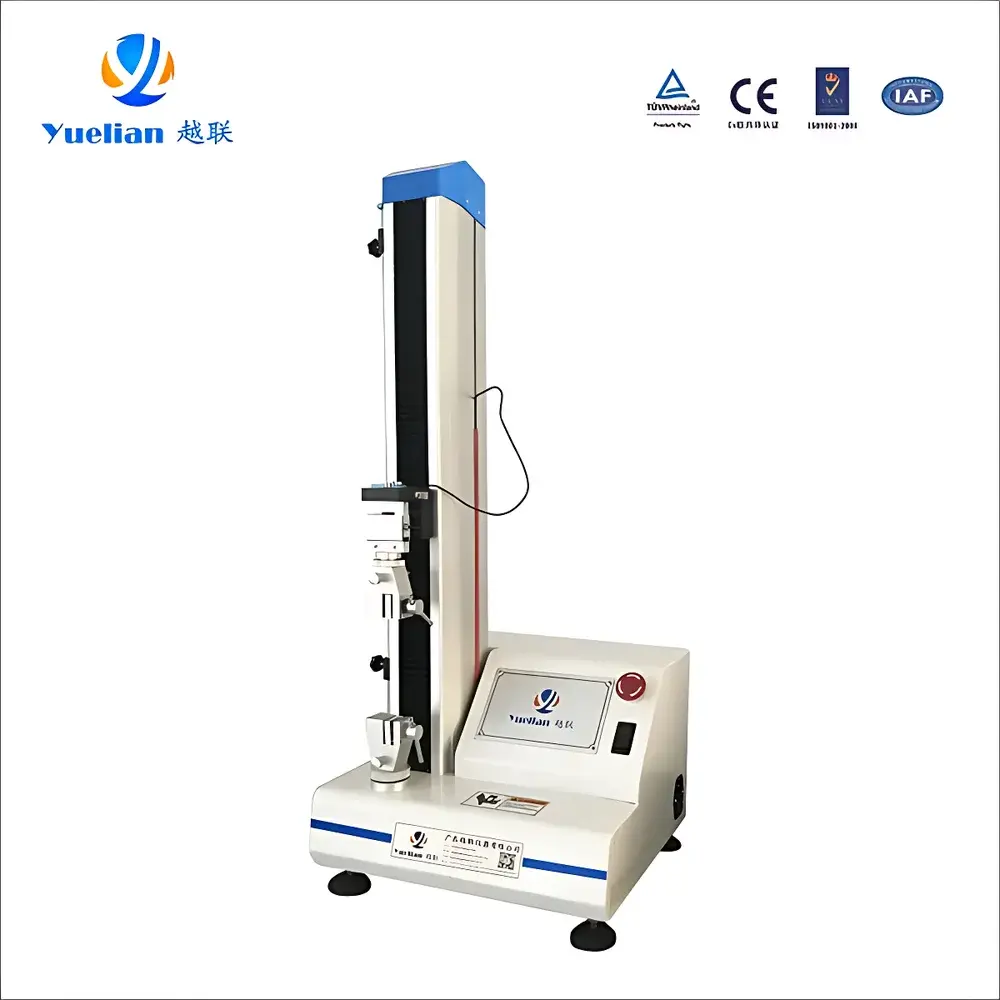
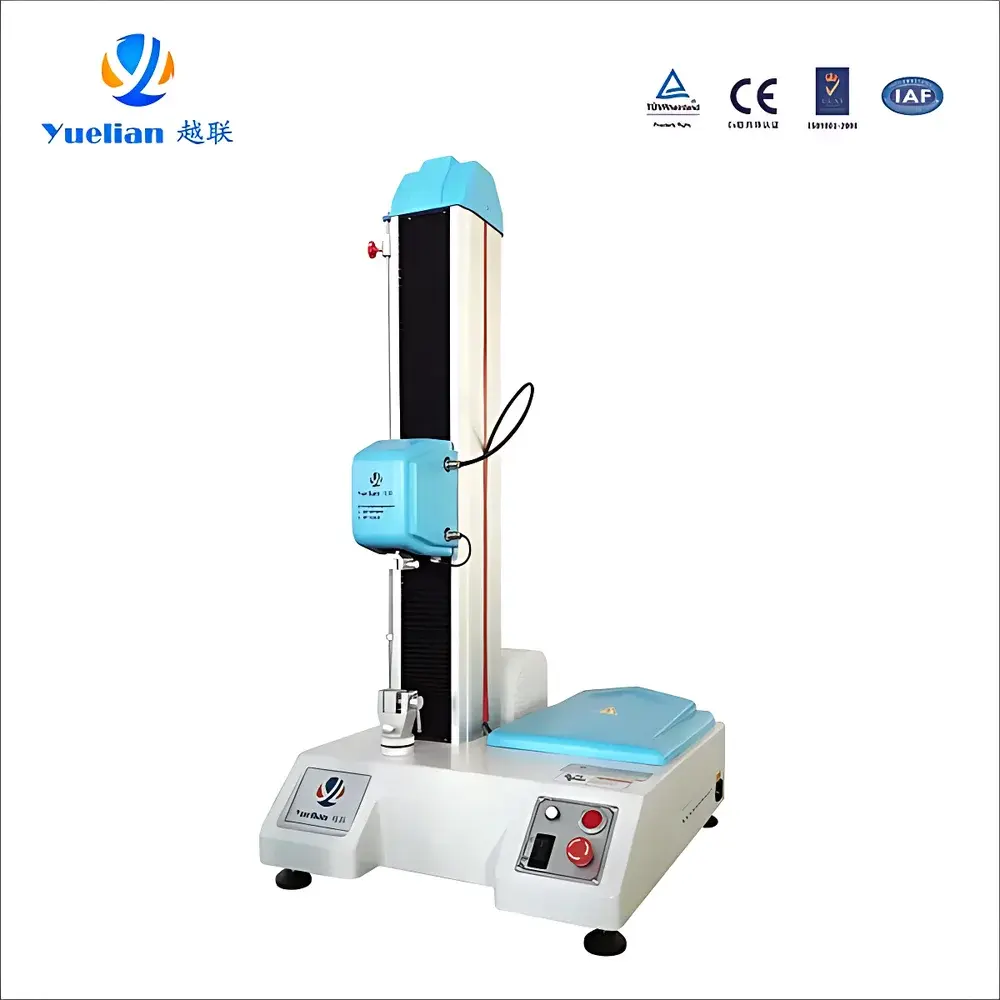
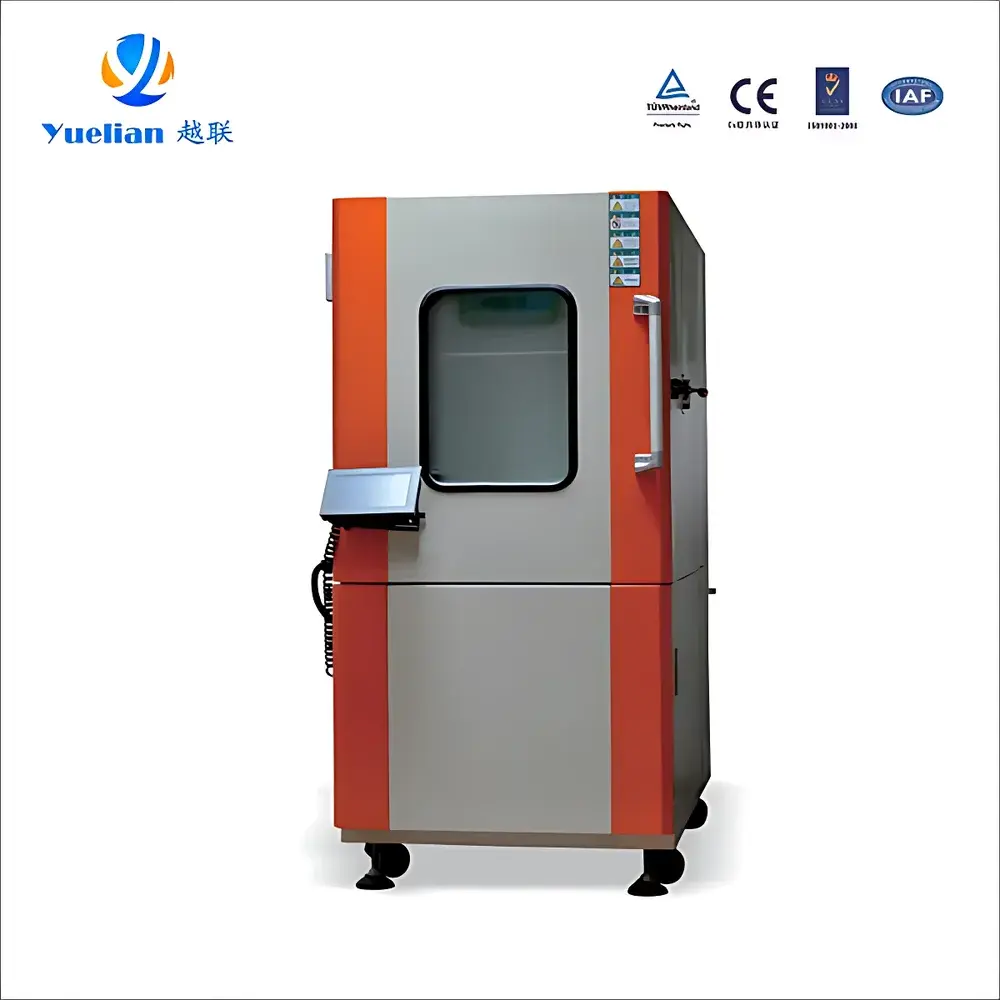
Yuelian S93 Electronic Tensile Testing Machine
| Brand | Yuelian |
|---|---|
| Origin | Guangdong, China |
| Manufacturer Type | Authorized Distributor |
| Country of Origin | China |
| Model | S93 |
| Instrument Type | Electronic Tensile Testing Machine |
| Maximum Test Load | 1 kN |
| Load Range | 100% FS |
| Load Accuracy | ±0.5% |
| Test Stroke | 600 mm |
| Displacement Resolution | 0.01 mm |
| Force Resolution | 1/120,000 |
| Speed Range | 0.5–600 mm/min |
| Crosshead Travel | 600 mm |
| Effective Width | Ø55 mm |
| Power Supply | 220 V, 50/60 Hz, 10 A |
| Motor Type | Stepper Motor |
| Drive System | Precision Ball Screw with Timing Belt |
| Power Consumption | 180 W |
| Dimensions (W×D×H) | 400 × 300 × 920 mm or 400 × 300 × 1200 mm |
| Net Weight | ~28 kg |
| Standard Accessories | One set of universal grips, PC software, RS-232 interface cable |
Overview
The Yuelian S93 Electronic Tensile Testing Machine is a precision-engineered benchtop system designed for static mechanical property evaluation of thin films, protective coatings, laminates, polymers, elastomers, textiles, paper, and lightweight composite materials. It operates on the fundamental principle of uniaxial force application under controlled displacement or load rate, conforming to standardized test methodologies including ASTM D882 (tensile properties of thin plastic sheeting), ISO 527-3 (plastics — determination of tensile properties — part 3: films and sheets), ASTM D3330 (peel adhesion of pressure-sensitive tape), and ISO 8510-2 (adhesives — peel resistance of flexible-bonded-to-rigid specimens). The machine employs a high-efficiency stepper motor coupled with a preloaded precision ball screw transmission system, achieving >85% mechanical transmission efficiency and minimizing thermal drift and energy loss during extended testing cycles. Its rigid C-frame architecture ensures minimal deflection under load, supporting repeatable measurement of tensile strength, elongation at break, Young’s modulus, peel force, tear resistance, and shear adhesion across diverse specimen geometries.
Key Features
- Full-range load capacity up to 1 kN with dual-capacity configuration support (e.g., simultaneous 100 N / 1 kN sensor switching)
- High-resolution force measurement: 1/120,000 internal resolution; certified accuracy ±0.5% of full scale
- Displacement resolution of 0.01 mm over a 600 mm stroke, enabling precise strain quantification in low-deformation regimes
- Programmable speed control from 0.5 to 600 mm/min via PC interface or front-panel keypad
- Integrated quick-adjust crosshead mechanism with fine-tuning knobs for rapid fixture alignment
- Multi-mode stopping logic: overload cutoff, emergency stop, specimen rupture detection, programmable upper/lower limit triggers, and automatic return-to-start post-test
- Universal grip interface with fast-swap couplings compatible with pneumatic, wedge, roller, peel, and loop-type fixtures
- Dual operation mode: standalone testing with real-time force/displacement display or synchronized PC-based control and analysis
- USB and RS-232 connectivity for seamless integration with laboratory data management systems
Sample Compatibility & Compliance
The S93 accommodates specimens ranging from 1 mm wide polymer films to 55 mm wide laminated substrates, supporting standardized sample geometries per ISO 527-3 Type 1B and ASTM D882 dog-bone or straight-edge configurations. It meets essential mechanical safety and electromagnetic compatibility requirements per IEC 61000-6-2/6-3 and complies with structural integrity benchmarks defined in ISO 7500-1 (static calibration of uniaxial testing machines). When operated with validated test protocols and traceable calibration certificates, the system supports GLP-compliant documentation workflows. Optional audit trail modules enable 21 CFR Part 11–compliant electronic records for regulated quality control environments.
Software & Data Management
The included Windows-based control and analysis software provides real-time graphical monitoring of force–displacement curves, automatic peak detection, modulus calculation via linear regression (ISO 527-1 Annex B), and multi-curve overlay for comparative analysis. All raw data are stored in ASCII CSV format for third-party statistical processing (e.g., Minitab, JMP) or LIMS ingestion. Software features include customizable report templates with embedded company logos, automatic unit conversion (N, kN, kgf, lbf, MPa), batch test sequencing, and pass/fail criteria based on user-defined thresholds. Audit-ready export includes timestamped metadata, operator ID, environmental conditions (if linked to optional hygrothermal sensors), and calibration history references.
Applications
- Quantitative assessment of protective film adhesion strength and cohesive failure modes on glass, metal, or polymer substrates
- Evaluation of peel resistance in pressure-sensitive adhesive tapes and functional laminates
- Tensile characterization of biodegradable packaging films, release liners, and medical device barrier layers
- Shear and loop tack testing of hot-melt adhesives used in labeling and assembly processes
- Quality assurance of textile reinforcements in composites and nonwovens for filtration media
- Routine QC screening of incoming raw materials against supplier specifications (e.g., ASTM D3759 for foil tapes)
- Research-grade mechanical profiling of nanocomposite thin films and conductive polymer coatings
FAQ
What standards does the S93 comply with for film tensile testing?
The system supports test execution per ASTM D882, ISO 527-3, GB/T 1040.3, and JIS K7127, with configurable parameters aligned to specimen gauge length, width, and crosshead speed requirements.
Can the S93 perform peel tests on curved surfaces?
Yes — when equipped with a 180° peel fixture and calibrated angular alignment jig, it enables standardized peel testing per ASTM D6862 on cylindrical or contoured substrates.
Is calibration traceable to national metrology institutes?
Calibration certificates issued by authorized service providers include NIST-traceable load cell verification and displacement encoder validation, meeting ISO/IEC 17025 documentation requirements.
Does the software support automated pass/fail reporting for production line use?
Yes — users define upper/lower specification limits per parameter; the software generates color-coded compliance flags and exports summary reports in PDF or Excel format.
What maintenance is required for long-term accuracy?
Annual verification of load cell linearity and displacement encoder repeatability is recommended; routine cleaning of the ball screw and lubrication per manufacturer guidelines ensures >10,000-cycle operational stability.



