
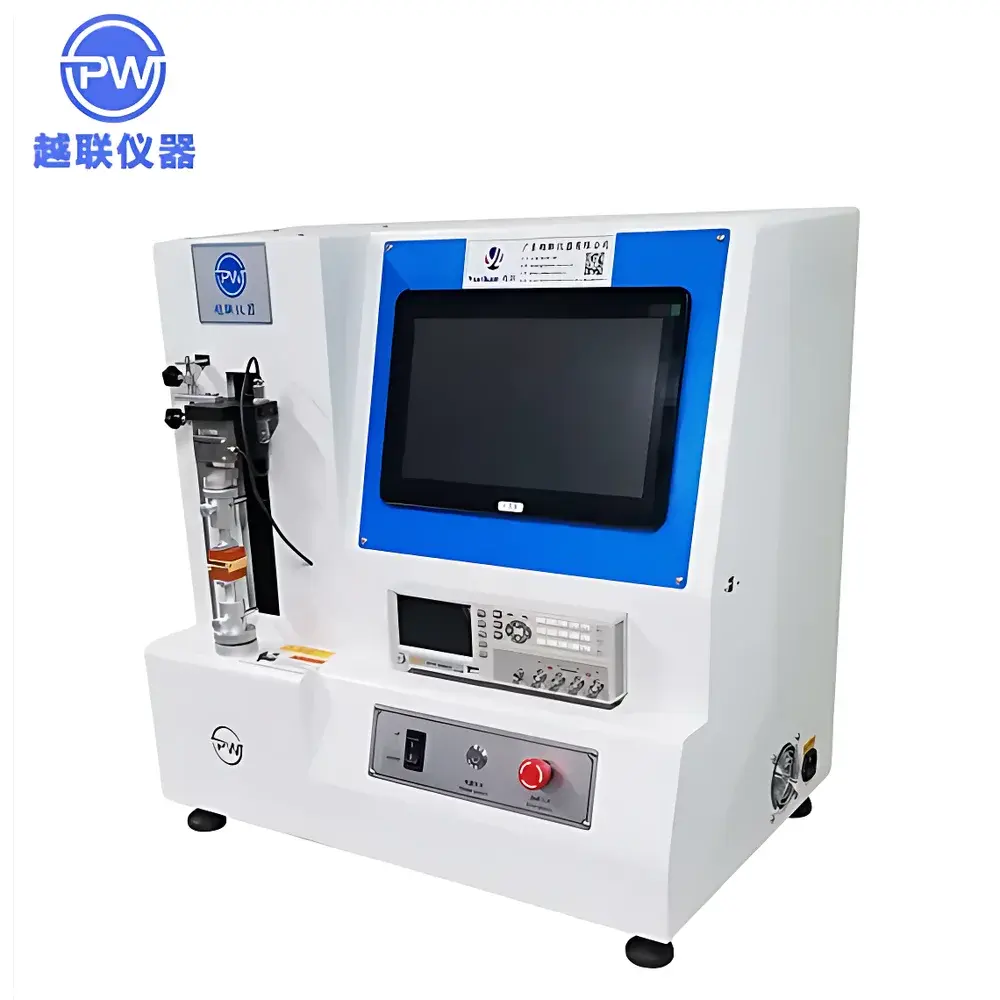
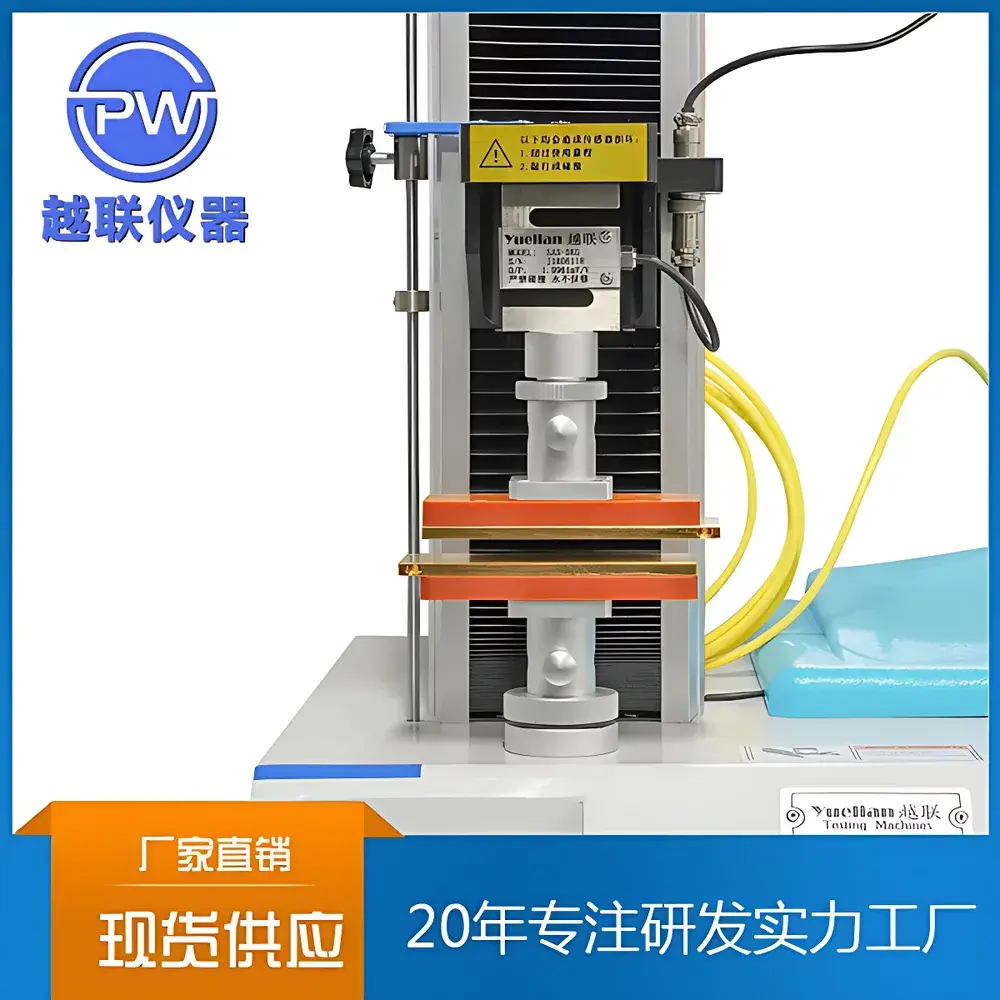
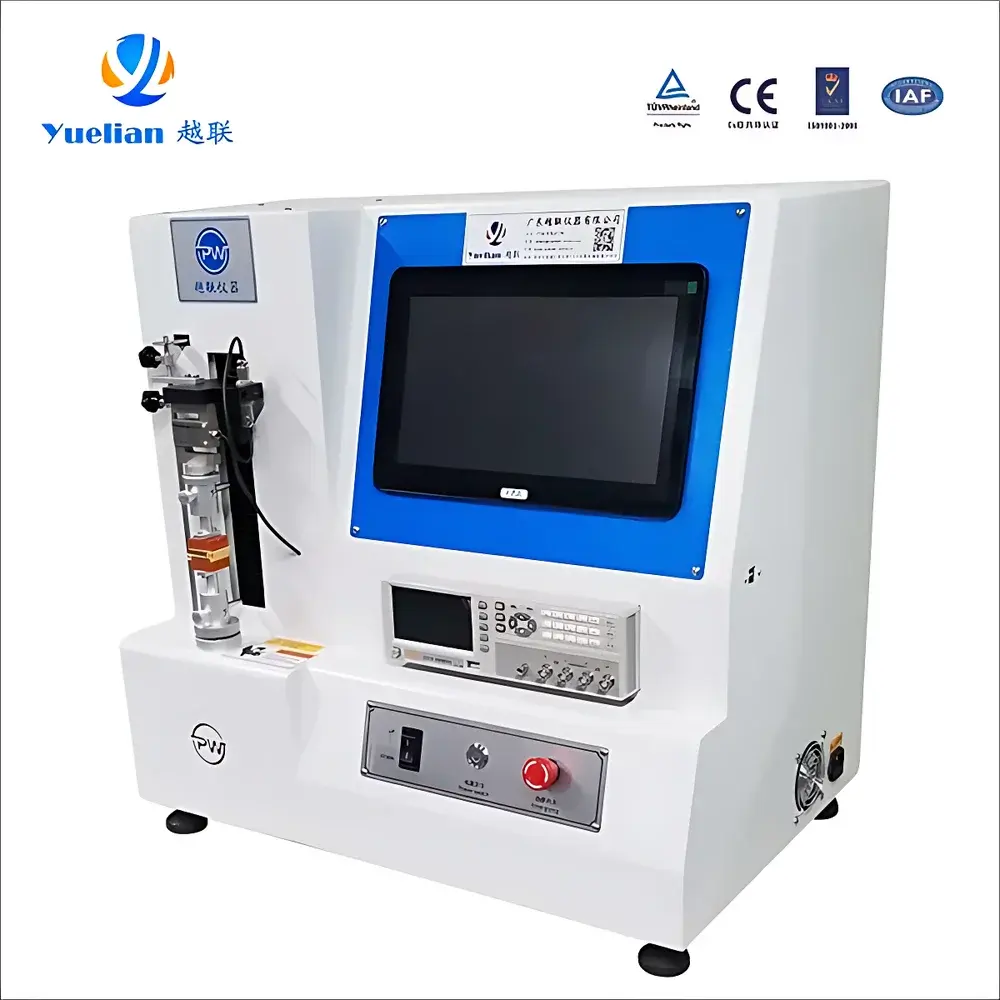
PW-UTM1K8C High-Precision Conductive Foam Compression Resistance Tester (Brand: YueLian / PW, Model: PW-FCR2-2)
| Brand | YueLian / PW |
|---|---|
| Origin | Guangdong, China |
| Manufacturer Type | Authorized Distributor |
| Country of Origin | China |
| Model | PW-FCR2-2 |
| Pricing | Available Upon Request |
Overview
The PW-UTM1K8C is a high-precision electromechanical testing system engineered specifically for the quantitative characterization of conductive foam materials under controlled compression. It integrates dual-parameter real-time measurement—mechanical force and electrical resistance—within a single synchronized test cycle. Based on servo-controlled uniaxial compression mechanics and four-wire low-resistance measurement principles, the system captures the dynamic interplay between structural deformation (displacement/strain) and electrical continuity (contact resistance, bulk resistivity, or surface conductivity) as the foam specimen is compressed to defined heights or strain levels. This capability is critical for R&D, quality assurance, and process validation in EMI shielding gasket design, flexible electronics packaging, wearable sensor integration, and automotive cabin sealing applications where both mechanical resilience and stable electrical performance must be co-optimized.
Key Features
- Servo-motor-driven actuation with precision ground ball-screw transmission, delivering smooth, repeatable motion across the full 50 mm effective stroke.
- Multi-range load cell options (10 N to 1 kN), each calibrated to ≤0.5% full-scale accuracy per ISO 7500-1 Class 0.5 requirements.
- Simultaneous acquisition of force, displacement, time, and resistance at up to 1 kHz sampling rate, enabling true synchronous correlation of mechanical and electrical responses.
- Modular fixture interface with quick-release couplings—supports interchangeable compression platens, custom electrode arrays, and environmental chamber adapters.
- Integrated micro-adjustment limit switches for fine-tuning upper/lower travel endpoints; hardware-based overload protection, emergency stop circuit, and programmable upper/lower stroke limits.
- Real-time graphical overlay of up to six concurrent curves: Force–Displacement, Force–Time, Displacement–Time, Stress–Strain, Stress–Resistance, and Resistance–Strain.
Sample Compatibility & Compliance
The system accommodates standard conductive foam specimens up to Ø140 mm × 50 mm height. Compression platens are stainless steel with optional gold-plated or carbon-coated surfaces to minimize contact interference. The test method aligns with ASTM D3574 Annex A10 (compression set of flexible cellular materials) and IEC 61340-2-3 (electrostatic dissipation testing), while supporting internal protocol development for customer-specific QC criteria. Data audit trails comply with GLP/GMP documentation standards; software supports 21 CFR Part 11–compliant electronic signatures, user access control, and immutable data archiving.
Software & Data Management
The proprietary UTMControl v4.x software provides full PC-based operation via USB or RS-232 interface. It enables advanced test sequencing—including multi-step nested loops with conditional branching (e.g., hold at 30% strain for 60 s → ramp to 50% → measure resistance stability). Statistical analysis includes CPK, Cpk, mean, median, standard deviation, trimmed mean (excluding top/bottom 5%), and histogram generation. Up to 40 manual cursor points and 120 auto-sampled points per test are extractable. Historical datasets can be overlaid for comparative trend analysis. Reports export to PDF, CSV, and XML formats—with customizable templates meeting ISO/IEC 17025 laboratory reporting requirements.
Applications
- Quantifying compression-set resistance and recovery hysteresis in nickel/copper-coated polyurethane foams.
- Evaluating contact resistance stability during cyclic compression (e.g., 10,000 cycles at 25% strain @ 0.5 Hz).
- Correlating surface resistivity (Ω/sq) and through-thickness resistivity (Ω·cm) with compressive stress in anisotropic conductive elastomers.
- Validating lot-to-lot consistency for automotive EMI gaskets under thermal preconditioning (when paired with optional environmental chamber).
- Supporting DOE studies on foam density, coating thickness, and binder formulation effects on electro-mechanical coupling behavior.
FAQ
What types of conductive foam materials can be tested?
The system is optimized for open-cell and closed-cell polyurethane, silicone, and EPDM foams with metallic (Ni, Cu, Ag), carbon-black, or graphene-based conductive fillers.
Is the resistance measurement performed using two-wire or four-wire method?
Four-wire (Kelvin) configuration is used to eliminate lead resistance errors, supporting measurements from 1 mΩ to 2 MΩ with ±0.2% basic accuracy.
Can test methods be saved and recalled for routine QC use?
Yes—users define, name, password-protect, and version-control test methods; all parameters (speed, target strain, dwell time, resistance thresholds) are fully scriptable.
Does the system support automated pass/fail judgment based on resistance thresholds?
Yes—programmable go/no-go logic triggers automatic test termination and status flagging if resistance exceeds user-defined upper/lower limits at specified compression points.
What calibration documentation is provided?
Each unit ships with NIST-traceable calibration certificates for force and displacement; optional third-party ISO/IEC 17025 calibration services are available.



