
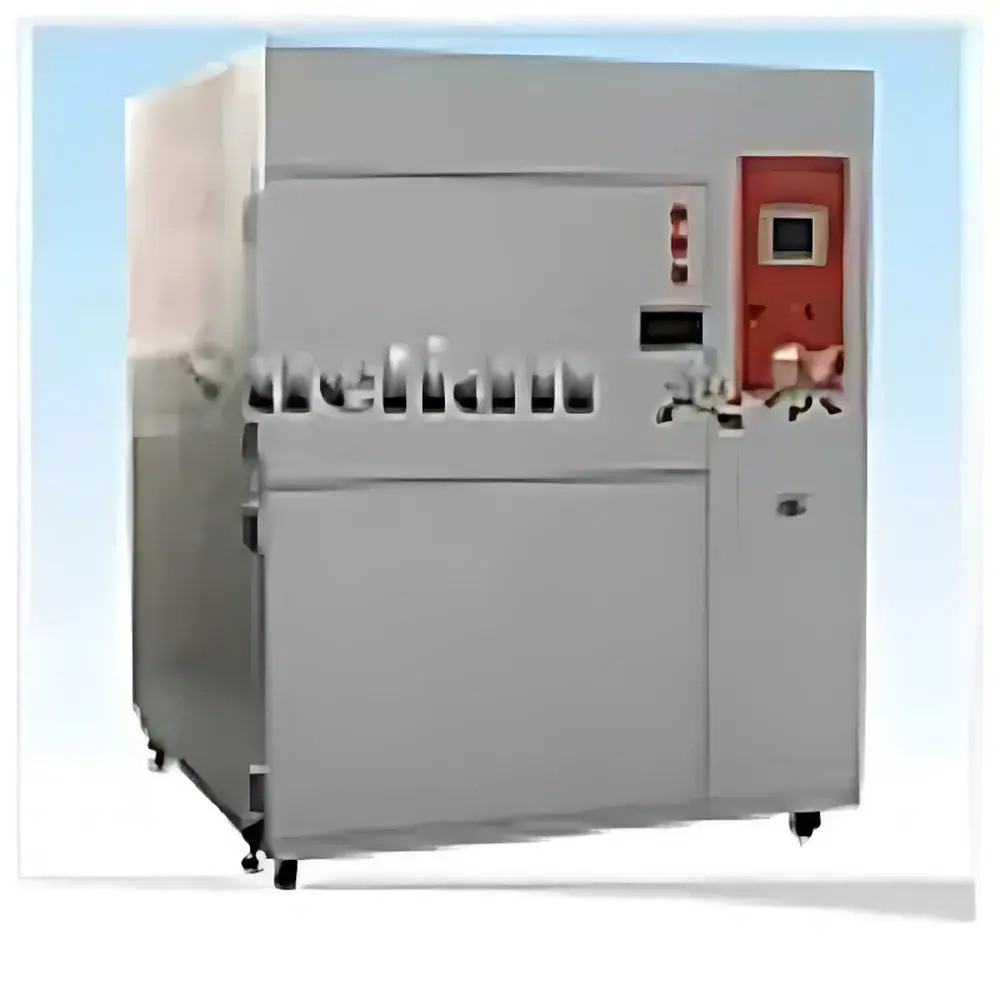
Yuelian YL-2280 Thermal Shock Test Chamber
| Brand | Yuelian |
|---|---|
| Origin | Guangdong, China |
| Model | YL-2280 |
| Chamber Configuration | Three-Zone (Hot Zone / Cold Zone / Test Zone) |
| Temperature Range | Preheat: +60°C to +200°C |
| Precool | −10°C to −70°C |
| Thermal Shock | +60°C to +150°C (Hot) / −10°C to −65°C (Cold) |
| Temperature Uniformity | ±2.00°C |
| Recovery Time (Hot/Cold) | ≤5 min |
| Control System | OYO-8226 PID Controller with LCD Interface (320 × 240 dots), RS-232 Communication |
| Programmable Cycles | Up to 9999 |
| Max. Program Storage | 120 Sets |
| Power Supply | AC 3φ 380 V, 50 Hz |
| Refrigeration | Dual-Stage Cascade System with Eco-Friendly Refrigerant |
| Construction | SUS#304 Stainless Steel Interior & Exterior |
| Cooling Method | Water-Cooled |
| Ambient Operating Range | 10°C–35°C |
| Compliance | ASTM D5229, ISO 11359-2, JIS Z 2243, MIL-STD-810H Method 503.5, IEC 60068-2-14 |
Overview
The Yuelian YL-2280 Thermal Shock Test Chamber is an engineered environmental test system designed to evaluate material integrity and structural reliability under rapid, repetitive transitions between extreme high and low temperature extremes. It operates on the principle of accelerated thermal stress induction—leveraging controlled, high-rate temperature transients to simulate real-world service conditions where components experience abrupt ambient shifts (e.g., aerospace deployment, automotive under-hood cycling, or outdoor electronics exposure). Unlike conventional temperature cycling chambers, the YL-2280 employs a three-zone architecture—comprising independent hot, cold, and test compartments—enabling true static-sample testing with gas-switching actuation. This design eliminates mechanical movement of test specimens, thereby preserving positional repeatability and eliminating vibration-induced artifacts during qualification. The system delivers precise thermal shock profiles per internationally recognized standards, including MIL-STD-810H Method 503.5 (Temperature Shock), IEC 60068-2-14 (Change of Temperature), and ASTM D5229 (Low-Temperature Impact Resistance of Plastics), making it suitable for validation in aerospace, automotive, semiconductor packaging, and RoHS-compliant lead-free solder process development (e.g., tin whisker acceleration per IPC-TR-579).
Key Features
- Three-zone segregated chamber architecture (preheat zone, precool zone, and stationary test zone) ensures zero specimen motion during thermal transition—critical for optical alignment stability and microstructural fidelity.
- Dual-stage cascade refrigeration system utilizing environmentally compliant refrigerants (R404A/R23 or equivalent), paired with water-cooled condensation, enables stable operation at −70°C precool and +200°C preheat extremes.
- OYO-8226 digital PID controller with 320 × 240 dot LCD interface supports bilingual (English/Chinese) operation, 120 programmable test sequences, up to 9999 cycles, and time resolution down to 1 minute.
- Automated air damper switching mechanism achieves ≤10 s transition between hot/cold gas paths; temperature recovery to target setpoint occurs within ≤5 minutes—verified per IEC 60068-3-10 Annex B.
- Integrated frost prevention protocol automatically returns test samples to ambient prior to door opening, mitigating condensation, ice accumulation, and surface oxidation on sensitive metallized substrates.
- Real-time multi-channel data logging via RS-232 interface enables traceable acquisition of temperature profiles, cycle counters, alarm events, and system status—fully compatible with GLP/GMP audit requirements when paired with validated third-party software.
Sample Compatibility & Compliance
The YL-2280 accommodates rigid and semi-rigid specimens—including printed circuit boards (PCBs), IC packages, metal alloys, elastomers, composite laminates, and ceramic substrates—within standardized stainless steel test trays (SUS#304). Its fixed-position test zone eliminates inertial loading, ensuring mechanical neutrality during shock events. The chamber meets essential compliance benchmarks for product qualification: ASTM D5229 for low-temperature impact resistance of polymeric materials; ISO 11359-2 for thermomechanical analysis of polymers; JIS Z 2243 for metallic material thermal shock resistance; and MIL-STD-810H Method 503.5 for military-grade environmental survivability. Optional LN₂ assist integration supports sub-second ramp rates required for advanced tin whisker acceleration per IPC-TR-579 and JEDEC JESD22-A106B. All control logic and data handling are structured to support FDA 21 CFR Part 11–aligned electronic record integrity when configured with audit-trail-enabled software.
Software & Data Management
The embedded OYO-8226 controller provides native support for remote monitoring and program management via RS-232 serial communication. Users may design, upload, execute, and archive test protocols from a Windows-based host PC using vendor-supplied configuration software. Real-time temperature curves—including individual sensor traces from four calibrated PT100 inputs—are continuously streamed and timestamped. Export formats include CSV and Excel-compatible .xls for downstream statistical process control (SPC) analysis. System-generated log files retain full metadata: operator ID, start/stop timestamps, cycle completion status, fault codes (e.g., compressor overtemp, door interlock breach), and calibration verification history. When deployed in regulated environments, the platform supports 21 CFR Part 11–compliant user authentication, electronic signatures, and immutable audit trails through validated third-party LIMS or MES integrations.
Applications
- Qualification of solder joint reliability in lead-free (Pb-free) electronics assemblies under thermal fatigue stress.
- Evaluation of coating adhesion, delamination thresholds, and interfacial fracture in multi-layer thin-film devices.
- Accelerated aging of polymer encapsulants and potting compounds used in automotive sensors and EV battery modules.
- Verification of hermetic seal integrity in MEMS packages and optoelectronic housings subjected to field-relevant thermal transients.
- Material screening for cryogenic instrumentation components operating in space-grade thermal vacuum environments.
- Process validation of rapid thermal processing (RTP) steps in semiconductor front-end manufacturing.
FAQ
What is the difference between two-zone and three-zone thermal shock configurations?
The YL-2280 supports both modes: in two-zone operation, the test specimen moves mechanically between hot and cold chambers; in three-zone mode, the specimen remains stationary while conditioned air is pneumatically routed into the test zone—eliminating motion artifacts and improving reproducibility.
Does the system comply with GLP or GMP documentation requirements?
Yes—when paired with validated data acquisition software, the RS-232 interface supports full electronic record generation, user access controls, and audit trail retention meeting GLP (21 CFR Part 58) and GMP (21 CFR Part 211) expectations.
Can the chamber perform tests below −65°C?
Standard configuration supports −70°C precool; sub-zero extensions to −80°C are available via optional LN₂ assist, subject to site-specific utility infrastructure assessment.
Is humidity control integrated into the thermal shock cycle?
No—the YL-2280 is a dry thermal shock system; relative humidity is not actively regulated. For combined temperature/humidity stress testing, a separate ESS (Environmental Stress Screening) chamber is recommended.
How is temperature uniformity verified and maintained?
Uniformity is validated per IEC 60068-3-10 using nine-point sensor mapping across the test volume; SUS#304 chamber walls with high-efficiency polyurethane insulation (≥150 mm thickness) minimize thermal bridging and ensure ±2.00°C tolerance across the working zone.
Related Products



