
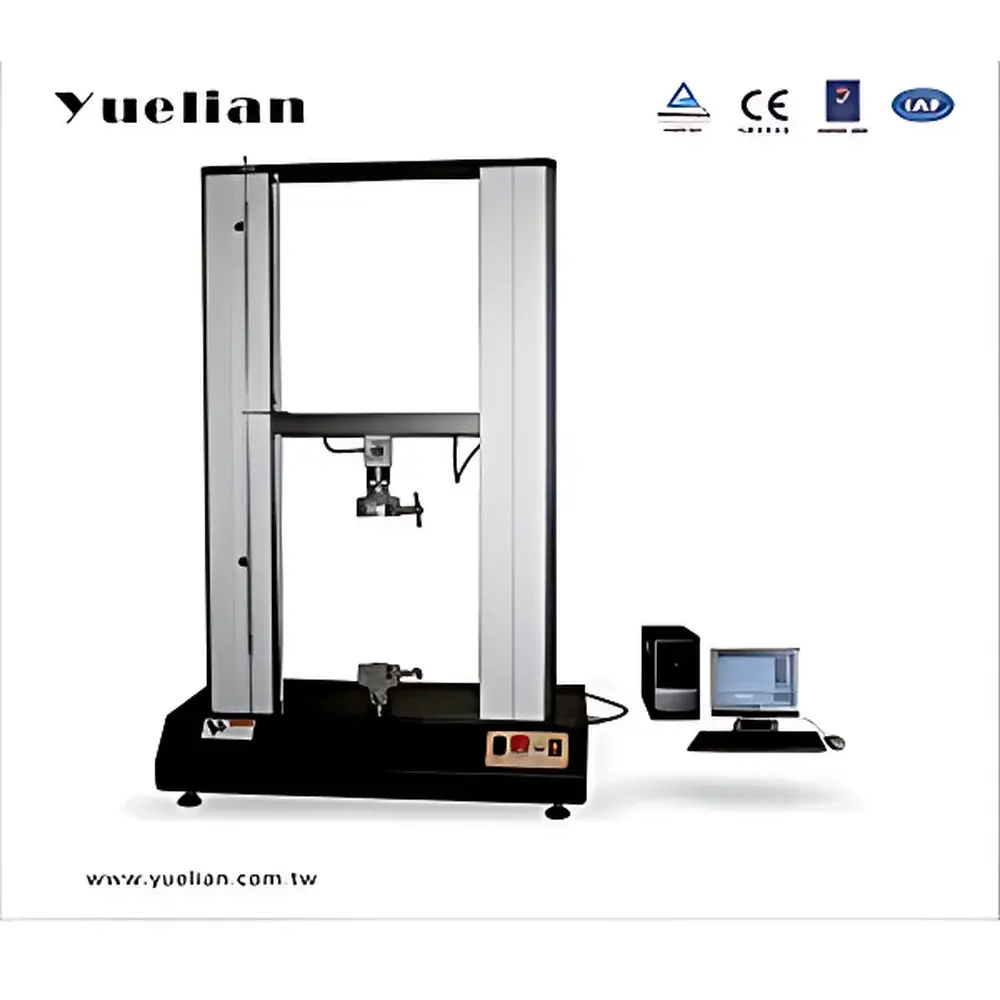
Yuelian YL-1123 Dual-Column Servo-Controlled Tensile Testing Machine
| Brand | Yuelian |
|---|---|
| Origin | Guangdong, China |
| Manufacturer Type | Authorized Distributor |
| Country of Origin | China |
| Model | YL-1123 |
| Instrument Type | Electromechanical Tensile Tester |
| Load Capacity Options | 10 N to 20 kN (dual-range configurable) |
| Force Resolution | 1/500,000 full scale |
| Force Accuracy | ±0.3% of reading |
| Crosshead Travel | 700 mm |
| Test Width | 420 mm |
| Speed Range | 0.01–1000 mm/min (programmable) |
| Displacement Resolution | 1/500,000 full scale |
| Control Interface | PC-based with USB connectivity |
| Power Supply | 220 V, 50/60 Hz, 10 A |
| Motor Drive | AC servo motor + precision ball screw + timing belt transmission |
| Dimensions (W×D×H) | 720 × 520 × 1300 mm |
| Weight | ~115 kg |
| Standard Accessories | One set of universal grips, test software, USB interface cable |
| Compliance Standards | ISO 7500-1, ASTM E4, EN 10002-1, GB/T 228.1, GB/T 2792, ASTM D3330, JJG 475 |
Overview
The Yuelian YL-1123 Dual-Column Servo-Controlled Tensile Testing Machine is an electromechanical universal testing system engineered for high-reproducibility mechanical characterization of solid materials across research, quality assurance, and production environments. Based on closed-loop servo control architecture, it applies controlled uniaxial force via a precision ball screw-driven crosshead, enabling precise execution of tensile, compression, flexural, shear, peel, tear, and adhesion tests per standardized mechanical testing protocols. Its dual-column rigid frame minimizes deflection under load, ensuring structural stability up to 20 kN capacity—making it suitable for both low-force polymer film evaluation and high-strength metallic or composite specimen analysis. Designed for compliance with international metrological requirements, the system meets ISO 7500-1 Class 1 verification criteria for force measurement accuracy and traceability.
Key Features
- Rigid dual-column steel frame with reinforced base and crosshead assembly for minimal axial deformation during high-load testing
- AC servo motor drive coupled with ground-precision ball screw and synchronous timing belt transmission—ensuring smooth motion, zero backlash, and long-term positional repeatability
- Programmable speed range from 0.01 to 1000 mm/min, adjustable in real time via software; includes rapid jog controls for manual fixture alignment
- High-resolution force transduction with 1/500,000 internal resolution and certified ±0.3% accuracy across full scale—validated per ASTM E4 and ISO 7500-1
- Displacement sensing with equivalent resolution and linearity, supporting precise strain determination in conjunction with extensometer-ready interfaces
- Modular load cell configuration supporting dual-range selection (e.g., 2 kN / 20 kN), optimizing signal-to-noise ratio across diverse material stiffness profiles
- Integrated safety logic including overload cutoff, emergency stop circuit, automatic break-stop upon specimen failure, and programmable upper/lower travel limits
Sample Compatibility & Compliance
The YL-1123 accommodates specimens ranging from thin elastomeric films and adhesive tapes to structural aluminum alloys and fiber-reinforced composites. Its 420 mm test width and 700 mm vertical stroke allow standard-compliant specimen mounting per ISO 527, ASTM D638, ASTM D3039, EN ISO 179, and GB/T 228.1. The system supports interchangeable grip systems—including pneumatic, wedge, roller, and custom fixtures—for optimal stress distribution and minimal slippage. All calibration and verification procedures align with national and international standards: JJG 475 (China), ASTM E4 (USA), ISO 7500-1 (Global), EN 10002-1 (EU), and GB/T 2792 (peel testing). It is fully compatible with GLP/GMP documentation workflows when paired with audit-trail-enabled software configurations.
Software & Data Management
The embedded Windows-based test platform provides full control over test sequencing, real-time data acquisition, and post-test analysis without third-party dependencies. It natively supports MS Access database storage for structured test records—including operator ID, environmental metadata, calibration logs, and raw channel data (force, displacement, time). Analytical functions include automatic yield point detection (0.2% offset method), Young’s modulus calculation, ultimate tensile strength (UTS), elongation at break, peel average force, and area-under-curve integration. Graphical overlays support multi-curve comparison, derivative plotting (e.g., tangent modulus), and export to CSV, PDF, or image formats. Software architecture complies with FDA 21 CFR Part 11 requirements when deployed with electronic signature modules and user-access-level permissions.
Applications
- Mechanical validation of thermoplastics, elastomers, and biopolymers in R&D labs per ISO 527 and ASTM D638
- Quality control of coated substrates, pressure-sensitive adhesives, and laminated packaging per ASTM D3330 and GB/T 2792
- Compliance testing of automotive interior trim, seatbelt webbing, and gasket materials per SAE J211 and DIN 53504
- Structural verification of fasteners, weld joints, and sheet metal components per ISO 6892-1 and GB/T 228.1
- Peel and tack evaluation of medical device bonding layers and transdermal patch adhesives under ISO 2555 and PSTC-107
- Educational use in materials science curricula for hands-on instruction in stress–strain behavior and failure mode analysis
FAQ
Is the YL-1123 compliant with ISO/IEC 17025 laboratory accreditation requirements?
Yes—the system’s force measurement chain is calibrated and verified per ISO 7500-1 Class 1, and its software supports traceable calibration certificate import, uncertainty budgeting, and instrument-specific identification fields required by ISO/IEC 17025 Clause 6.5.
Can the machine perform cyclic loading or fatigue tests?
No—the YL-1123 is configured for static and quasi-static monotonic testing only. For dynamic or high-cycle fatigue applications, a dedicated electrodynamic or hydraulic servo system is recommended.
What operating system versions are supported by the control software?
The current release supports Windows 10 (64-bit) and Windows 11 (64-bit); legacy support for Windows 7 ended in Q4 2023 per vendor lifecycle policy.
Is third-party extensometer integration possible?
Yes—the system provides analog voltage output (±10 V) and digital TTL trigger ports compatible with contact and non-contact extensometers meeting ASTM E83 Class B2 specifications.
Does the system include factory calibration documentation?
Each unit ships with a NIST-traceable calibration certificate covering force, displacement, and speed performance across three load points and two speed ranges, valid for 12 months from date of shipment.



