
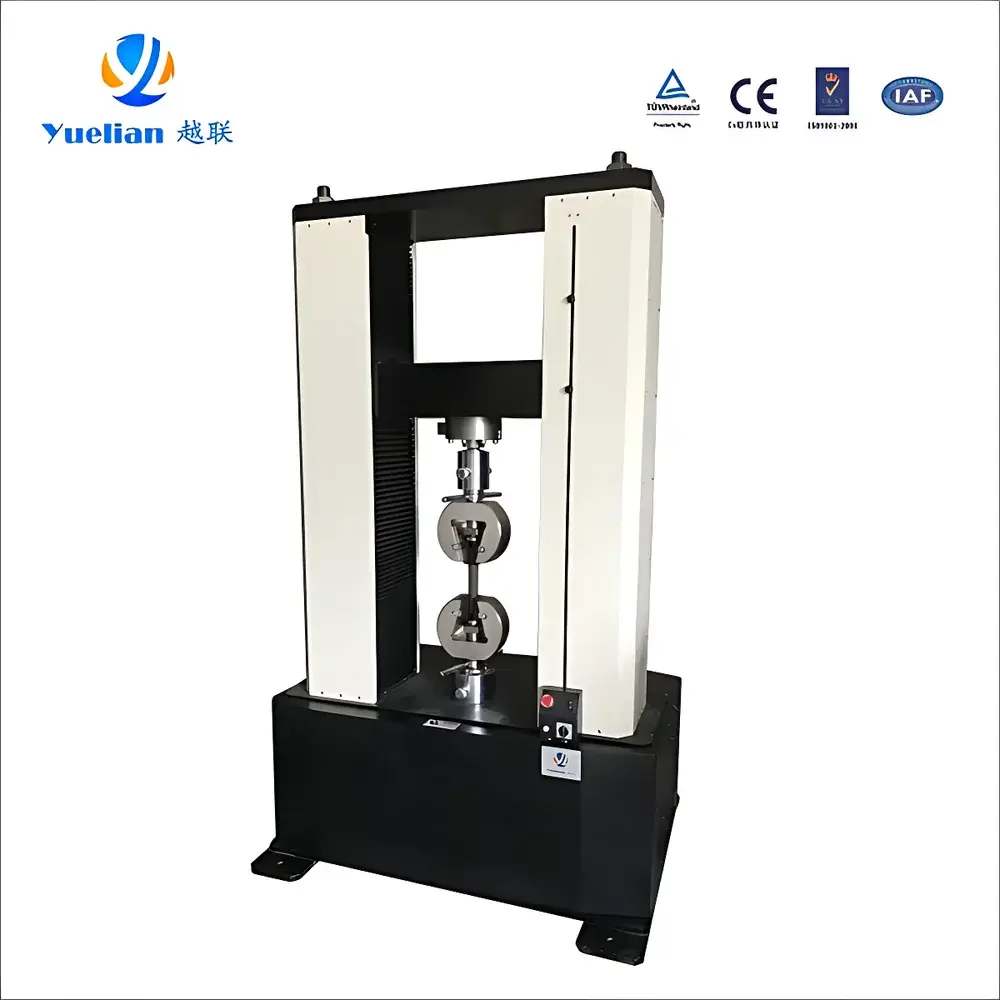
Yuelian YL-D200 Universal Tensile Testing Machine (200 kN)
| Brand | Yuelian |
|---|---|
| Origin | Guangdong, China |
| Model | YL-D200 |
| Maximum Test Load | 200 kN |
| Load Range | 1–200 kN (Full Scale) |
| Load Accuracy | ±0.3% FS |
| Test Stroke | 800 mm |
| Displacement Resolution | 1/500,000 |
| Force Resolution | 1/500,000 |
| Crosshead Speed | 0.01–300 mm/min (PC-controlled) |
| Test Width | 550 mm |
| Power Supply | 380 V, 50 Hz, 3 kW |
| Machine Weight | ~1700 kg |
| Dimensions (W×D×H) | 108 × 85 × 205 cm |
Overview
The Yuelian YL-D200 Universal Tensile Testing Machine is an electromechanical static testing system engineered for high-precision mechanical property characterization of structural and functional materials. Based on servo-motor-driven actuation with precision ground ball screws and synchronous timing belts, it delivers stable, repeatable force application across tension, compression, bending, shear, peel, tear, and adhesion test modes. Designed in accordance with ISO 7500-1 (Class 1 calibration), ASTM E4 (Standard Practices for Force Verification), and EN 10002-1 (Metallic Materials — Tensile Testing), the system meets international metrological requirements for materials certification, quality assurance, and R&D validation. Its dual-capacity configuration capability (e.g., 100 kN/200 kN) supports both high-strength metallic plates and lower-force polymer or composite specimens without hardware reconfiguration.
Key Features
- Servo-motor actuation with closed-loop position and load control ensures consistent velocity profiles and minimal overshoot during dynamic transitions.
- High-resolution force transduction (1/500,000 full scale) and displacement feedback (1/500,000 stroke resolution) enable detection of micro-yield events and precise modulus determination.
- Adjustable crosshead travel (800 mm) and wide test width (550 mm) accommodate standard ASTM/ISO coupons as well as thick-section structural plates up to 50 mm thickness.
- Multi-standard compliance support: preconfigured test methods for ASTM D3330 (peel adhesion), ASTM D638 (tensile plastics), ISO 527, GB/T 228.1 (metal tensile), GB/T 2792 (peel strength), and EN 1002-2 (compression of concrete).
- Integrated safety architecture includes overload cutoff, emergency stop, automatic specimen fracture detection, programmable upper/lower limit stops, and motorized auto-return functionality.
- Modular fixture interface supports wedge-action grips, hydraulic clamps, flexure fixtures, and custom tooling for specialized applications such as shear testing per ASTM D5379 or interlaminar shear per ASTM D2344.
Sample Compatibility & Compliance
The YL-D200 accommodates a broad spectrum of specimen geometries and material classes, including hot-rolled and cold-rolled steel plates (up to 200 kN yield strength), aluminum alloys, stainless steels, fiber-reinforced composites, elastomeric sheets, laminated packaging films, geotextiles, and adhesive-bonded joints. All test protocols adhere to GLP-aligned data integrity principles: audit trails, user access levels, electronic signatures, and raw-data immutability are enforced through the embedded software framework. Calibration documentation conforms to ISO/IEC 17025 requirements, and traceability to NIM (National Institute of Metrology, China) or equivalent national standards bodies is maintained via annual third-party verification reports.
Software & Data Management
The PC-based control and analysis suite operates under Windows OS and utilizes MS Access relational database architecture for long-term data retention and query-driven reporting. Real-time acquisition supports simultaneous multi-channel input from load cells, extensometers, and environmental sensors (optional). The software computes standardized mechanical parameters—including ultimate tensile strength (UTS), yield strength (Rp0.2), elongation at break, Young’s modulus, secant modulus, Poisson’s ratio, and energy absorption—and exports results in CSV, PDF, and XML formats compatible with LIMS integration. Curve overlay, derivative analysis (dF/dx), hysteresis loop quantification, and statistical batch evaluation (mean, SD, CV%, confidence intervals) are supported. System compliance with FDA 21 CFR Part 11 is achievable via optional digital signature module and electronic record archiving.
Applications
This system serves as a primary verification platform in metallurgical QA/QC laboratories for incoming inspection of medium- and heavy-gauge steel plates used in shipbuilding, pressure vessel fabrication, bridge construction, and wind turbine tower manufacturing. It supports ASTM A6/A6M (structural steel plates), EN 10025 (hot-rolled products), and GB/T 700 (carbon structural steels) conformance testing. In polymer and packaging R&D, it performs peel strength assessment per ASTM D903 and seal integrity validation per ASTM F88. Automotive suppliers utilize it for weld joint tensile evaluation (AWS D8.1), while aerospace component manufacturers apply it to bond strength qualification per MIL-STD-401. Academic users employ its programmable ramp-hold cycles for creep and stress-relaxation studies on viscoelastic materials.
FAQ
What standards does the YL-D200 comply with for calibration and verification?
It complies with ISO 7500-1 (static calibration), ASTM E4 (force verification), JJG 475-2008 (Chinese national verification regulation), and EN 10002-1.
Can the system perform tests requiring extensometer feedback?
Yes — the controller supports analog and digital inputs from clip-on, video, or laser extensometers for strain-controlled testing and true modulus calculation.
Is the software validated for regulated environments?
Out-of-the-box, it supports ALCOA+ data integrity principles; 21 CFR Part 11 compliance requires optional audit trail and e-signature modules.
What is the maximum specimen thickness the standard grips can accommodate?
Standard wedge grips accept specimens up to 25 mm thick; optional high-capacity grips extend this to 50 mm for plate testing.
Does the system support automated test sequencing for batch processing?
Yes — the software allows creation of multi-step test sequences with conditional logic, pass/fail criteria, and auto-generated certificates.



