
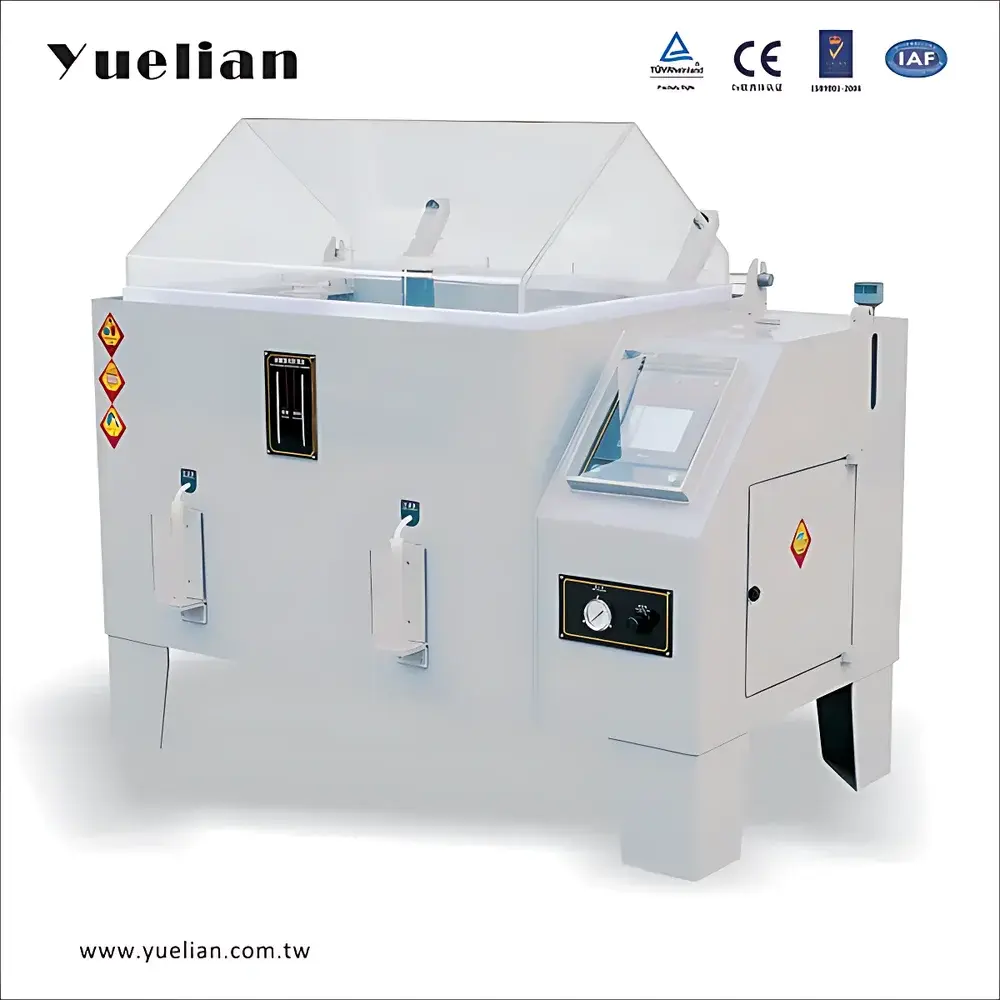
Yuelian SAS Series Salt Spray Test Chamber
| Brand | Yuelian |
|---|---|
| Model | SAS-108 / SAS-270 / SAS-480 / SAS-800 |
| Chamber Volume | 108 L / 270 L / 480 L / 800 L |
| Interior Dimensions (W×D×H, cm) | 60×40×45 |
| Test Temperature Range | Neutral Salt Spray (NSS): 35 ±1 °C |
| Acetic Acid Salt Spray (AASS) | 50 ±1 °C |
| Saturated Air Chamber Temperature | NSS: 47 ±1 °C |
| AASS | 63 ±1 °C |
| Salt Solution Temperature | 35 ±1 °C |
| Salt Spray Deposition Rate | 1.0–2.0 mL/80 cm²/h (±0.3 mL tolerance) |
| pH Range | NSS: 6.5–7.2 |
| AASS | 3.0–3.2 |
| Timer Range | 0–999.9 h with power-loss memory & buzzer alarm |
| Heating Control | PID-based, ±0.1 °C accuracy |
| Construction Material | Imported PVC board & PP lining |
| Nozzle Type | Precision borosilicate glass, rated for ≥4000 h operation without clogging |
| Spray Mode | Continuous or cyclic (user-selectable) |
| Safety Features | Dual overtemperature protection, low-water-level auto-detection & alarm, thermal cutoffs on all heaters, circuit breakers on all electrical circuits |
| Control Interface | Waterproof digital membrane keypad with real-time parameter display |
| Water Supply | Auto/manual fill system with level-sensing feedback |
Overview
The Yuelian SAS Series Salt Spray Test Chamber is an engineered environmental test system designed to evaluate the corrosion resistance of metallic substrates and protective surface treatments—including electroplated coatings, organic/inorganic conversion films, paint systems, chemical passivation layers, and rust-preventive oils—under standardized accelerated salt fog exposure conditions. Operating on the principles of controlled aerosol generation and thermally stabilized chamber environments, the SAS series complies with internationally recognized corrosion testing protocols such as ASTM B117 (Neutral Salt Spray), ISO 9227 (NSS, AASS, CASS), and JIS Z2371. The chamber generates a continuous, highly reproducible saline mist via Bernoulli-effect atomization, ensuring uniform deposition across test specimens placed on calibrated specimen racks. Its five-wall heating architecture, precision PID temperature regulation (±0.1 °C), and saturated air chamber governed by Henry’s law enable strict adherence to thermal and humidity boundary conditions required for inter-laboratory comparability and regulatory audit readiness.
Key Features
- Structural integrity ensured by imported high-purity PVC board construction with ring-band 3D reinforcement—resistant to warping, chemical degradation, and long-term thermal stress.
- Five-sided chamber wall heating system delivers exceptional thermal uniformity (±0.5 °C across working volume), critical for consistent corrosion kinetics across all specimen positions.
- Bernoulli-driven borosilicate glass nozzles produce fine, stable salt aerosols with deposition rate tightly controlled at 1.0–2.0 mL/80 cm²/h (±0.3 mL tolerance per ASTM B117 Annex A1).
- Saturated air chamber operates under Henry’s law equilibrium, maintaining precise relative humidity (>95% RH) and temperature (47 ±1 °C for NSS; 63 ±1 °C for AASS) to ensure stable fog nucleation and droplet size distribution.
- Digital membrane control panel with waterproof, anti-fog interface supports intuitive navigation, real-time monitoring of chamber temperature, saturation temperature, elapsed time, and fault diagnostics.
- Integrated dual overtemperature protection (electronic + mechanical), low-water-level auto-detection with audible alarm, and individual circuit breakers on all heater circuits ensure fail-safe operation and GLP-compliant safety documentation.
- Auto/manual water replenishment system maintains uninterrupted testing cycles—even during extended duration tests up to 999.9 hours—with power-loss memory retention and buzzer alert upon anomaly detection.
Sample Compatibility & Compliance
The SAS Series accommodates flat, cylindrical, or irregularly shaped specimens up to maximum dimensions of 160 × 50 × 100 cm (SAS-800 model), with standardized specimen rack configurations supporting ISO 1514 and ASTM G151 alignment requirements. All models are compatible with standard test coupons (e.g., ASTM G101 reference specimens), coated panels, fasteners, automotive components, and electronic enclosures. The system meets essential compliance benchmarks including ISO/IEC 17025 laboratory accreditation prerequisites, supports FDA 21 CFR Part 11–aligned audit trails when integrated with validated data logging software, and facilitates traceable calibration against NIST-traceable temperature and deposition rate standards. Routine verification per ASTM D609 and ISO 9227 Annex B ensures ongoing measurement validity for internal QA/QC and third-party certification submissions.
Software & Data Management
While the base SAS configuration features embedded microcontroller-based operation with local parameter storage, optional Ethernet-enabled data acquisition modules support continuous timestamped logging of chamber temperature, saturation temperature, runtime, and alarm events. Export formats include CSV and PDF reports compatible with LIMS integration and electronic lab notebook (ELN) platforms. When deployed in regulated environments (e.g., automotive Tier-1 suppliers, medical device manufacturers), the system can be qualified under IQ/OQ protocols to satisfy ISO 13485, IATF 16949, and GMP documentation requirements—including calibration records, preventive maintenance logs, and change control history. All firmware revisions are version-controlled and archived for full revision traceability.
Applications
- Quality assurance of zinc, nickel, chromium, and tin electroplating processes in automotive and aerospace component manufacturing.
- Validation of corrosion-inhibiting properties of volatile corrosion inhibitors (VCI) and petroleum-based rust preventives used in military logistics and industrial storage.
- Comparative evaluation of organic coating systems (epoxy, polyurethane, acrylic) per ASTM D1654 for marine and offshore infrastructure applications.
- Accelerated aging studies for printed circuit board (PCB) conformal coatings exposed to coastal or industrial atmospheric conditions.
- Supplier qualification testing per OEM specifications (e.g., Ford CETP, GMW14872, VW TL226) requiring repeatable NSS/AASS exposure sequences.
FAQ
What salt spray standards does the SAS Series support?
The SAS Series is configured to meet ASTM B117 (Neutral Salt Spray), ISO 9227 (NSS, AASS, CASS), JIS Z2371, and GB/T 2423.17—supporting both continuous and cyclic test profiles through programmable timer logic.
How is spray deposition rate verified and maintained?
Deposition is measured daily using calibrated funnels per ASTM B117 Annex A1. The Bernoulli nozzle design, combined with constant-temperature saturated air delivery and pressure-regulated brine supply, ensures long-term stability within ±0.3 mL/80 cm²/h.
Is the chamber suitable for testing painted steel substrates per automotive OEM requirements?
Yes—models SAS-480 and SAS-800 accommodate full-size automotive test panels (e.g., 100 × 150 mm or larger). Optional specimen rotation fixtures and humidity-controlled post-test drying stations are available for extended protocol compliance.
Can test data be exported for regulatory submission?
With the optional DAQ module, time-stamped temperature, runtime, and alarm logs export to CSV/PDF. When paired with 21 CFR Part 11–compliant software, full electronic signatures, audit trails, and user access controls are enabled.
What maintenance intervals are recommended for long-term reliability?
Daily visual inspection of nozzle integrity and brine tank level; weekly cleaning of PVC chamber walls with deionized water; quarterly calibration of temperature sensors and annual verification of PID controller response per ISO/IEC 17025 Clause 6.5.



