
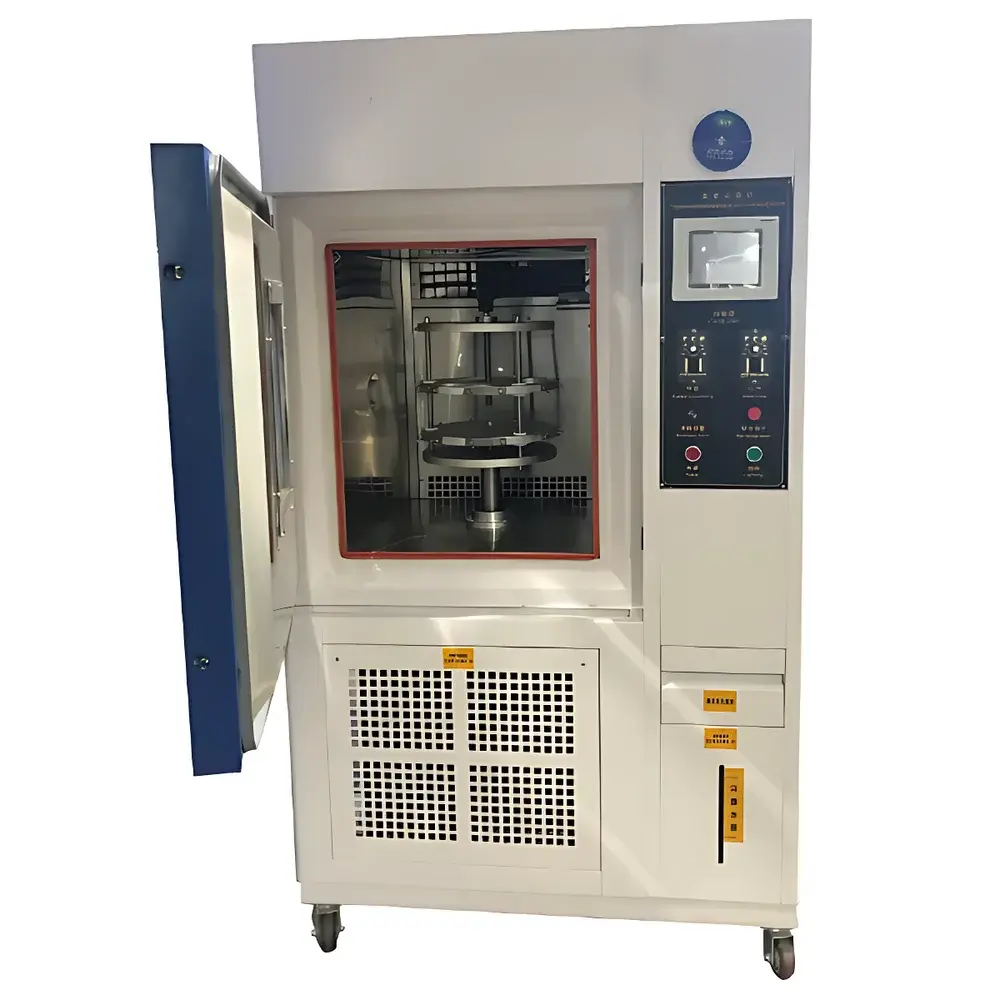
Yuelian PW-CYO-150 Ozone Aging Test Chamber
| Brand | Yuelian / PW |
|---|---|
| Origin | Guangdong, China |
| Model | PW-CYO-150 |
| Internal Dimensions (D×W×H) | 500×500×600 mm |
| Temperature Range | 0–70°C |
| Humidity Range | 40–98% RH |
| Temperature Uniformity | ≤±2°C |
| Temperature Stability | ≤±0.5°C |
| Temperature Deviation | ≤±1.5°C |
| Humidity Fluctuation | +2 / −3% RH |
| Heating Rate | 0.7–1.0°C/min |
| Cooling Rate | ≤20 min (from ambient to 10°C, non-restricted) |
| Ozone Concentration Range | 10–500 pphm or 500–1000 pphm (selectable) |
| Gas Flow Velocity | 12–16 mm/s |
| Sample Rack | Static or dynamic tensile rack (customer-specified at order) |
| Rack Rotation Speed | 1 rpm (360° continuous rotation) |
| Timer Range | 0–9999 hours |
| Power Supply | AC 380 V ±10%, 50 Hz, 3-phase 5-wire |
| Ozone Sensor | Imported UK CT electrochemical sensor |
| Ozone Measurement Accuracy | ≤±5% F.S. |
| Ozone Control Signal Output | 4–20 mA |
| Ozone Generator Type | Silent discharge tube (air-fed, wind-cooled) |
| Compliance Standards | GB/T 7762–2003 (static), GB/T 13642–1992 (dynamic) |
Overview
The Yuelian PW-CYO-150 Ozone Aging Test Chamber is an engineered environmental simulation system designed for accelerated evaluation of ozone-induced degradation in elastomeric and polymeric materials. It operates on the principle of controlled atmospheric exposure—precisely regulating temperature, relative humidity, and ozone concentration within a sealed test chamber to replicate long-term atmospheric aging under standardized laboratory conditions. Unlike general-purpose climate chambers, this instrument integrates a calibrated silent-discharge ozone generator, high-fidelity electrochemical sensing (UK CT sensor), and programmable sample motion systems to support both static and dynamic tensile testing per internationally referenced methodologies. Its architecture enables reproducible assessment of surface cracking, embrittlement, and cross-link density changes in rubber compounds, seals, gaskets, cables, and other non-metallic components exposed to tropospheric ozone—a critical failure mode in automotive, aerospace, and infrastructure applications.
Key Features
- Integrated silent-discharge ozone generator with air-fed operation and forced-air electrode cooling—ensuring compact footprint, low acoustic emission (<45 dB(A)), and stable ozone output across the full 10–1000 pphm range.
- High-accuracy ozone monitoring via imported UK CT electrochemical sensor (≤±5% F.S.), delivering linear 4–20 mA analog output for closed-loop concentration control.
- Dual-mode sample handling: configurable static tensile racks (fixed elongation, e.g., 20%) or dynamic tensile racks (0.5 ± 0.025 Hz cyclic stretch/recovery), both mounted on a continuously rotating 1 rpm sample carrier (20–25 mm/s peripheral speed).
- Robust thermal management system featuring French Tecumseh hermetic compressors (R404A/R23 refrigerant blend),斜率式 evaporator (slanted evaporator), and independent heating/cooling circuits for precise thermal trajectory control.
- Tempered multi-layer observation window with conductive ITO film for anti-fogging and EMI shielding; dual-lip high-elasticity silicone gasket ensuring >99.9% chamber integrity during ozone exposure.
- Full stainless-steel SUS304 interior (mirror finish) and A3 steel exterior with electrostatic epoxy coating; 100 mm thick high-density glass fiber insulation for thermal efficiency and structural stability.
Sample Compatibility & Compliance
The PW-CYO-150 accommodates standard ASTM D1149, ISO 1431-1, and GB/T 7762–2003 compliant specimens—including dumbbell-shaped, ring, or strip geometries up to 500 mm in length. Dynamic tensile fixtures meet GB/T 13642–1992 stroke and frequency tolerances (±0.025 Hz, 0–max elongation). Chamber design supports concurrent compliance with GLP documentation requirements: all critical parameters (temperature, humidity, ozone, time) are logged with timestamped audit trails. The system’s calibration traceability aligns with ISO/IEC 17025 practices, and its operational envelope satisfies pre-conditioning requirements for ISO 2230 and SAE J2236 validation protocols.
Software & Data Management
Control is executed via the imported Korean TEMI-880 microprocessor-based P.I.D. controller with SSR output modulation. The interface provides real-time graphical display of all process variables, user-defined ramp/soak profiles, and password-protected parameter locking. Ozone concentration is regulated through a dedicated PLC analog expansion module interfacing with the CT sensor and ozone generator’s 4–20 mA input. Data logging occurs at user-selectable intervals (1 s to 60 min) to internal flash memory (≥100,000 data points) and exports via USB to CSV format. Optional RS485 Modbus RTU integration enables SCADA-level supervision and 21 CFR Part 11-compliant electronic signatures when paired with validated third-party LIMS platforms.
Applications
This chamber is routinely deployed in R&D labs and QC departments for: evaluating ozone resistance of natural rubber (NR), styrene-butadiene rubber (SBR), ethylene propylene diene monomer (EPDM), and fluorocarbon elastomers (FKM); validating seal integrity in HVAC and EV battery enclosures; qualifying cable jacketing for outdoor telecom infrastructure; supporting ASTM D1149 Type A/B/C test matrices; and generating failure-time datasets for Arrhenius-based lifetime modeling. Its ability to sustain <65% RH at 40°C while maintaining ±5 pphm ozone tolerance makes it suitable for simulating subtropical service environments where humidity-mediated oxidative stress dominates.
FAQ
What ozone concentration ranges does the PW-CYO-150 support?
The chamber offers two selectable ranges: 10–500 pphm (standard) or 500–1000 pphm (high-concentration option), both calibrated against NIST-traceable ozone standards.
Is dynamic tensile testing hardware included by default?
No—dynamic tensile fixtures must be specified at time of order. Static racks are supplied as standard; dynamic configurations require additional mechanical and control integration.
Does the system comply with FDA 21 CFR Part 11 requirements?
The base controller does not include Part 11 features; however, optional firmware upgrade and external validation-ready LIMS integration enable full electronic record/electronic signature (ERES) compliance.
What maintenance intervals are recommended for the ozone sensor?
The UK CT electrochemical sensor requires annual recalibration using certified ozone gas standards and replacement every 24 months under continuous operation.
Can the chamber operate continuously at 70°C and 98% RH?
Yes—thermal and humidity control systems are rated for uninterrupted operation across the full specified envelope, verified per IEC 60068-3-6 thermal shock endurance criteria.



