
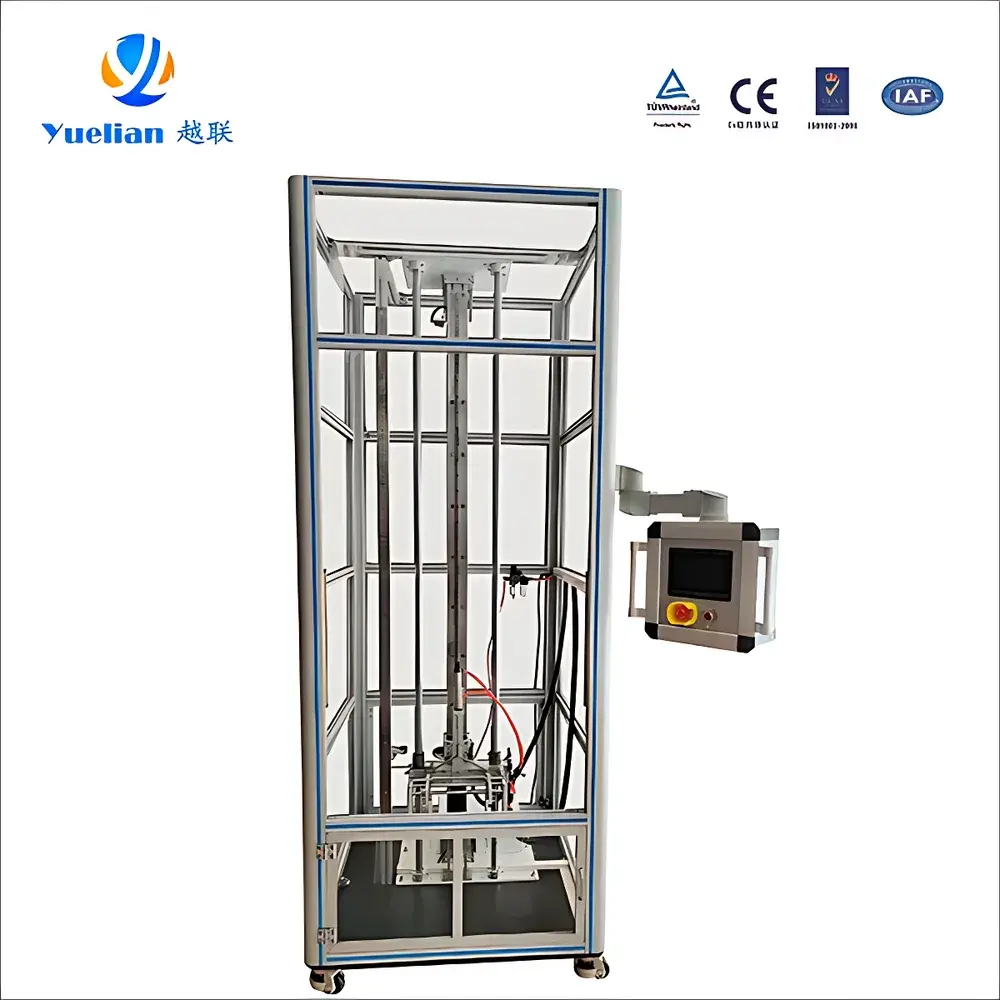
Yuelian PW-FSD-200B Directional Drop Tester
| Brand | Yuelian |
|---|---|
| Model | PW-FSD-200B |
| Origin | Guangdong, China |
| Drive System | Servo Motor + Timing Belt |
| Drop Height Range | 300–2000 mm (±0.5 mm positioning accuracy) |
| Sample Weight Limit | ≤5000 g |
| Sample Size Compatibility | 7–17 inch diagonal dimension |
| Drop Surfaces | 50 mm & 20 mm marble plates, 20 mm wooden board |
| Fixture Types | Vacuum suction cup fixture and mechanical clamp fixture |
| Drop Orientations | 6 faces, 8 corners, 12 edges of rectangular samples |
| Control Interface | Touchscreen + PLC |
| Safety Features | Interlocked safety door, fully enclosed frame, automatic stop on door opening |
| Air Supply Requirement | ≥0.6 MPa clean compressed air |
| Power Supply | AC 220 V ±10%, 50 Hz |
| Rated Power | 400 W |
| Dimensions (W×D×H) | ≈950 × 1200 × 2800 mm |
| Net Weight | 400 kg |
Overview
The Yuelian PW-FSD-200B Directional Drop Tester is an electromechanically controlled impact testing system engineered for precise, repeatable evaluation of mechanical robustness in portable electronic devices under controlled free-fall conditions. It operates on the principle of gravitational acceleration to simulate real-world accidental drops—specifically those occurring from handheld or lap-mounted positions—enabling quantitative assessment of structural integrity, housing deformation, screen cracking, and functional degradation post-impact. Unlike generic drop testers, the PW-FSD-200B integrates dual-column linear bearing guidance with servo-driven vertical positioning, ensuring high repeatability in height setting and minimal lateral deviation during release. Its design conforms to the operational intent of international drop-test standards—including IEC 60068-2-32 (Free Fall), ISO 20653:2013 (IP Code-related mechanical impact), and portions of MIL-STD-810H Method 516.8 (Shock)—while supporting customized test protocols required for internal quality assurance, R&D validation, and supplier qualification.
Key Features
- Dual-column linear bearing guidance system ensures vertical stability and minimizes angular deviation (<±0.3°) during sample release.
- Servo motor coupled with timing belt drive enables programmable height positioning across a 300–2000 mm range with ±0.5 mm repeatability—critical for correlating drop energy (E = m·g·h) with failure thresholds.
- Modular fixture system includes vacuum suction cups (for smooth, non-marking surface engagement) and mechanical clamps (for edge/corner anchoring), enabling standardized testing of all six faces, eight vertices, and twelve edges of rectangular consumer electronics per IEC 60068-2-32 Annex A.
- Integrated safety architecture features a fully enclosed steel frame, interlocked transparent polycarbonate safety door, and hardware-level emergency stop circuitry that halts motion immediately upon door actuation—compliant with ISO 13857 and EN 60204-1 requirements for operator protection.
- PLC-based control logic with 7-inch industrial touchscreen interface supports parameter configuration (drop height, cycle count, dwell time), real-time status monitoring, and local data logging without external PC dependency.
- Adjustable base plate assembly accommodates interchangeable impact surfaces: 50 mm and 20 mm thick granite slabs (for high-stiffness, low-damping response) and 20 mm hardwood board (for moderate energy absorption), allowing correlation with varying floor-type scenarios defined in ASTM D5276.
Sample Compatibility & Compliance
The PW-FSD-200B is validated for testing consumer electronics with diagonal dimensions from 7 inches (e.g., smartphones, e-readers) up to 17 inches (e.g., full-size laptops, detachable tablets), provided mass remains within the 5000 g limit. Fixture geometry and vacuum pressure are calibrated to prevent slippage or torsional misalignment during release—essential for maintaining orientation fidelity in corner/edge drop tests. The system supports test documentation traceability aligned with GLP principles: all executed test parameters (height, count, fixture type, surface material) are timestamped and stored locally. While not certified to UL or CE as a standalone medical device tester, its mechanical and electrical architecture meets IEC 61000-6-2 (immunity) and IEC 61000-6-4 (emission) limits for industrial environments. Optional calibration certificates (traceable to NIM or CNAS-accredited labs) may be supplied upon request for metrological validation.
Software & Data Management
The embedded HMI firmware provides intuitive test setup via touchscreen navigation, with password-protected administrator mode for parameter lockout and audit trail configuration. All test records—including date/time stamp, set height, actual measured height (via integrated linear encoder feedback), cycle number, and pass/fail status per drop—are saved in CSV format to internal flash memory (≥10,000-cycle capacity). Export is supported via USB 2.0 port; no proprietary software installation is required for data retrieval. For integration into enterprise QA systems, optional Modbus TCP or RS-485 serial output enables direct communication with MES or LIMS platforms. Audit trails comply with basic ALCOA+ principles (Attributable, Legible, Contemporaneous, Original, Accurate), though full 21 CFR Part 11 compliance requires supplementary server-side electronic signature and user access control layers—not embedded in standard firmware.
Applications
- Pre-production durability screening of smartphone housings, OLED display modules, and battery enclosures.
- Comparative analysis of protective case efficacy under identical drop vectors and energies.
- Root-cause investigation of hinge fatigue or keyboard detachment in convertible laptops after repeated corner drops.
- Validation of adhesive bond strength between glass cover and mid-frame in tablet assemblies.
- Supplier qualification testing per OEM-specified drop profiles (e.g., “3 drops per face onto granite at 1000 mm”).
- Supporting accelerated life testing sequences where drop events are interleaved with thermal cycling or vibration exposure.
FAQ
What drop orientations does the PW-FSD-200B support for rectangular devices?
It supports standardized testing of all six faces (flat surfaces), eight vertices (corners), and twelve edges (linear intersections), per IEC 60068-2-32 definitions.
Is calibration service available with traceability to national standards?
Yes—optional factory calibration with certificate traceable to China’s National Institute of Metrology (NIM) or CNAS-accredited third-party labs can be arranged.
Can the system operate without compressed air?
No—the vacuum suction fixture requires ≥0.6 MPa clean, oil-free compressed air; mechanical clamp operation is independent but suction mode is essential for face-drop configurations.
Does the device meet CE or UL safety certification requirements?
The unit complies with core mechanical and electrical safety directives (EN 60204-1, ISO 13857) but is not CE-marked or UL-listed as a complete system; end-user responsibility includes site-specific risk assessment and integration into certified production lines.
How is height accuracy verified during routine operation?
Linear encoder feedback is continuously monitored by the PLC; users may perform periodic verification using certified gauge blocks or laser distance meters against the reference scale mounted on the column.



