
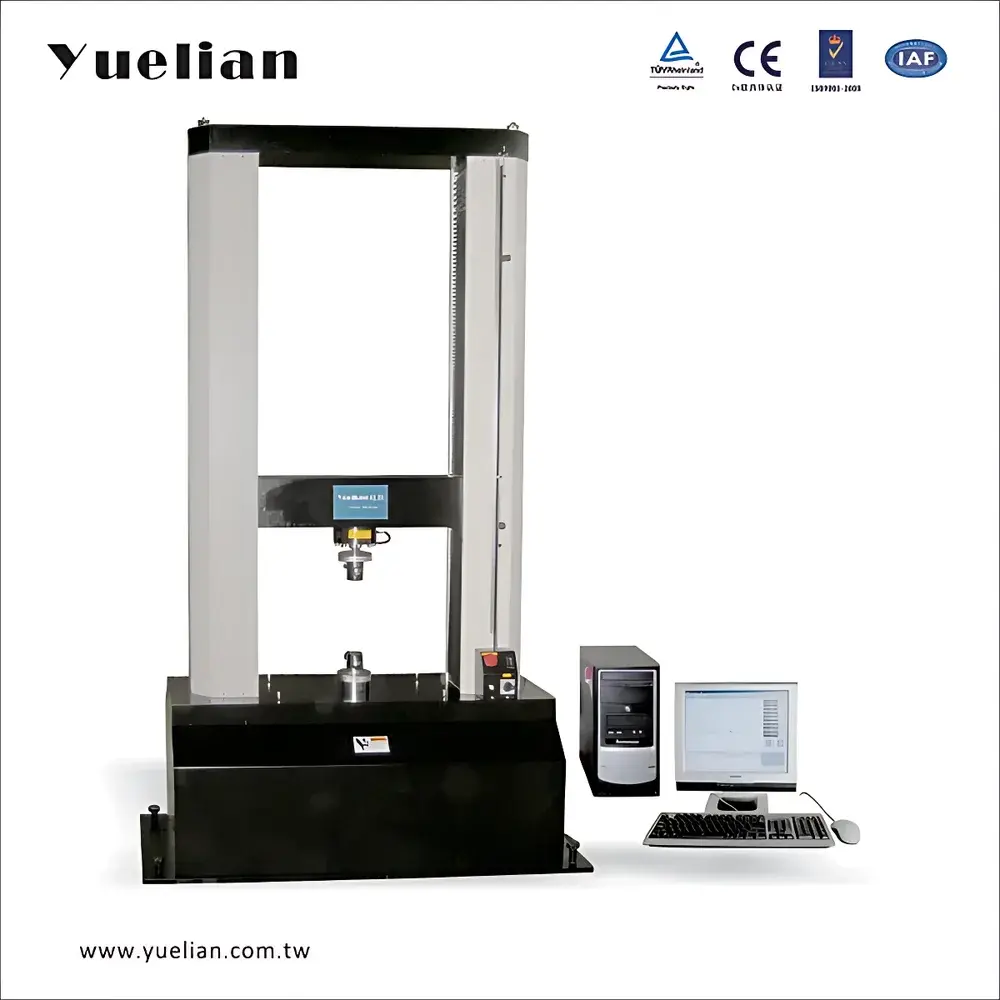
YL-1152 Yuelian Universal Testing Machine for Shear Strength Testing of Low-Carbon Steel
| Brand | Yuelian |
|---|---|
| Model | YL-1152 |
| Type | Electromechanical Universal Testing Machine |
| Capacity Options | 1 kN, 2 kN, 5 kN, 10 kN, 20 kN, 50 kN, 100 kN (dual-range configuration available) |
| Force Resolution | 1/250,000 full scale |
| Force Accuracy | ≤ ±0.5% FS |
| Travel Resolution | 0.005 mm |
| Crosshead Speed Range | 0.5–500 mm/min (PC-controlled) |
| Maximum Test Stroke | 1000 mm |
| Test Width | 550 mm |
| Drive System | Servo motor with precision ball screw and timing belt transmission |
| Power Supply | 220 V, 50/60 Hz, 10 A |
| Rated Power | 1800 W |
| Dimensions (W×D×H) | 92 × 75 × 199 cm |
| Weight | ~800 kg |
| Compliant Standards | ISO 7500-1, ASTM E4, EN 10002-1, EN 10002-2, DIN 51221, JIS B7721/B7733, GB/T 228.1, JJG 475 |
Overview
The YL-1152 Yuelian Universal Testing Machine is an electromechanical force-testing platform engineered for high-reproducibility mechanical characterization of metallic and non-metallic materials under uniaxial loading conditions. While frequently deployed for tensile, compressive, flexural, peel, and tear testing across polymers, composites, textiles, and thin-film substrates, its modular load frame and calibrated shear fixture configurations enable standardized shear strength evaluation of low-carbon steel specimens per ASTM E229, ISO 3507, and GB/T 228.1 Annex D (shear test method). The system operates on a closed-loop servo-controlled architecture, where displacement and load are simultaneously acquired via high-stability load cells and linear encoders, ensuring traceable force measurement within ±0.5% of full scale — validated per ISO 7500-1 Class 1 certification requirements. Its rigid C-frame construction, precision-ground ball screw actuation, and low-backlash timing belt drive collectively minimize parasitic deflection and dynamic compliance, supporting reliable determination of yield shear stress, ultimate shear strength, and shear modulus in ductile ferrous alloys.
Key Features
- Electromechanical actuation with brushless AC servo motor and preloaded precision ball screw, delivering stable velocity control from 0.5 to 500 mm/min with <0.1% speed deviation under load
- Multi-range load cell support (1–100 kN), including optional dual-capacity configuration for enhanced resolution at low-force regimes without manual sensor swapping
- Real-time data acquisition at up to 1 kHz sampling rate, synchronized with position and extensometer inputs (where installed)
- Full PC-based control interface compatible with Windows OS, supporting automated test sequencing, parameter scripting, and multi-step ramp-hold cycles
- Integrated safety logic: overload cutoff, emergency stop circuit (EN 60204-1 compliant), specimen rupture detection via load drop threshold, programmable upper/lower travel limits, and automatic crosshead return
- Modular fixture mounting system accommodating ASTM-standard shear fixtures (e.g., punch-and-die assemblies per E229), wedge grips, compression platens, and custom adapters
Sample Compatibility & Compliance
The YL-1152 accommodates flat-sheet, round-bar, and notched coupon geometries typical for low-carbon steel shear evaluation (e.g., ASTM E229 Type I or II specimens, ISO 3507 double-shear coupons). Fixture alignment tolerances meet ISO 7500-1 requirements for axial load train eccentricity (<0.2% of force capacity). The system supports calibration traceability to national standards (e.g., NIM China, NIST SRM reference loads) and is routinely used in laboratories operating under ISO/IEC 17025 quality management systems. Test reports generated include metadata required for GLP-compliant documentation: operator ID, environmental conditions (optional external sensor integration), calibration certificate IDs, and audit trail timestamps.
Software & Data Management
The proprietary test control software provides ISO 17025-aligned data handling: all raw channel data (load, displacement, time) are stored in binary format with embedded metadata headers. Calculated results — including maximum shear force, shear stress at yield/rupture, % elongation in shear, and secant shear modulus — are exported to CSV, PDF, or MS Access databases. The software implements role-based user accounts, electronic signatures, and configurable audit trails meeting FDA 21 CFR Part 11 criteria for regulated environments. Graphical overlays support comparative analysis of multiple curves; derivative functions (e.g., dF/dx for stiffness estimation) and statistical batch reporting (mean, SD, CV%) are natively supported.
Applications
- Determination of shear yield strength and ultimate shear strength of Q235, SPCC, and similar low-carbon steels per ASTM E229 and GB/T 228.1 Annex D
- Interfacial shear strength assessment of metal-clad laminates and brazed joints
- Validation of cold-forming process parameters (e.g., blanking, piercing) through controlled shear deformation
- Quality conformance testing of incoming raw material batches against supplier specifications
- Research-grade mechanical property mapping for alloy development and heat treatment optimization
- Support for fatigue shear pre-characterization prior to torsional or mixed-mode loading studies
FAQ
Does the YL-1152 comply with ISO 7500-1 Class 1 accuracy requirements?
Yes — factory calibration and annual verification are performed using certified reference standards traceable to national metrology institutes; full uncertainty budgets are provided upon request.
Can shear test fixtures for ASTM E229 be supplied as standard equipment?
A basic single-shear die set is included; double-shear and punch-and-die configurations compliant with ASTM E229 Fig. 1 are available as optional accessories with documented alignment verification reports.
Is the software validated for use in GMP-regulated environments?
The software includes 21 CFR Part 11 readiness features (audit trail, e-signature, user access controls); site-specific validation protocols and IQ/OQ documentation templates are provided to support client-led PQ execution.
What is the maximum specimen thickness supported in shear mode?
With standard fixtures, the usable shear gap accommodates specimens up to 12 mm thick; custom tooling can extend this to 25 mm based on load capacity and fixture design constraints.
How is thermal drift compensated during long-duration shear hold tests?
The load cell electronics incorporate real-time temperature compensation algorithms; for extended creep-shear protocols (>30 min), optional environmental chamber integration is recommended to stabilize ambient conditions.



