
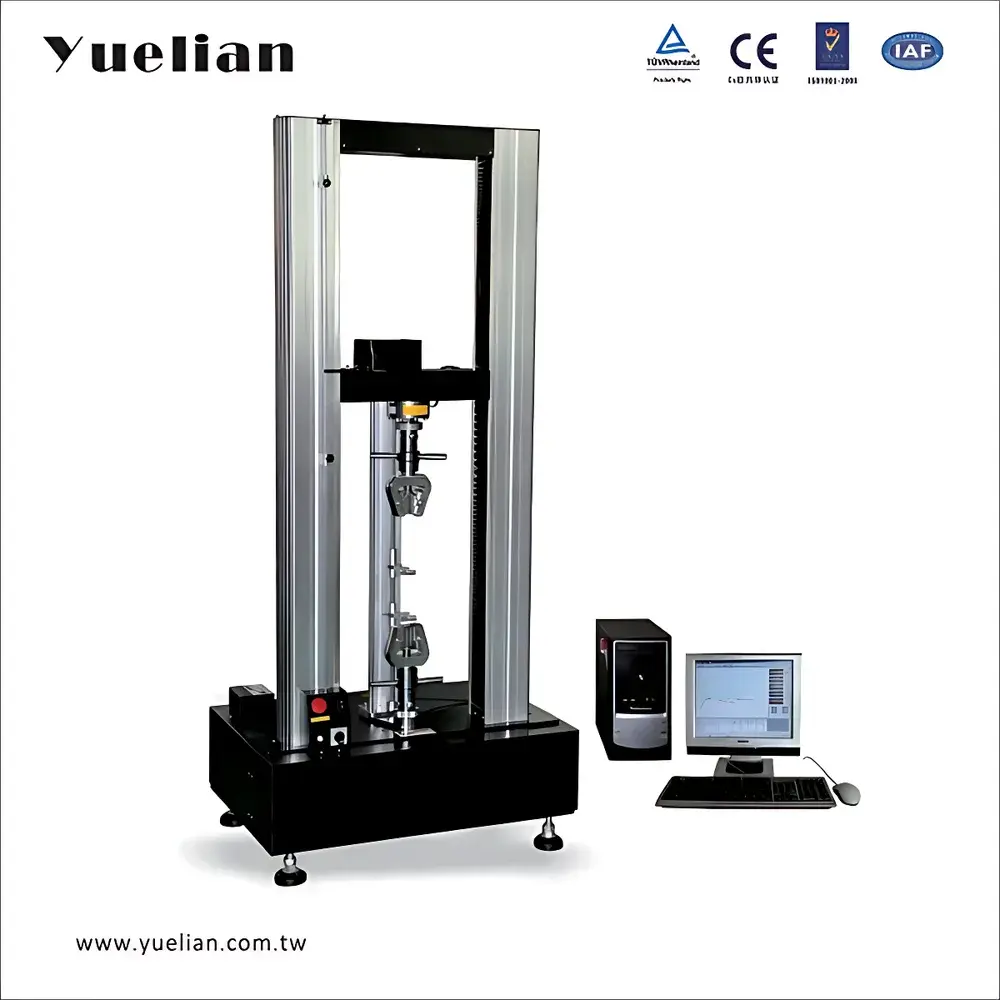
YL-1125 Honeycomb Aluminum Panel Drum Peel Tester
| Brand | Yuelian |
|---|---|
| Origin | Guangdong, China |
| Model | YL-1125 |
| Instrument Type | Electromechanical Universal Testing Machine |
| Capacity Options | 10 N – 50 kN (dual-range configurable) |
| Force Resolution | 1/500,000 full scale |
| Force Accuracy | ±0.3% of reading |
| Crosshead Travel | 1200 mm |
| Test Width | 420 mm |
| Speed Range | 0.01 – 1000 mm/min (programmable) |
| Displacement Resolution | 1/500,000 full stroke |
| Control Interface | PC-based closed-loop system with USB communication |
| Compliance Standards | ISO 7500-1, ASTM E4, GB/T 228.1, GB/T 2792, ASTM D3330, GB/T 15598, ISO 8510-2, EN 14410, JIS K6854-2 |
| Power Supply | 220 V, 50/60 Hz, 10 A |
| Motor | AC servo motor with precision ball screw and timing belt drive |
| Dimensions (W×D×H) | 920 × 620 × 1990 mm |
| Weight | 422 kg |
Overview
The YL-1125 Honeycomb Aluminum Panel Drum Peel Tester is a specialized electromechanical universal testing machine engineered for high-precision peel adhesion evaluation of sandwich-structured composite materials—particularly aluminum honeycomb core panels bonded to face sheets via adhesive films, foams, or thermoplastic interlayers. Unlike general-purpose tensile testers, this system implements the drum peel geometry per ISO 8510-2 and EN 14410, where the specimen is wrapped around a fixed-diameter drum (typically 100 mm or 150 mm) while the free end is pulled at a controlled angle (usually 90° or 180°) to induce progressive interfacial debonding. This configuration replicates real-world delamination stresses encountered in aerospace radomes, transport interior panels, and architectural cladding systems. The instrument integrates a rigid C-frame architecture, high-resolution load cell feedback (0.3% accuracy), and sub-micron displacement tracking to ensure repeatability across batch qualification, R&D screening, and supplier audit protocols.
Key Features
- Drum peel fixture assembly compliant with ISO 8510-2 Annex A and EN 14410 Clause 6.3, including precision-machined anodized aluminum drum (Ø100 mm standard, optional Ø150 mm), adjustable peel arm, and low-friction roller guide
- Dual-range force transducer support: selectable capacities from 10 N to 50 kN, enabling seamless transition between thin-film adhesive validation (e.g., acrylic transfer tapes) and structural bonding assessment (e.g., epoxy-bonded Al-honeycomb)
- Closed-loop servo control with 0.01 mm/min minimum speed resolution and <±0.2% speed stability over full range, critical for capturing rate-dependent peel resistance in viscoelastic adhesives
- PC-based test controller with real-time force–displacement curve acquisition, automatic peak detection, and post-test calculation of average peel force, maximum peel force, and energy-to-peel (J/m) per ASTM D903 methodology
- Rigid frame design (422 kg mass, 920 × 620 × 1990 mm footprint) minimizes dynamic deflection during high-load peel events, ensuring measurement integrity up to 50 kN
- Comprehensive safety architecture: dual-channel overload cutoff, hardware emergency stop, specimen rupture auto-stop, and programmable upper/lower travel limits
Sample Compatibility & Compliance
The YL-1125 accommodates standard peel specimens per ISO 8510-2 (25 mm wide × ≥200 mm long) and custom widths up to 420 mm. It supports metallic face sheets (Al 5052, Al 2024-T3), fiber-reinforced polymer skins, prepreg laminates, and polymeric core materials (Nomex®, aluminum honeycomb, polymer foam). Fixture adaptability enables evaluation of both single-face and double-face bonded configurations. The system meets mechanical verification requirements of ISO 7500-1 Class 1, ASTM E4 calibration traceability, and metrological compliance for GLP/GMP-regulated environments. Data acquisition satisfies FDA 21 CFR Part 11 audit trail requirements when paired with validated software version and user access controls.
Software & Data Management
The proprietary test software operates under Windows OS and provides ISO/ASTM-compliant test method templates—including preconfigured setups for ISO 8510-2 drum peel, ASTM D3330 loop tack, GB/T 2792 180° peel, and ASTM D903 cloth peel. All raw data are stored in encrypted MS Access database files with timestamped operator ID, environmental conditions (optional humidity/temperature input), and full metadata tagging. Curve overlay, statistical batch reporting (mean ± SD, CV%), and export to CSV/PDF/Excel formats are supported. Audit logs record all parameter modifications, test starts/stops, and calibration events—enabling full traceability for internal QA reviews or external regulatory inspections.
Applications
- Quantitative peel strength validation of aluminum honeycomb core panels used in aircraft secondary structures (e.g., cargo liners, ceiling panels)
- Adhesive bondline integrity assessment for fire-rated architectural wall systems incorporating mineral wool or phenolic cores
- Comparative screening of structural film adhesives (e.g., FM73, AF163-2K) under varying cure cycles and surface preparation protocols
- Quality conformance testing per OEM specifications (Boeing BAC 5400, Airbus AITM 1-0002, GE Aviation PSS-1000)
- Research into peel fracture mechanics of hybrid joints combining adhesive bonding and mechanical fastening
- Failure mode analysis via synchronized video recording (optional accessory) correlated with force–displacement discontinuities
FAQ
What peel angles does the YL-1125 support?
The system is configured for standardized 90° and 180° drum peel geometries per ISO 8510-2; angular adjustment requires optional fixture reconfiguration.
Can it test non-metallic honeycomb cores such as Nomex® or polymer foam?
Yes—the drum peel method is material-agnostic; specimen mounting fixtures accommodate compressible and brittle core types with appropriate backing support.
Is the software compliant with FDA 21 CFR Part 11?
Full Part 11 compliance (electronic signatures, audit trails, role-based access) is enabled upon installation of the validated software package and documented system qualification.
Does the system include calibration certification?
A factory-issued ISO/IEC 17025-accredited calibration certificate (traceable to NIM China) is supplied with each unit; annual recalibration is recommended.
What maintenance is required for long-term accuracy?
Biannual verification of load cell linearity and crosshead alignment, plus periodic lubrication of ball screw and timing belt—full procedures detailed in the technical manual.



