
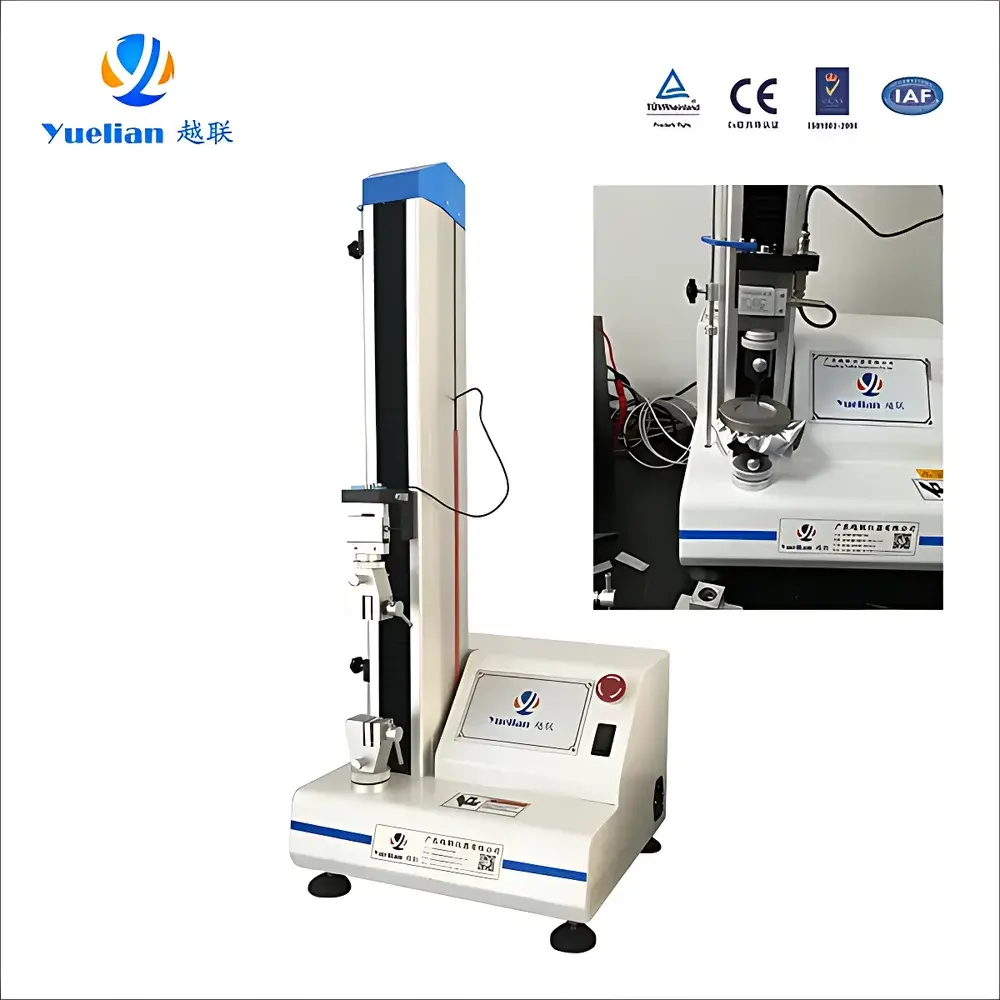
Yuelian YL-S90 Aluminum-Plastic Foil Puncture Tester
| Brand | Yuelian |
|---|---|
| Origin | Guangdong, China |
| Model | YL-S90 |
| Instrument Type | Electromechanical Tensile Testing Machine |
| Maximum Test Load | 1 kN |
| Load Range | 10 N – 1 kN |
| Load Accuracy | ≤ ±0.5% FS |
| Travel Distance | 500 mm |
| Displacement Resolution | 1/500,000 mm |
| Drive System | Stepper Motor + Precision Ball Screw |
| Control Interface | PC-based via USB/RS-232 |
| Standard Fixture | 1 set |
| Power Supply | 220 V, 50/60 Hz, 10 A |
| Dimensions (W×D×H) | 400 × 300 × 700 mm |
| Weight | ~28 kg |
Overview
The Yuelian YL-S90 Aluminum-Plastic Foil Puncture Tester is a dedicated electromechanical testing system engineered for precise quantification of puncture resistance in flexible barrier packaging materials—particularly aluminum-plastic laminates widely used in pharmaceutical blister packaging, medical device pouches, and high-barrier food packaging. It operates on the principle of controlled axial penetration: a standardized stainless-steel probe (typically Ø1.0 mm or Ø1.5 mm per ASTM F1306 and ISO 14662) is driven at a defined crosshead speed into a clamped specimen under uniaxial load, while real-time force and displacement data are acquired with high-fidelity resolution. The instrument complies with core regulatory test methodologies including USP for container closure integrity, ASTM F2475 (Standard Test Method for Puncture Resistance of Plastic Film and Thin Sheeting), and ISO 14662 (Plastics — Determination of Puncture Resistance). Its rigid frame, low-inertia stepper motor actuation, and precision-ground ball screw transmission ensure minimal mechanical hysteresis and high reproducibility across repeated puncture cycles—critical for QC labs operating under GLP or GMP environments.
Key Features
- Multi-functional test capability: configurable for puncture, tensile, peel, tear, and compression modes via interchangeable fixtures and software-defined test profiles.
- High-resolution load measurement: 1/500,000 internal resolution with ≤ ±0.5% full-scale accuracy—validated per ISO 7500-1 Class 1 requirements.
- Precise displacement control: 500 mm travel range with sub-micron effective resolution enabled by encoder-coupled stepper drive and digital position feedback.
- Full PC-based operation: intuitive Windows-compatible software with USB/RS-232 interface; supports automated test sequencing, real-time curve overlay, and batch reporting.
- Comprehensive safety architecture: dual-limit hardware stops, overload cutoff, emergency stop button, specimen rupture auto-stop, and programmable upper/lower travel bounds.
- Modular fixture system: quick-release couplers compatible with ASTM-standard puncture probes, pneumatic grips, peel jigs, and custom adapters for irregular substrates.
Sample Compatibility & Compliance
The YL-S90 accommodates specimens up to 55 mm wide and 500 mm in effective gauge length, supporting standard aluminum-plastic foils (e.g., 80–250 µm total thickness), cold-forming blisters, peel-open pouches, synthetic rubber stoppers, and laminated medical packaging films. All puncture tests adhere to internationally recognized protocols: ASTM F1306 (for film toughness), ISO 14662 (puncture energy), and JP 17 Annex 5 (container closure integrity assessment). Data audit trails—including operator ID, timestamp, calibration certificate reference, and raw sensor logs—are exportable in CSV and PDF formats to support FDA 21 CFR Part 11 compliance when deployed with validated electronic signatures and access controls.
Software & Data Management
The embedded test control software provides ISO/IEC 17025-aligned data handling: automatic calculation of peak puncture force (N), energy-to-puncture (mJ), deformation at peak load (mm), and post-yield displacement. Raw force-displacement curves are stored in MS Access relational databases with metadata tagging (batch ID, material lot, environmental conditions). Graphical analysis tools include derivative slope computation (to identify yield onset), curve smoothing (Savitzky-Golay filter), and comparative overlay of up to eight test records. Export options include Excel-compatible .csv, vector-based .emf plots, and printable PDF reports containing statistical summaries (mean, SD, CV%) per test group. Software safeguards include password-protected method editing, version-controlled firmware updates, and built-in calibration verification routines traceable to NIST-certified load cells.
Applications
This system serves as a primary qualification tool in pharmaceutical packaging development labs evaluating seal integrity of push-through blisters, assessing needle-penetration resistance of vial stoppers, and validating child-resistant foil lidding performance. In quality control settings, it supports routine release testing per pharmacopoeial monographs (USP , Ph. Eur. 3.2.9), supplier audits, and stability study protocols where puncture resistance degradation over accelerated aging must be quantified. Beyond pharma, it is employed in food packaging R&D for evaluating tamper-evident seals, in medical device manufacturing for pouch seal validation (ISO 11607-2), and in academic polymer research for structure-property correlation studies of multilayer laminates under localized stress.
FAQ
What probe diameter is recommended for aluminum-plastic foil puncture testing per ASTM F1306?
A 1.0 mm or 1.5 mm cylindrical stainless-steel probe is specified—selection depends on foil thickness and application-specific failure mode criteria.
Can the YL-S90 perform simultaneous multi-point puncture tests?
No—the system is configured for single-axis, single-probe penetration; multi-point evaluation requires sequential manual repositioning or optional custom multi-probe fixtures.
Is the software compliant with FDA 21 CFR Part 11 for electronic records?
Yes—when deployed with user role management, audit trail logging, and electronic signature modules activated, it meets baseline Part 11 requirements for closed systems.
What calibration standards are supported for traceability?
The system accepts external verification using Class M1 or better deadweight standards per ISO/IEC 17025-accredited laboratories; factory calibration certificates include uncertainty budgets.
Does the instrument support temperature-controlled testing environments?
Not natively—the base configuration operates at ambient lab conditions (20–25°C, 40–60% RH); environmental chambers may be integrated externally with custom mounting interfaces.



