
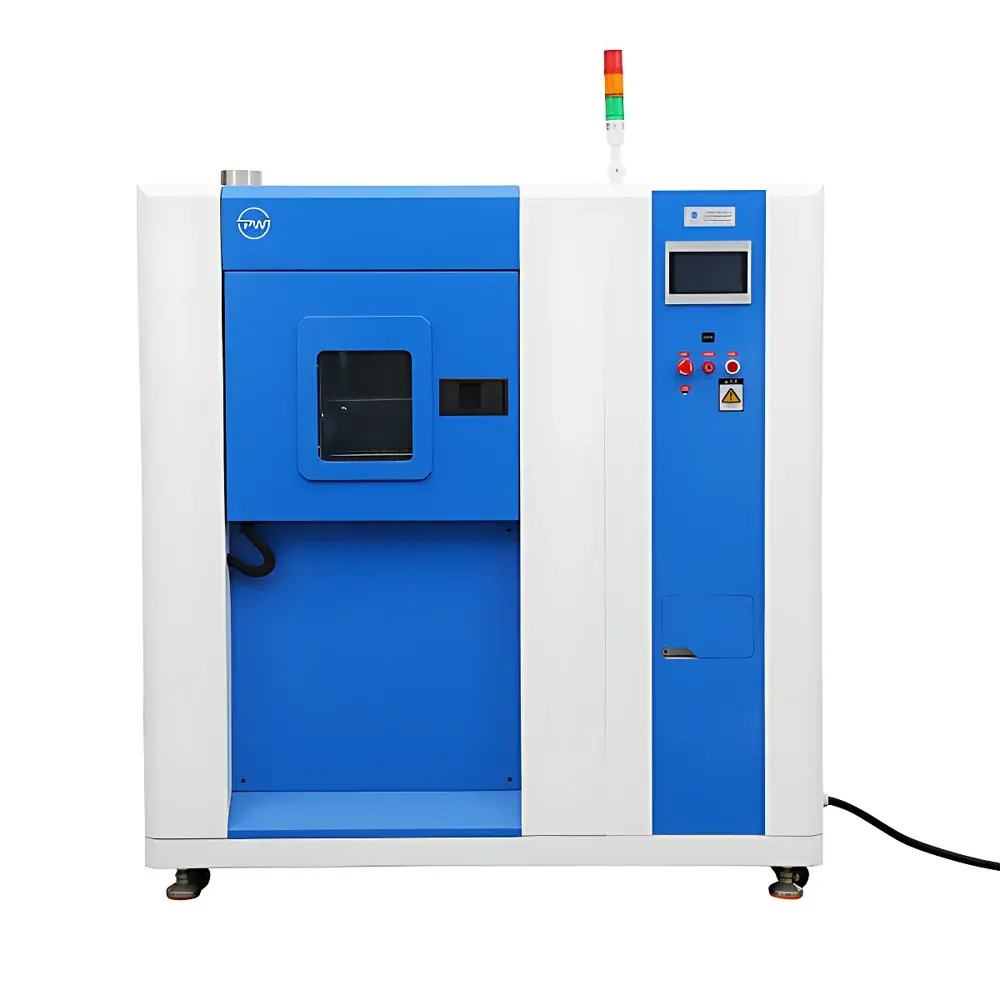
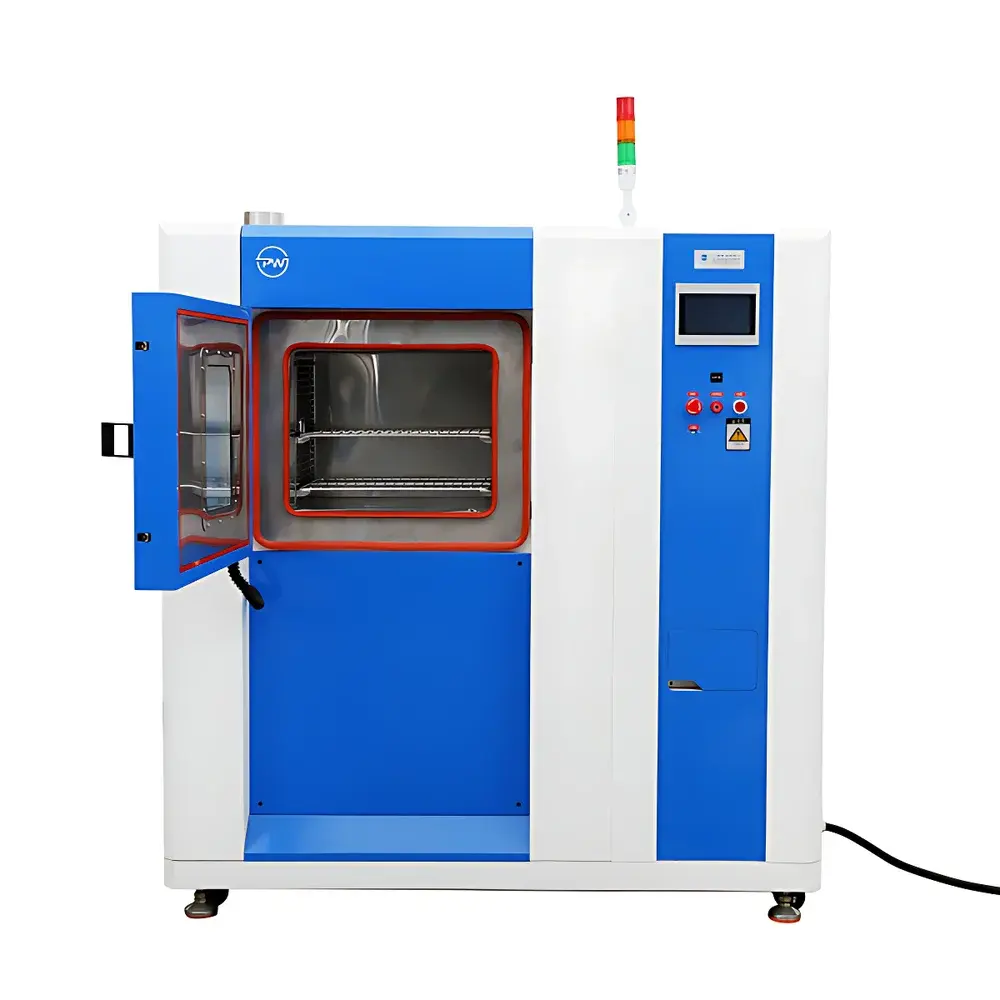
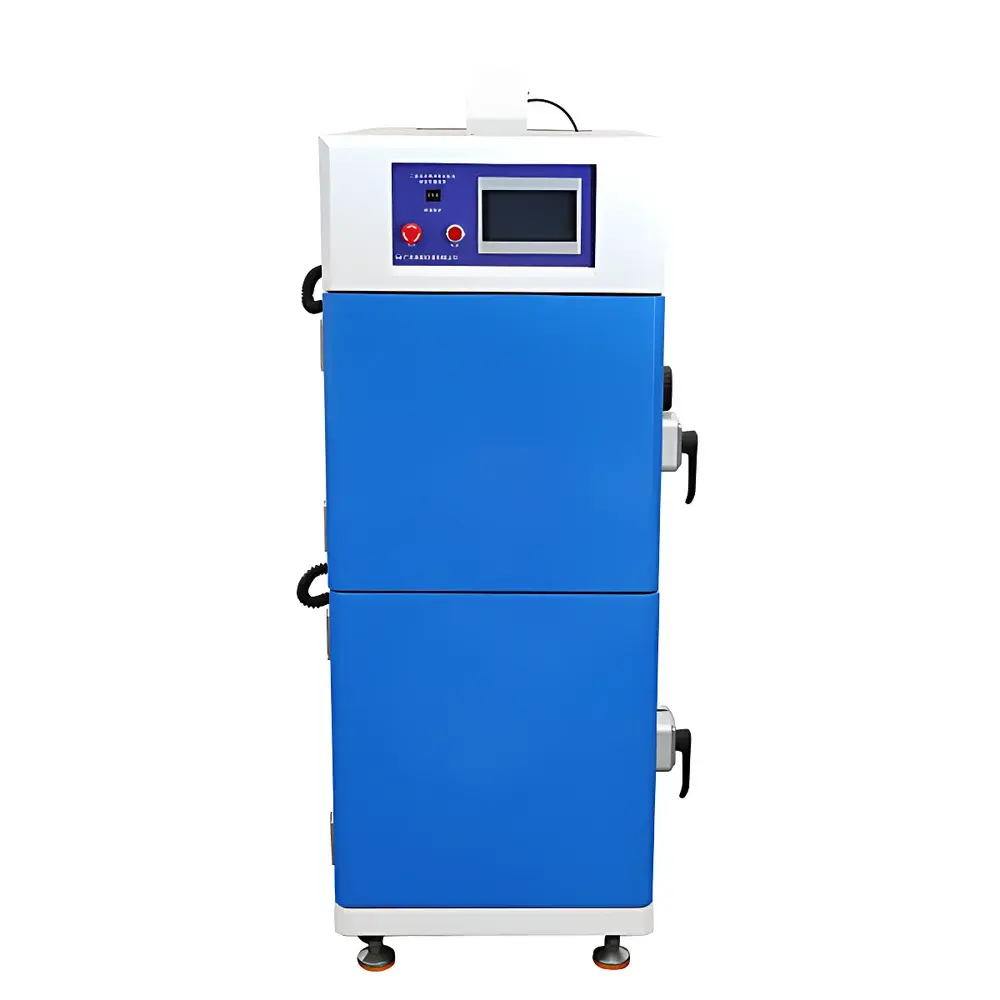
Yuelian PW-CTS3-100 Three-Zone Air-Cooled Thermal Shock Test Chamber
| Brand | Yuelian / PW |
|---|---|
| Origin | Guangdong, China |
| Manufacturer Type | Domestic OEM |
| Product Category | Domestic |
| Model | PW-CTS3-100 |
| Price Range | USD 420 – 28,000 |
| High-Temperature Range | +150 °C |
| Low-Temperature Range | −55 °C |
| Thermal Shock Range | −55 °C to +150 °C |
| Temperature Stability | ±0.5 °C |
| Heating Rate | ≥3 °C/min (non-linear, empty load) |
| Cooling Rate | ≥2 °C/min (non-linear, empty load) |
| High-Low Temperature Transfer Time | ≤10 s |
| Recovery Time | 3–5 min (non-linear, empty load) |
| Temperature Uniformity | ≤2.0 °C |
| Temperature Fluctuation | ≤±0.5 °C |
| Control Accuracy | ±0.2 °C (setpoint vs. measured) |
| Noise Level | ≤70 dB(A) |
| Internal Chamber Dimensions | W500 × H400 × D400 mm |
| Nominal Volume | 80 L |
| Gross Dimensions | W1650 × H1720 × D1680 mm |
| Weight | 800 kg |
| Power Supply | 3-phase 380 V ±10%, 50 Hz, 23 kW max |
| Safety Compliance | GB/T 2423.1–2008, GB/T 2423.2–2008, GB/T 2423.22–1987, GJB 150.3–2001, GJB 150.5–1986, GJB 360.7–1987, GJB 367.2–1987 |
| Refrigerant | R404A/R23 (ODP = 0) |
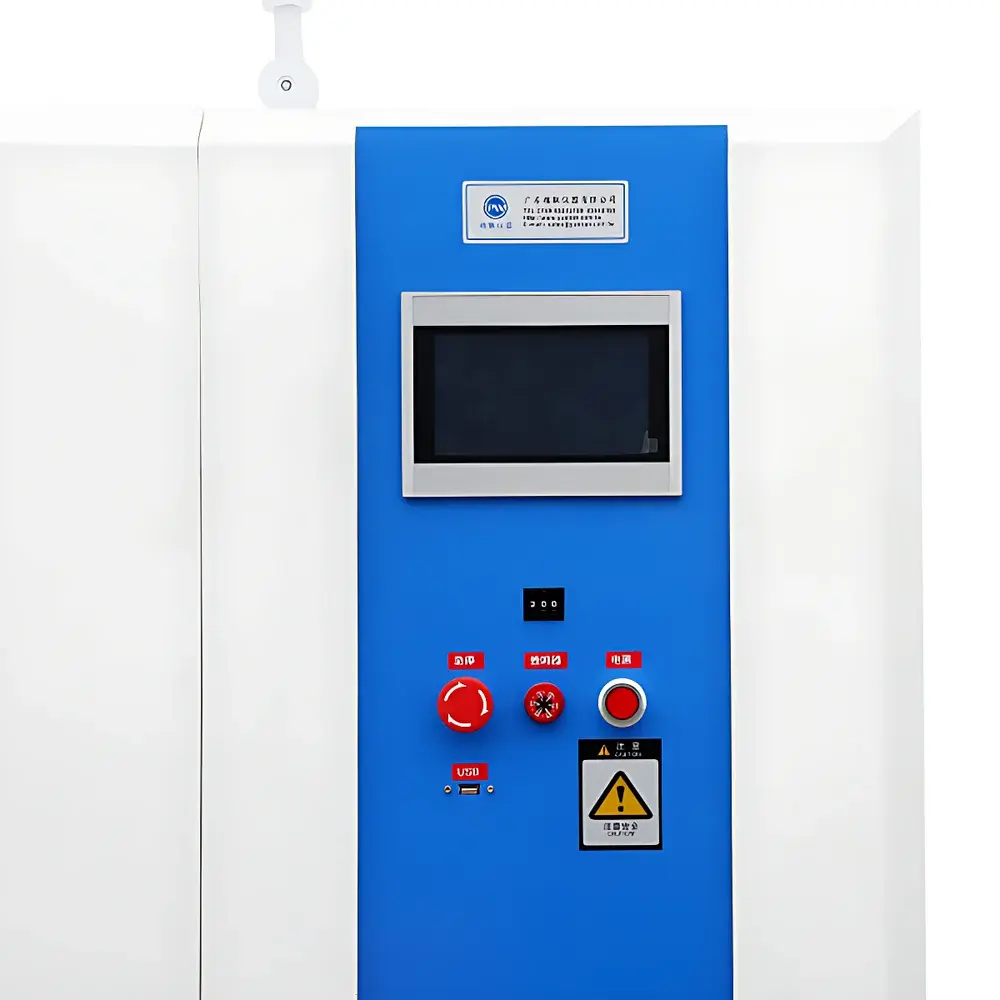
| Control System | TFT color LCD touchscreen, PID + BTC balanced temperature control, DCC intelligent cold-capacity modulation, DEC intelligent electrical regulation, 120 programmable profiles, infinite cycling, data logging (180 days @ 60 s interval), RS-232 & USB interface, alarm history with fault code diagnostics |
Overview
The Yuelian PW-CTS3-100 is a three-zone, air-cooled thermal shock test chamber engineered for high-reproducibility evaluation of material and component resilience under rapid, extreme temperature transitions. Unlike two-zone designs, its dedicated preheat, precool, and test zones enable true zero-dwell thermal shock cycles — eliminating ambient interference and supporting standardized low-temperature impact testing per MIL-STD-810G Method 503.5, IEC 60068-2-14, and ASTM D573. The system employs dual-stage cascade refrigeration (R404A/R23), precision T-type thermocouples (Omega-specified, −100 °C to +200 °C), and a PID-driven BTC (Balanced Temperature Control) algorithm that dynamically modulates heating, cooling, and airflow to maintain thermal equilibrium without auxiliary heater compensation — reducing energy consumption by up to 35% versus conventional chambers. Its structural architecture complies with ISO/IEC 17025 traceability requirements for calibration-critical environments and supports GLP/GMP-aligned validation protocols.
Key Features
- Three-zone configuration (preheat / precool / test) enabling true thermal shock without ambient contamination or dwell-time artifacts
- Dual-stage cascade refrigeration system with R404A (high-stage) and R23 (low-stage), both zero-ozone-depletion refrigerants compliant with Montreal Protocol Annex A Group II
- PID + BTC + DCC + DEC multi-layer control architecture for dynamic thermal load compensation and stable setpoint tracking (±0.2 °C control accuracy)
- Airflow management via dual centrifugal fans with aluminum alloy impellers, FLOW THROW directional ducting, and pneumatic damper actuation (≤10 s zone transfer)
- Energy-optimized design: no auxiliary heating elements; full reliance on resistive heating (9 kW NiCr wire) regulated via SSR pulse-width modulation
- Insulation composed of rigid polyurethane foam (≥100 mm thickness) and glass fiber composite, achieving thermal leakage <0.8 W/m²·K at ΔT = 205 K
- Full hardware safety redundancy: dual independent overtemperature cutouts, compressor high/low pressure switches, oil pressure monitoring (for semi-hermetic units), and emergency stop with mechanical latch
Sample Compatibility & Compliance
The PW-CTS3-100 is strictly intended for non-hazardous, non-volatile, non-corrosive, and non-biological test specimens. Per IEC 61000-4-2 and UL 61010-1, the chamber prohibits operation with flammable, explosive, radioactive, toxic, or electromagnetically emissive materials. It conforms to national and military standards including GB/T 2423.1–2008 (cold), GB/T 2423.2–2008 (dry heat), GB/T 2423.22–1987 (temperature change), GJB 150.3–2001 (high-temp exposure), GJB 150.5–1986 (thermal shock), and GJB 360.7–1987 (electronic component qualification). All thermal performance metrics (uniformity, fluctuation, recovery time) are verified per ISO 16750-4 Annex B using NIST-traceable reference probes. The chamber’s control software supports 21 CFR Part 11-compliant audit trails when paired with validated PC-based acquisition systems.
Software & Data Management
The embedded controller features a 7-inch TFT LCD touchscreen with bilingual (English/Chinese) menu navigation and intuitive drag-and-drop profile editing. It stores up to 120 user-defined test programs, each supporting unlimited cycle nesting, ramp/soak segments, and conditional branching. Real-time data logging records temperature at the chamber center and up to four user-defined points at configurable intervals (1 s to 60 min); all logs are timestamped, battery-backed in RAM, and exportable via USB to CSV or Excel-compatible formats. Communication interfaces include isolated RS-232 (max 115.2 kbps) and USB 2.0 host port. Optional PC software enables remote monitoring, statistical process control (SPC) charting, deviation analysis, and IQ/OQ/PQ documentation templates aligned with ISO/IEC 17025 and FDA guidance.
Applications
This chamber serves critical reliability screening across aerospace, automotive electronics, semiconductor packaging, defense avionics, and medical device manufacturing. Typical use cases include: accelerated life testing of solder joints per IPC-9701; thermal fatigue assessment of ceramic substrates and MEMS devices; qualification of conformal coatings under cyclic thermal stress; validation of battery thermal management systems; and failure mode analysis of optical assemblies exposed to diurnal extremes. Its −55 °C to +150 °C operational envelope meets JEDEC JESD22-A104E for high-temperature storage and JESD22-A106B for thermal shock of integrated circuits. The 80 L working volume accommodates PCB assemblies up to 450 mm × 350 mm × 300 mm, with stainless-steel sample racks rated for 60 kg total distributed load.
FAQ
What is the difference between two-zone and three-zone thermal shock chambers?
A three-zone design isolates preheating and precooling functions from the test zone, eliminating thermal inertia delays and enabling true zero-dwell transitions — essential for compliance with GJB 150.5 and IEC 60068-2-14.
Does this chamber support automated calibration verification?
Yes — the controller accepts external reference thermocouple inputs and supports periodic sensor offset correction routines traceable to NIST or CNAS-accredited laboratories.
Can the system operate continuously for extended qualification tests?
Rated for continuous duty (IEC 60034-1), the chamber includes redundant fan motors, dual-stage refrigerant monitoring, and predictive compressor health diagnostics via runtime and pressure differential trending.
Is the software compatible with LabVIEW or MATLAB?
Native RS-232 ASCII protocol documentation is provided; third-party drivers for LabVIEW (NI-VISA) and MATLAB (Instrument Control Toolbox) are supported via standard SCPI-like command syntax.
What maintenance intervals are recommended for long-term stability?
Compressor oil and filter replacement every 12 months (or 4,000 operating hours), refrigerant leak check quarterly, and thermal sensor recalibration annually — all documented in the included GLP-compliant maintenance logbook.



