
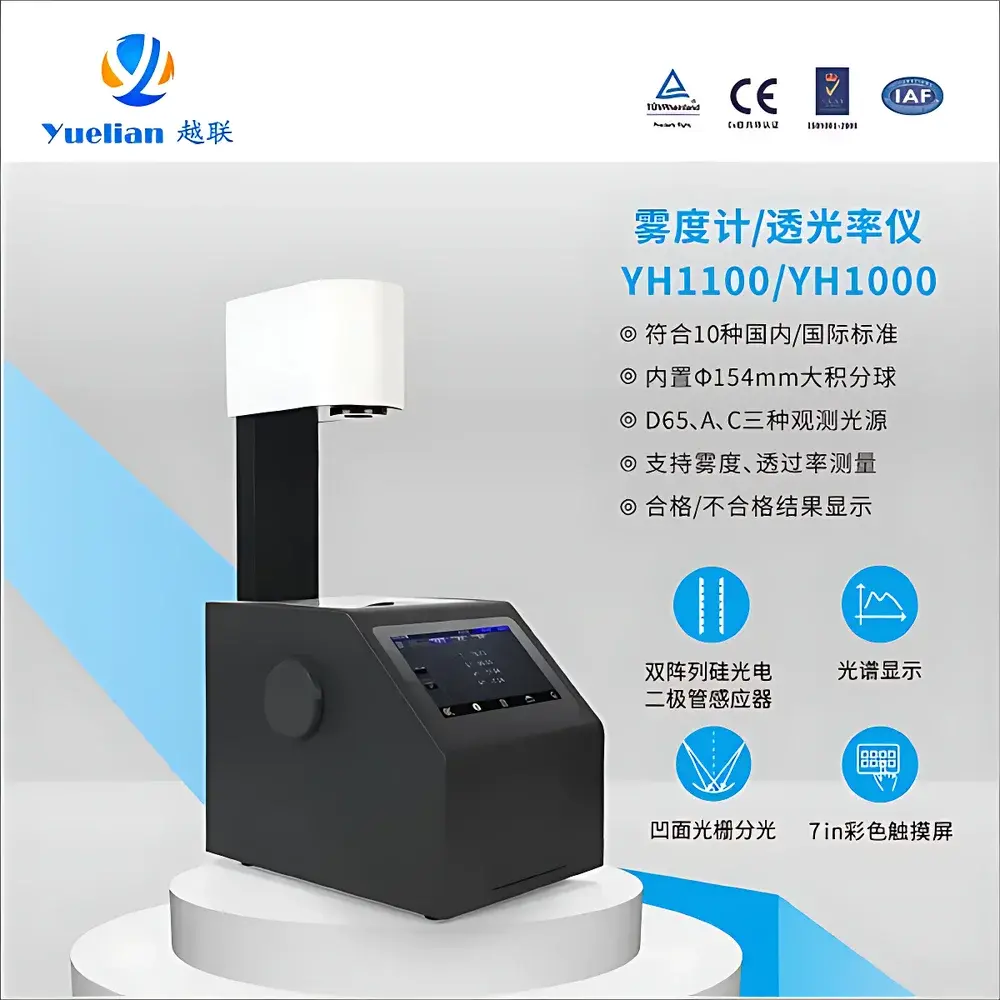
Yuelian YH1100 Automated Haze and Transmittance Meter
| Brand | Yuelian |
|---|---|
| Origin | Guangdong, China |
| Model | YH1100 |
| Product Type | Automated |
| Transmittance Range | 0–100% |
| Haze Repeatability | <0.1 (with φ20 mm aperture) |
| Illumination Geometry | 0/D (0° incident / Diffuse reception) |
| Integrating Sphere Diameter | φ154 mm |
| Light Source | 400–700 nm LED array |
| Detector | PD array compliant with CIE V(λ) 2° photopic luminosity function |
| Measurement Wavelength Range | 400–700 nm (customizable extension available) |
| Aperture Options | φ20 mm / φ15 mm / φ8 mm / φ4 mm (single fixed aperture per unit) |
| Sample Thickness Limit | <170 mm |
| Measurement Time | ~1.5 s |
| Haze Resolution | 0.01% |
| Haze Unit | % |
| Inter-instrument Agreement (φ20 mm) | <0.4% |
| Dimensions (L×W×H) | 290 × 211 × 511 mm |
| Weight | 7.6 kg |
| Power Supply | DC 24 V, 3 A adapter |
| Light Source Lifetime | >3 million measurements or ≥5 years |
| Display | 7-inch TFT capacitive touchscreen |
| Interfaces | USB, RS-232 serial (printer port) |
| Data Storage | 1,000 standards + 20,000 samples |
| Supported Languages | English, Simplified Chinese, Traditional Chinese |
| Operating Temperature | 0–40 °C |
| Storage Temperature | −20–50 °C |
| Compliance Standards | ASTM D1003, ASTM D1044, ISO 14782, ISO 13468, GB/T 2410, JJF 1303–2011, JIS K7105, JIS K7361, JIS K7136, CIE 15.2 |
Overview
The Yuelian YH1100 Automated Haze and Transmittance Meter is a precision optical instrument engineered for quantitative assessment of light scattering and transmission characteristics in transparent and translucent materials. It operates on the principle of integrating sphere photometry with 0/D (zero-degree illumination / diffuse detection) geometry, conforming to the fundamental measurement framework defined in ASTM D1003 and ISO 14782. The instrument employs a spectrally stable 400–700 nm LED array calibrated to match the CIE standard photopic luminosity function V(λ) for 2° observer conditions—ensuring metrological traceability to human visual response. Its core function is the simultaneous determination of total transmittance (Tt) and haze (H), where haze is calculated as the ratio of diffusely transmitted light to total transmitted light, expressed as a percentage. This dual-parameter output enables rigorous quality control in manufacturing environments where optical clarity, uniformity, and consistency are governed by international specifications.
Key Features
- Automated measurement cycle completing in approximately 1.5 seconds, optimized for high-throughput laboratory and production-line use.
- PD (photodiode) array detector system with spectral responsivity aligned to CIE V(λ) 2°, eliminating reliance on mechanical filter wheels and enhancing long-term stability.
- Modular aperture selection (φ20 mm, φ15 mm, φ8 mm, or φ4 mm) allows adaptation to sample geometry while maintaining compliance with standardized test area requirements across ASTM and ISO methods.
- Open-access sample chamber supports both vertical and horizontal placement—critical for rigid panels (e.g., architectural glass), flexible films (e.g., PET, PC), and irregularly shaped components encountered in packaging and display fabrication.
- Dual real-time monitoring: independent temperature sensor and photometric feedback loop continuously track source output drift and ambient thermal fluctuations, enabling dynamic compensation and preserving measurement integrity over extended operational periods.
- 7-inch capacitive touchscreen interface with multilingual support (English, Simplified/Traditional Chinese), intuitive workflow navigation, and on-device pass/fail evaluation against user-defined thresholds.
Sample Compatibility & Compliance
The YH1100 accommodates solid, semi-rigid, and flexible planar specimens up to 170 mm in thickness—including float glass, tempered automotive glazing, injection-molded polycarbonate housings, biaxially oriented polypropylene (BOPP) films, OLED encapsulation layers, pharmaceutical vial resins, and laminated safety glass interlayers. Its mechanical design permits unobstructed loading without clamping-induced stress artifacts. Regulatory alignment includes full technical adherence to ASTM D1003 (Method A, non-compensating), ASTM D1044 (haze only), ISO 14782 (transmittance and haze), ISO 13468 (plastics), GB/T 2410 (Chinese national standard), JJF 1303–2011 (calibration specification), and multiple JIS standards (K7105, K7361, K7136). While not inherently 21 CFR Part 11 compliant, audit-ready data export via USB ensures compatibility with validated LIMS or ELN systems under GLP/GMP frameworks when deployed with appropriate procedural controls.
Software & Data Management
The included Windows-based Quality Management Software provides comprehensive post-acquisition analysis: statistical process control (SPC) charts, batch comparison reports, delta-haze/delta-transmittance trend visualization, and customizable PDF/Excel report generation. Raw measurement logs—including timestamp, operator ID, aperture used, calibration status, and environmental metadata—are stored locally with 20,000-sample capacity. USB export supports direct integration into enterprise QA databases; optional RS-232 connectivity enables legacy printer coupling for hard-copy documentation during audits. All software modules operate without cloud dependency, preserving data sovereignty—a critical requirement for regulated industries including medical device packaging and pharmaceutical primary container qualification.
Applications
- Glass manufacturing: verification of anti-reflective coating uniformity and bulk homogeneity in architectural, automotive, and display-grade substrates.
- Plastics processing: incoming raw material screening and in-process validation of extruded sheets, blow-molded containers, and thermoformed trays.
- Flexible packaging: haze/transmittance profiling of metallized PET, PVDC-coated films, and barrier-laminated structures for food and pharma applications.
- Optoelectronics: characterization of cover lens clarity, touch panel overlay haze, and OLED microcavity effects prior to module assembly.
- Pharmaceuticals: quantification of solution turbidity and container clarity per USP <790> guidance, supporting sterility assurance and extractables/leachables program development.
FAQ
Does the YH1100 support both ASTM D1003 Method A and Method B?
Yes—it implements Method A (non-compensating) by default, which is the most widely adopted protocol for industrial quality control. Method B (compensating) capability requires optional firmware upgrade and dedicated reference standards.
Can haze values be correlated directly between YH1100 units across different laboratories?
Inter-instrument agreement is specified at <0.4% haze (φ20 mm aperture) when units are calibrated using NIST-traceable haze standards and operated under controlled environmental conditions (23 ± 2 °C, 50 ± 5% RH).
Is the instrument suitable for measuring curved or textured surfaces?
The YH1100 is designed for flat or gently curved planar samples. Highly textured, frosted, or deeply contoured surfaces require specialized fixtures or alternative techniques such as goniophotometry.
What calibration standards are required for routine operation?
Daily verification uses supplied 0% black trap and certified haze reference tiles (e.g., 10%, 30%, 70% haze). Annual recalibration should be performed by an accredited metrology lab against CIE-standard reference materials.
How does temperature variation affect measurement stability?
Integrated thermal monitoring triggers automatic correction algorithms; however, sustained operation outside 15–30 °C may degrade repeatability. For ISO 14782-compliant reporting, measurements must be conducted within ±1 °C of the reference temperature specified in the standard.




