
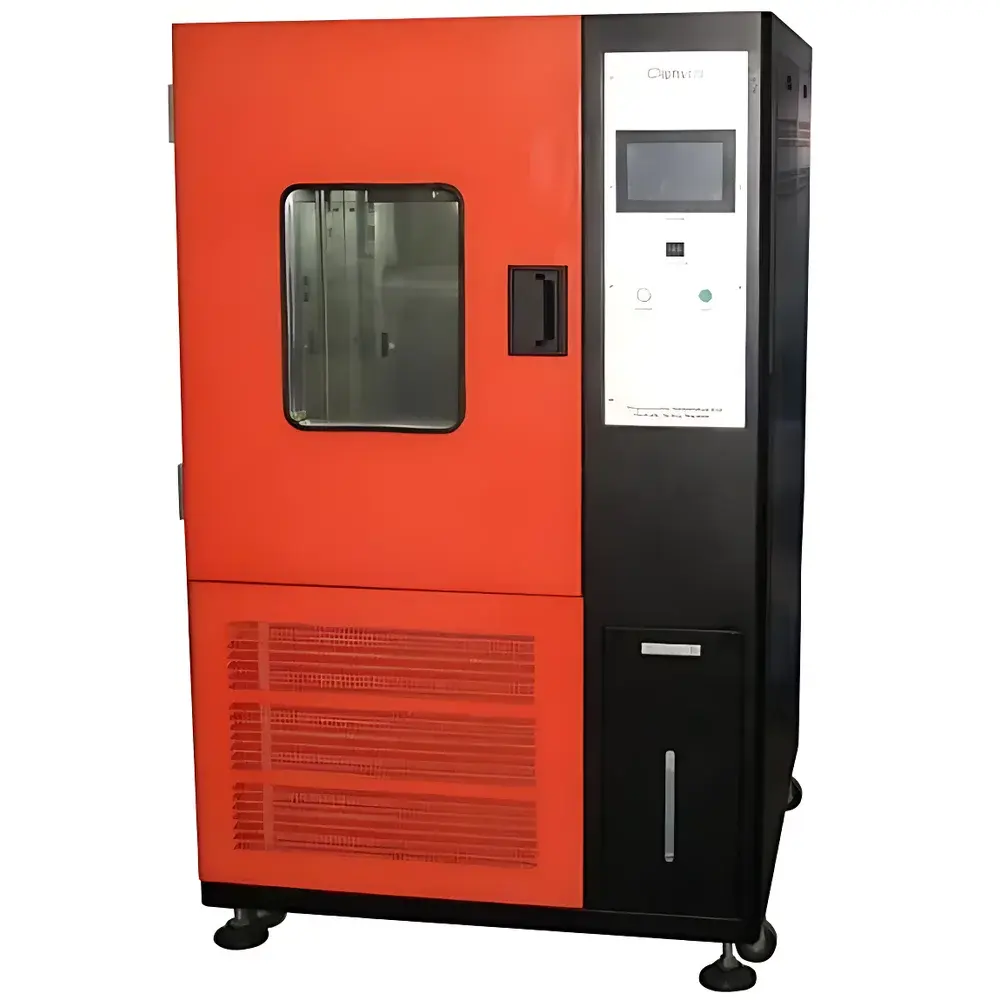
Yuelian YL-2236 Series Programmable Temperature and Humidity Environmental Test Chamber
| Brand | Yuelian |
|---|---|
| Origin | Guangdong, China |
| Model | YL-2236A–F |
| Internal Dimensions (W×H×D) | 40×50×40 cm to 100×100×100 cm |
| Volume | 80 L to 800 L |
| Temperature Range | −70 °C to +150 °C |
| Humidity Range | 5 %RH to 98 %RH (optional low-humidity configuration) |
| Temperature Uniformity | ±0.5 °C |
| Humidity Uniformity | ±3 %RH |
| Temperature Stability | ±0.3 °C |
| Humidity Stability | ±2.5 %RH |
| Heating Rate | 0 °C→100 °C in ~20 min |
| Cooling Rate | 20 °C→−70 °C in ~90 min |
| Control System | PID + SSR/SCR bidirectional output with slope logic |
| Programming Capacity | 150 programs × 1500 segments |
| Cycles | 9999 × 999 with 5 independent sub-cycle divisions |
| Safety Monitoring | 15-point real-time system diagnostics |
| Refrigeration | Hermetic air-cooled dual-stage (≤−40 °C) or single-stage (>−40 °C) |
| Construction | SUS#304 stainless steel interior and exterior |
| Insulation | Rock wool + rigid polyurethane foam |
| Humidification | Surface evaporation type with auto-water-generation system |
| Dehumidification | Refrigerative latent heat removal |
| Power Supply | AC 220 V / 380 V ±10 %, 50/60 Hz |
Overview
The Yuelian YL-2236 Series Programmable Temperature and Humidity Environmental Test Chamber is an engineered platform for accelerated environmental stress testing of materials and components under precisely controlled thermal and hygrothermal conditions. Based on the principle of balanced heating and refrigerative dehumidification—combined with dynamic humidity generation via surface evaporation—the chamber delivers high reproducibility in simulating real-world climatic exposures. It supports standardized test protocols aligned with IEC 60068-2, MIL-STD-810, GB/T 2423, and JIS C 0021, enabling validation of product robustness across temperature extremes (−70 °C to +150 °C) and relative humidity ranges (5–98 %RH). Its dual-stage refrigeration architecture ensures stable operation below −40 °C, while the integrated pure-water generation system eliminates manual refilling and maintains consistent water quality for repeatable humidification performance.
Key Features
- Intelligent dual-mode control logic: Combines PID regulation with SSR/SCR bidirectional power output and built-in slope-based ramping algorithms for precise transient profile execution.
- High-capacity programmability: Stores up to 150 multi-segment programs (1500 total segments), supporting nested loops, conditional branching, and 5 independently definable partial cycles per main program.
- Comprehensive safety architecture: Monitors 15 critical parameters—including refrigerant pressure, heater overtemperature, compressor overload, and water-level integrity—with automatic fault logging, timestamped error codes, and recommended remediation steps.
- Optimized thermal/hygral uniformity: Achieves ±0.5 °C temperature uniformity and ±3 %RH humidity uniformity across working volume via laminar airflow design, insulated double-wall construction, and calibrated sensor placement per ISO 16750-4 Annex B.
- Robust mechanical design: Entire chamber fabricated from SUS#304 stainless steel; insulated with fire-retardant rock wool and rigid polyurethane foam (≥80 mm thickness); features anti-sweat heated observation window with high-luminance fluorescent lighting.
- Modular utility integration: Includes three programmable time-signal outputs (10 timing modes), RS-232 interface for remote supervision, and optional analog/digital I/O expansion for external actuator synchronization.
Sample Compatibility & Compliance
The YL-2236 accommodates a broad spectrum of physical samples—from PCB assemblies and automotive ECUs to polymer films, pharmaceutical packaging, and aerospace composites—without requiring sample-specific fixtures. Internal dimensions range from 80 L (YL-2236A) to 800 L (YL-2236E/F), with standard configurations featuring two adjustable stainless-steel shelves, a 100 mm diameter test port, and casters for mobility. All models comply with CE marking requirements (2014/30/EU EMC Directive, 2014/35/EU LVD Directive) and meet electrical safety standards per IEC 61010-1. Optional configurations support GLP/GMP-aligned audit trails when paired with validated data acquisition software compliant with FDA 21 CFR Part 11.
Software & Data Management
The embedded controller supports local programming via a 7-inch TFT-LCD touchscreen with intuitive icon-driven navigation. Full remote monitoring and control are enabled through RS-232 serial communication, compatible with third-party SCADA systems and custom LabVIEW or Python-based data loggers. Standard firmware includes real-time trend plotting, alarm history export (CSV), and segmented event tagging. For regulated environments, optional validation packages provide IQ/OQ documentation templates, calibration traceability records (NIST-traceable sensors), and electronic signature support per ALCOA+ principles.
Applications
This chamber serves as a core qualification tool in reliability engineering workflows: thermal cycling per JEDEC JESD22-A104, damp heat testing (IEC 60068-2-78), cold storage simulation for biologics transport, accelerated aging of elastomers, and preconditioning prior to HALT/HASS. It is routinely deployed in QC labs for incoming material verification (e.g., moisture sensitivity level (MSL) screening per J-STD-020), in R&D for formulation stability studies, and in manufacturing for batch release testing of medical devices subject to ISO 13485 environmental controls.
FAQ
What is the lowest achievable humidity level?
Standard configuration reaches 5 %RH using optional deep-dry hardware; standard range is 20–98 %RH.
Can the chamber operate continuously at −70 °C?
Yes—dual-stage refrigeration with R507 refrigerant enables sustained operation at −70 °C with full humidity control down to 10 %RH.
Is the controller compliant with FDA 21 CFR Part 11?
The base controller supports audit trail export; full Part 11 compliance requires optional validated software module with electronic signatures and role-based access control.
What maintenance intervals are recommended?
Compressor oil inspection every 24 months; refrigerant leak check annually; humidifier tank cleaning every 3 months; calibration verification every 6 months per ISO/IEC 17025 guidelines.
Does the system support custom test profiles defined in Excel?
Yes—via optional PC software that imports CSV-formatted time-temperature-humidity sequences and auto-generates executable program files.



