
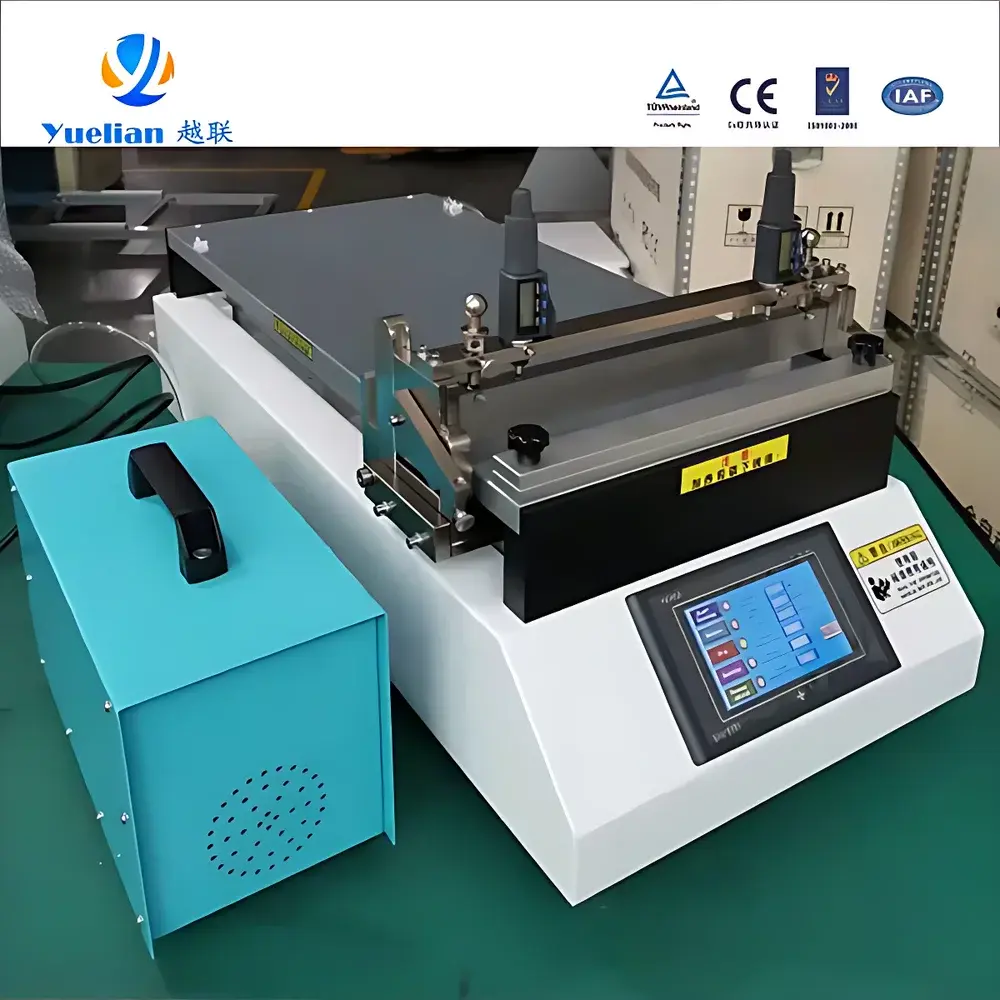
YL-TB300AZK Vacuum-Heated Laboratory Coating Trial Machine by YueLian / PW
| Brand | YueLian / PW |
|---|---|
| Origin | Guangdong, China |
| Manufacturer Type | Authorized Distributor |
| Country of Origin | China |
| Model | YL-TB300AZK |
| Price | Upon Request |
| Control System | Self-developed Touchscreen HMI |
| Coating Methods | Interchangeable Doctor Blade & Wire Rod |
| Speed Range | 1–10 m/min (adjustable) |
| Stroke Length | 10–420 mm (adjustable) |
| Leveling Mechanism | Integrated Auto-Leveling System |
| Thickness Accuracy | ±0.003 mm |
| Coating Width | 300 × 450 mm |
| Wet Film Thickness Range | 0.005–5 mm |
| Temperature Range | Ambient to 160 °C (PID-controlled恒温) |
| Vacuum Adsorption | Yes |
| Wire Rod Length | 400 mm |
| Doctor Blade Material | Alloy Stainless Steel |
| Power Supply | 110–220 V AC, 50/60 Hz |
| Power Consumption | 48 W |
| Dimensions (L×W×H) | 800 × 380 × 410 mm |
| Net Weight | 32 kg |
Overview
The YL-TB300AZK Vacuum-Heated Laboratory Coating Trial Machine is a precision-engineered benchtop instrument designed for controlled, reproducible wet-film deposition on flat substrates under regulated thermal and mechanical conditions. It operates on the principle of metered gap coating—where either a precision-ground alloy stainless steel doctor blade or a calibrated wire rod establishes a defined wet-film thickness through shear-controlled material transfer. Integrated vacuum adsorption ensures substrate immobilization during traversal, eliminating slippage-induced thickness variation. The PID-regulated heating platen (ambient to 160 °C) enables real-time thermal modulation of coating rheology—critical for solvent evaporation kinetics, polymer melt viscosity control, and crosslinking onset studies. Unlike manual applicators, this system decouples operator-dependent variables (e.g., hand pressure, stroke consistency) from process parameters, delivering metrologically traceable film formation for R&D validation, formulation screening, and QC method development.
Key Features
- Vacuum-assisted substrate fixation across full 300 × 450 mm coating area, compatible with rigid and semi-rigid planar materials including paper, PET, PVC, aluminum sheet, woven fabrics, and coated metals.
- Interchangeable coating modules: precision-machined doctor blade (alloy stainless steel, wear-resistant edge geometry) and standardized wire rods (400 mm length; selectable diameter for target wet-film thickness).
- Programmable traverse motion: linear speed adjustable from 1 to 10 m/min with <±0.5% repeatability; stroke length digitally set between 10 and 420 mm.
- Integrated auto-leveling mechanism ensures parallelism between coating element and substrate surface within ±0.003 mm tolerance—essential for uniform meniscus formation and edge defect minimization.
- Touchscreen HMI with embedded firmware supports parameter storage, recipe recall, and real-time monitoring of temperature, speed, and vacuum pressure.
- Thermally isolated heated platen with ±0.3 °C stability at setpoint (160 °C max), enabling accelerated drying trials, thermoset curing simulations, and hot-melt coating assessments.
Sample Compatibility & Compliance
The YL-TB300AZK accommodates substrates up to 450 mm wide and 300 mm deep, with thicknesses ranging from 0.05 mm (thin films) to 3 mm (rigid panels). Surface energy independence is achieved via vacuum clamping—eliminating reliance on adhesive tapes or static friction. All wetted components comply with ISO 8502-3 for non-contaminating contact surfaces. While not certified to IEC 61000-6-3 or UL 61010-1 as a standalone system, its electrical architecture meets CE marking requirements for laboratory equipment (EMC Directive 2014/30/EU, LVD Directive 2014/35/EU). For GLP/GMP environments, audit-ready operation logs (timestamped speed/temp/vacuum data) can be exported via USB—supporting traceability per FDA 21 CFR Part 11 when paired with validated third-party data management software.
Software & Data Management
The embedded touchscreen interface stores up to 99 user-defined coating protocols, each containing speed, stroke, temperature, dwell time, and vacuum setpoints. Parameter changes are logged with date/time stamps and operator ID fields (configurable via alphanumeric input). Raw operational data—including real-time temperature deviation curves and motor current signatures—can be exported in CSV format for post-processing in MATLAB, JMP, or Python-based statistical analysis pipelines. No cloud connectivity or remote access functionality is implemented, preserving data sovereignty—a requirement specified in many corporate IT security policies for pre-commercial R&D instrumentation.
Applications
- Formulation optimization of aqueous and solvent-based coatings: correlating rheological modifiers with final film uniformity under controlled thermal profiles.
- Adhesive transfer studies: quantifying peel strength vs. wet-film thickness on dissimilar substrates (e.g., PET-to-aluminum laminates).
- Photovoltaic electrode screening: depositing conductive inks (Ag, Cu, PEDOT:PSS) with sub-5 µm thickness resolution prior to sintering trials.
- Pharmaceutical film-coating development: simulating pan coater hydrodynamics using model tablet arrays mounted on custom carriers.
- Automotive clear-coat aging research: applying UV-curable topcoats under nitrogen-purged vacuum to suppress bubble entrapment.
FAQ
What substrate flatness tolerance is required for optimal performance?
Substrates must exhibit ≤0.1 mm total indicator reading (TIR) over the 300 × 450 mm area. Warped panels exceeding this limit may compromise vacuum seal integrity and leveling accuracy.
Can the machine handle high-viscosity pastes (>50,000 mPa·s)?
Yes—doctor blade mode is recommended for viscosities above 10,000 mPa·s. Wire rod application is limited to Newtonian or near-Newtonian fluids below 5,000 mPa·s to ensure capillary fill consistency.
Is calibration documentation provided with shipment?
A factory verification report is included, covering speed encoder linearity (NIST-traceable tachometer), temperature sensor accuracy (±0.5 °C at 100 °C), and vacuum gauge linearity (±2% FS). Full ISO/IEC 17025 calibration requires third-party service.
How is thermal uniformity across the platen verified?
Thermal mapping is performed at three points (center, left edge, right edge) during final QA. Deviation remains ≤±1.2 °C at 120 °C steady state, per ASTM E220 standard practices.
Are replacement wire rods supplied with dimensional certification?
All optional wire rods include individual certificates stating nominal diameter, tolerance (±0.5 µm), and surface roughness (Ra ≤ 0.2 µm), measured per ISO 4287.



