
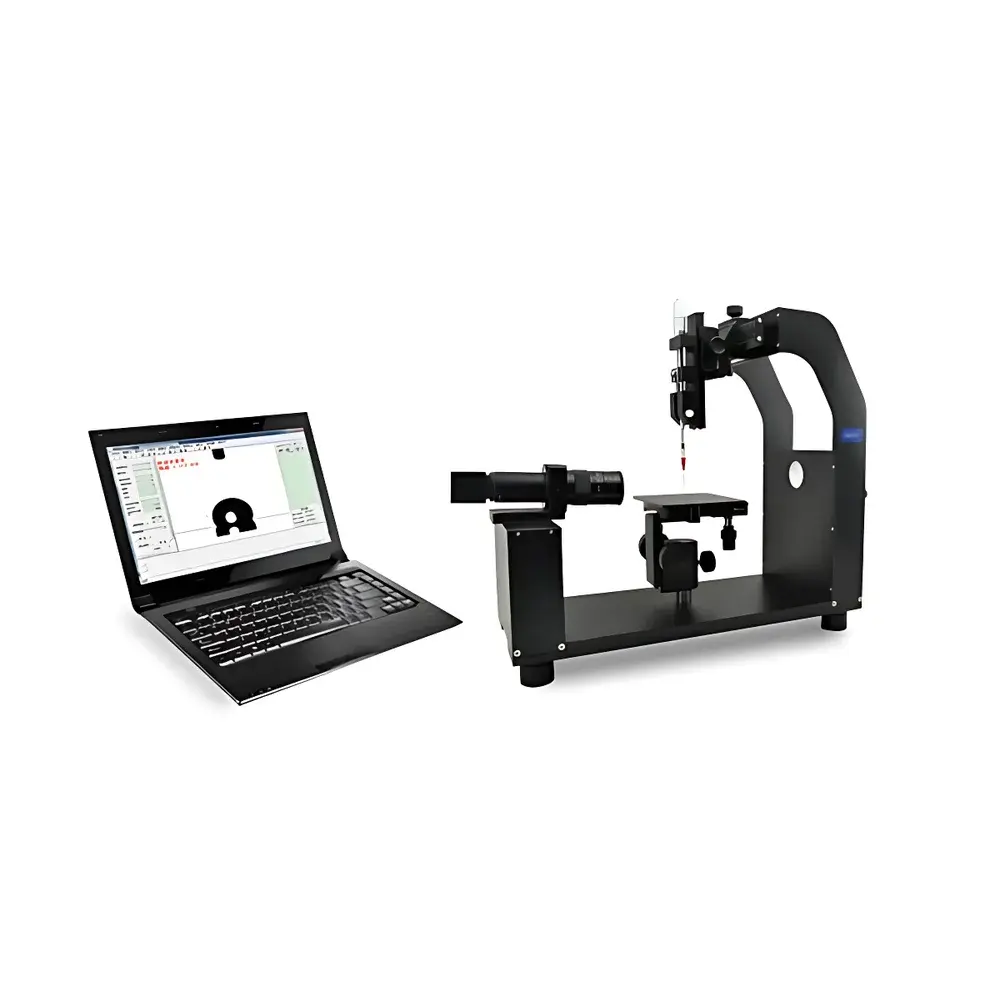
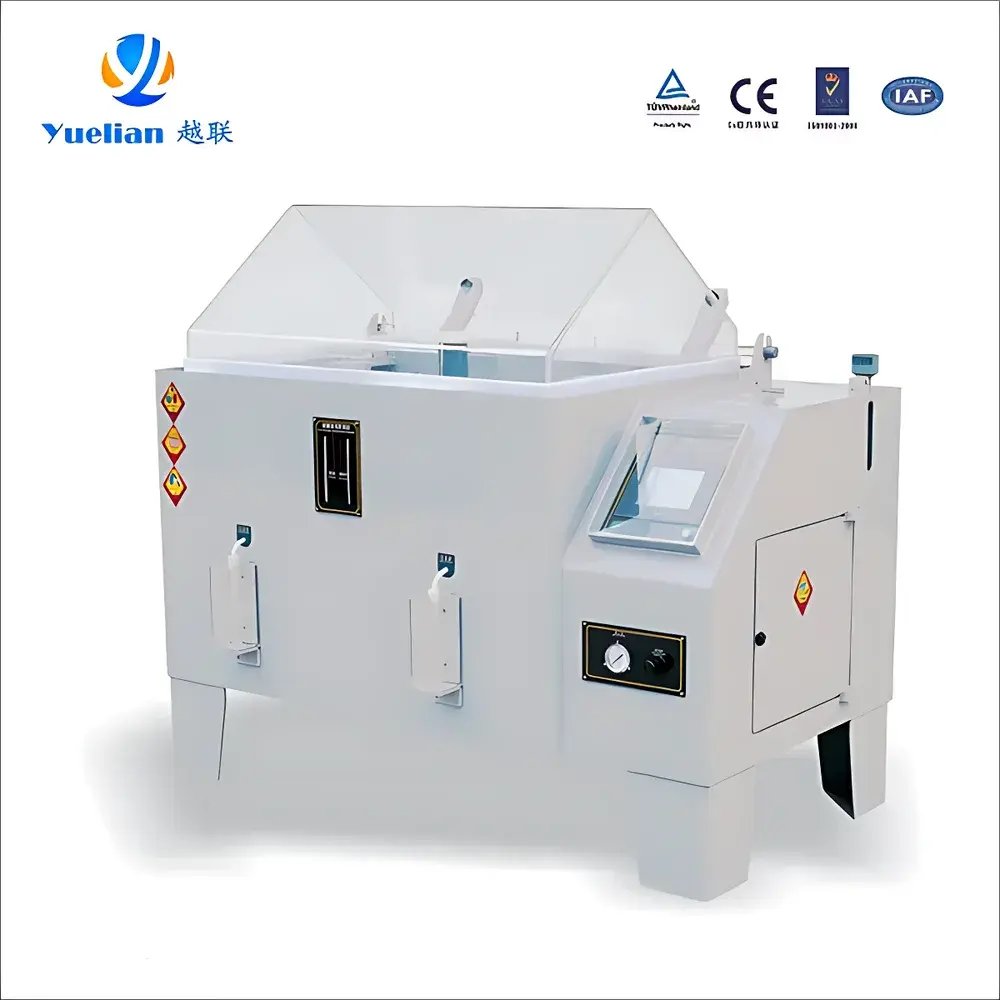
YL-WD100 Contact Angle Goniometer for Mobile Device Structural Component Reliability Testing
| Key | Brand: Yuelian |
|---|---|
| Origin | Guangdong, China |
| Model | YL-WD100 |
| Contact Angle Range | 0–180° |
| Measurement Accuracy | ±0.1° |
| Measurement Methods | Sessile Drop, Insertion, Captive Bubble |
| Analysis Algorithms | Automatic Circle Fitting, Ellipse Fitting, Curved Surface Fitting, Height-Width Method, Tangent Method, Dynamic Sequence Analysis |
| Surface Energy Models | Fowkes, OWRK, Zisman, EOS |
| Stage Travel (X/Y/Z) | 100/100/50 mm (sample stage), 150 mm (fixed plate), 80 mm (microscope, ±3 mm fine adjustment) |
| Sample Max Size | 100 mm (W) × 80 mm (D) |
| Microscope | 2× Fixed-Magnification Optical System |
| Imaging | High-Resolution CMOS Camera with Video Capture, Frame-by-Frame Export, Real-Time Playback |
| Lighting | Adjustable Cold LED Backlight |
| Compliance Standards | GB/T 24368–2009, SY/T 5153–2007, ASTM D724–99(2003), ASTM D5946–2004, ISO 15989 |
Overview
The YL-WD100 Contact Angle Goniometer is an engineered optical measurement system designed specifically for quantitative wettability characterization of structural components in mobile device manufacturing—particularly for evaluating surface energy, interfacial adhesion, and coating integrity across glass, metal, polymer, and composite substrates. It operates on the principle of optical contact angle analysis using high-resolution silhouette imaging of sessile or captive liquid droplets under controlled environmental conditions. By measuring the tangent angle formed between the liquid–solid interface and the liquid–vapor meniscus, the instrument enables calculation of solid surface free energy, work of adhesion, spreading coefficient, and interfacial tension via thermodynamically grounded models (e.g., OWRK and Fowkes). Its application scope extends beyond routine QC to support R&D validation of hydrophobic coatings, anti-fingerprint layers, adhesive bonding interfaces, vapor-deposited barrier films, and plasma-treated surfaces—critical parameters influencing long-term reliability in drop, bend, thermal cycling, and chemical exposure tests.
Key Features
- Modular optical platform with 2× fixed-magnification microscope and industrial-grade CMOS camera (1280×1024 resolution) enabling sub-pixel edge detection and repeatable contact angle quantification at ±0.1° accuracy.
- Motorized XYZ sample stage with independent travel ranges: ±100 mm (X), ±100 mm (Y), ±50 mm (Z); plus 150 mm longitudinal translation of the fixed mounting plate and 80 mm ±3 mm micrometer-adjusted microscope positioning for precise focal alignment on curved, textured, or recessed surfaces.
- Programmable cold LED backlight with continuous intensity control—eliminating thermal drift during extended acquisition sequences and ensuring consistent contrast for low-contact-angle (<10°) or high-hysteresis measurements.
- Multi-method analytical engine supporting static and dynamic contact angle evaluation: sessile drop, insertion, captive bubble, advancing/receding angle, roll-off angle, and time-resolved sequential capture (up to 60 fps video export with frame-accurate timestamping).
- Comprehensive surface energy computation suite compliant with ISO 15989, ASTM D5946, and GB/T 24368—integrating Fowkes, OWRK, Zisman Plot, and Equation-of-State (EOS) models with built-in error propagation analysis for uncertainty estimation.
- Full software automation including one-click batch processing, auto-baseline detection, curvature-aware fitting for convex/concave substrates, and direct annotation overlay on exported images with metadata (timestamp, method, model, confidence index).
Sample Compatibility & Compliance
The YL-WD100 accommodates standard mobile device structural parts—including front/rear glass covers (2.5D/3D curved), aluminum midframes, stainless steel SIM trays, PET-based decorative films, and molded plastic housings—within its 100 mm × 80 mm maximum sample footprint. Its mechanical design permits tilt-angle compensation up to ±15° for non-planar specimens without recalibration. All measurement protocols align with internationally recognized standards governing surface wettability assessment: ASTM D724 (paper surface wettability), ASTM D5946 (polymer film water contact angle), ISO 15989 (corona-treated plastic films), SY/T 5153 (reservoir rock wettability), and GB/T 24368 (hydrophobic contaminant detection on glass). Data audit trails, user-access controls, and report generation meet GLP-aligned documentation requirements for internal QA/QC labs; optional configuration supports 21 CFR Part 11-compliant electronic signatures and immutable data archiving.
Software & Data Management
The embedded Windows-based software provides a validated, traceable workflow from image acquisition to regulatory-ready reporting. Raw video and still frames are stored in lossless TIFF format with embedded EXIF metadata (exposure, gain, focus position, stage coordinates). Quantitative results—including contact angle, hysteresis, surface energy components (dispersive/polar), adhesion work, and spreading coefficient—are exportable to CSV, Excel, or Word templates pre-formatted for internal test reports or customer deliverables. The software includes configurable pass/fail thresholds per test point, statistical summary dashboards (mean, SD, CV%), and comparative overlay tools for before/after treatment analysis (e.g., plasma activation vs. aged state). Audit logs record all user actions, parameter changes, and calibration events—supporting ISO 9001 and IATF 16949 process validation requirements.
Applications
- Quantifying hydrophobicity retention of oleophobic coatings after RCA abrasion, alcohol rub, or MEK exposure.
- Validating uniformity of silane coupling agent application on aluminum midframes prior to adhesive bonding.
- Assessing surface energy shift following UV-ozone or atmospheric plasma treatment of PET logo films.
- Correlating contact angle hysteresis with delamination risk in NMT (Nano-Molding Technology) hybrid structures.
- Screening solder mask wettability for selective plating processes on PCB-integrated metal frames.
- Monitoring aging effects on anti-fingerprint layer performance under temperature-humidity cycling (85°C/85% RH).
- Supporting root-cause analysis of adhesive failure in drop-test–induced fractures by mapping interfacial energy gradients across bond lines.
FAQ
What liquid probes are recommended for mobile device surface testing?
Deionized water (surface tension 72.8 mN/m at 20°C) is standard for hydrophobicity screening; diiodomethane (50.8 mN/m) and ethylene glycol (48.0 mN/m) are used in OWRK surface energy calculations.
Can the YL-WD100 measure contact angles on highly curved smartphone displays?
Yes—the system supports curvature-adaptive baseline detection and elliptical/circular fitting algorithms optimized for radii down to 2.5 mm, validated per ISO 15989 Annex B for concave and convex substrates.
Is dynamic contact angle measurement supported for simulating real-world condensation behavior?
Yes—time-lapse droplet growth/shrinkage sequences can be captured at user-defined intervals (100 ms–10 s), with automated advancing/receding angle extraction using tangent or ellipse methods.
How does the instrument ensure measurement repeatability across multiple operators?
Through standardized lighting calibration routines, auto-focus lock, stage homing protocols, and operator-independent algorithm selection—validated via ASTM E2500-13 guidelines for instrument qualification.
Does the software generate reports compliant with automotive or medical device quality systems?
Yes—report templates include fields for test ID, operator, equipment ID, calibration date, environmental conditions (T/RH), and statistical summaries required for PPAP, APQP, or MDR Annex II documentation.



