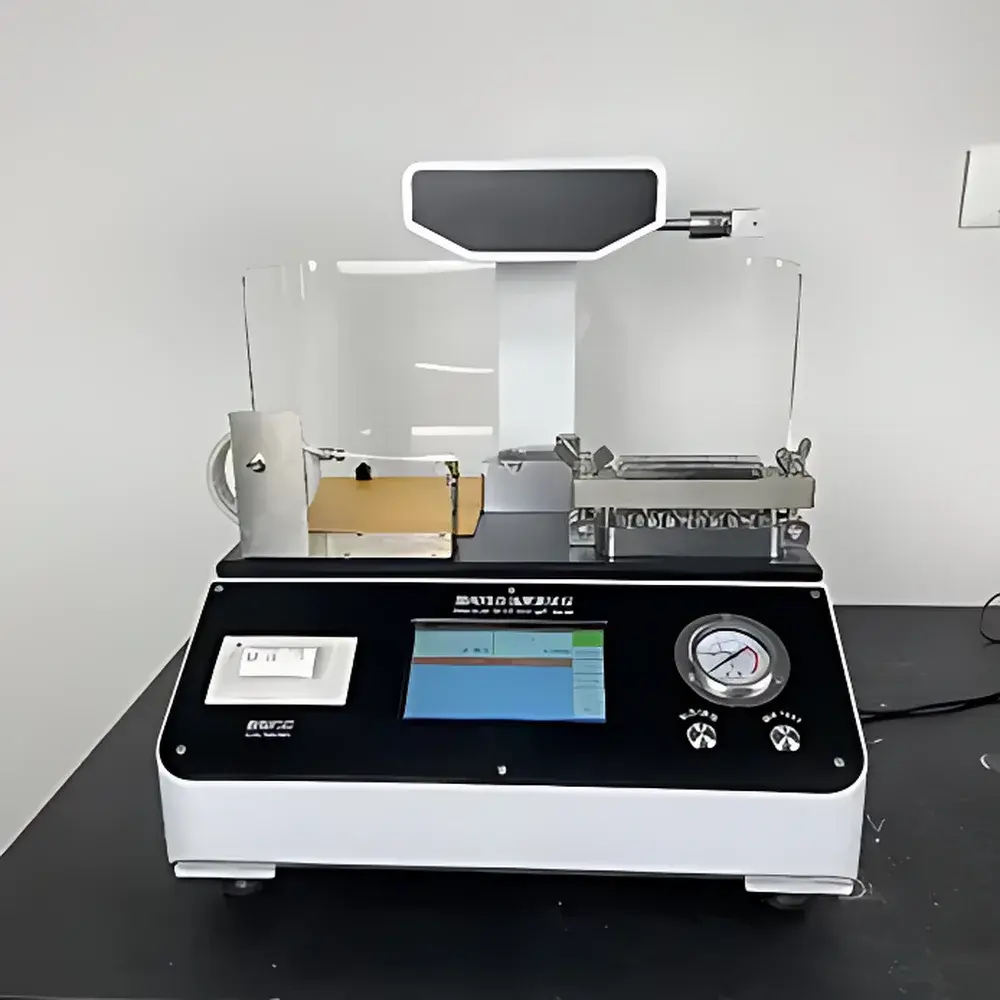
Yuelian PW-6617 Interlaminar Bond Strength Tester (Scott-Type Internal Bond Tester)
| Brand | Yuelian / PW |
|---|---|
| Origin | Guangdong, China |
| Manufacturer Type | Authorized Distributor |
| Country of Manufacture | China |
| Model | PW-6617 |
| Price Range | USD 780–2,350 |
| Sample Size | 25.4 mm × 127 mm |
| Thickness Range | 0.1–5 mm |
| Impact Angle | 90° (standard energy release) |
| Release Mechanism | Fully Automatic Pneumatic Release |
| Measurement Range | 0–1000 J/m² (A-range: 0–500 J/m² |
| B-range | 500–1000 J/m²) |
| Accuracy | ±1 J/m² (A), ±2 J/m² (B) |
| Resolution | 0.001 J/m² |
| Units | J/m² and lbf/in² (interchangeable) |
| Encoder Resolution | 5000-pulse high-precision optical encoder |
| HMI | 7.0-inch capacitive touchscreen (bilingual: English/Chinese) |
| Printer | Integrated thermal printer module |
| Dimensions (W×D×H) | 500 × 400 × 650 mm |
| Weight | ~70 kg |
| Pneumatic Clamping | Yes |
| Compliance Standards | GB/T 26203, GB/T 25203, ASTM T569 pm-00, DIN ISO 16260, TAPPI UM403 |
Overview
The Yuelian PW-6617 Interlaminar Bond Strength Tester is a precision-engineered Scott-type internal bond tester designed for quantitative evaluation of z-direction fiber bonding integrity in paper, board, and laminated packaging substrates. It operates on the principle of pendulum impact energy absorption: a calibrated falling pendulum strikes an aluminum impact block clamped against a double-sided adhesive sandwich—comprising two adhesive-coated tapes with the test specimen positioned centrally—mounted on a rigid metal anvil. Upon impact, the aluminum block rotates, inducing controlled delamination along the inter-fiber plane of the sample. The angular displacement of the pendulum before and after impact is measured via a high-resolution 5000-pulse optical encoder, enabling calculation of absorbed energy per unit area (J/m²). This method directly correlates to the resistance of fibrous networks to interlayer separation under dynamic shear loading—a critical performance parameter for industrial papers subjected to winding, converting, printing, and end-use mechanical stress.
Key Features
- 7.0-inch capacitive touchscreen HMI with real-time bilingual (English/Chinese) interface and intuitive navigation for test setup, calibration, and result review.
- Pneumatically actuated clamping system with programmable pressure control ensures consistent adhesive contact and eliminates manual variability during specimen mounting.
- Structurally reinforced cast-iron frame and vibration-damped base minimize energy dissipation from extraneous oscillations, preserving measurement fidelity across repeated cycles.
- Automated pendulum release mechanism guarantees precise 90° impact angle repeatability and eliminates operator-induced timing errors.
- Integrated thermal printer provides immediate hard-copy output of test ID, date/time stamp, energy value (J/m² and lbf/in²), statistical summary (mean, SD, CV%), and pass/fail status relative to user-defined thresholds.
- Onboard data logging supports up to 500 test records with timestamped metadata; optional PC connectivity enables CSV export and real-time curve plotting via RS232 or USB interface.
Sample Compatibility & Compliance
The PW-6617 is validated for standardized testing of diverse paper-based materials within thicknesses of 0.1–5.0 mm and nominal dimensions of 25.4 mm × 127 mm. Typical applications include electrical insulation paperboards (e.g., transformer board per IEC 60641), tube winding papers (kraft liner, spiral wound core stock), greyboard and folding boxboard (FBB), solid bleached sulfate (SBS) and coated unbleached kraft (CUK) cartons, and multi-ply laminated packaging composites. All measurements comply strictly with internationally harmonized test protocols: GB/T 26203 (China), ASTM T569 pm-00 (Technical Association of the Pulp and Paper Industry), DIN ISO 16260 (German Institute for Standardization), and TAPPI UM403. The instrument’s traceable calibration procedure aligns with ISO/IEC 17025 requirements for testing laboratories, supporting GLP-compliant documentation workflows and audit-ready data integrity.
Software & Data Management
The embedded firmware implements ISO 17025-aligned data governance principles: all test events—including calibration logs, operator ID, environmental conditions (optional sensor input), and raw encoder counts—are time-stamped and cryptographically sealed within non-volatile memory. Statistical functions compute arithmetic mean, standard deviation, coefficient of variation (%CV), and outlier detection per ASTM E178. Optional PC software (Yuelian TestSuite v3.2) extends functionality with SPC charting (X̄-R, Cpk), batch-level trending, PDF report generation with digital signature fields, and integration into LIMS environments via ODBC-compliant database drivers. Audit trail compliance includes immutable event sequencing, user-access level controls (admin/operator/guest), and full 21 CFR Part 11 readiness when paired with external electronic signature modules.
Applications
This tester serves as a primary quality gate for paper mills, packaging converters, and R&D labs evaluating structural cohesion in multi-layered substrates. In electrical insulation manufacturing, it verifies z-direction dielectric integrity of pressboard prior to impregnation. For corrugated and folding carton producers, it quantifies adhesive penetration depth and fiber anchoring in starch-laminated boards—directly correlating with crush resistance and stacking performance. In food packaging, it assesses delamination risk in metallized PET/PE laminates and barrier-coated paper cups under thermal cycling and moisture exposure. Automotive interior suppliers use it to validate bonding strength of nonwoven composites in headliner substrates, while medical device packaging engineers rely on its repeatability to qualify peel-resistant pouch seals per ISO 11607-2.
FAQ
What standards does the PW-6617 comply with?
It fully conforms to GB/T 26203, GB/T 25203, ASTM T569 pm-00, DIN ISO 16260, and TAPPI UM403 for internal bond strength determination.
Is calibration traceable to national metrology institutes?
Yes—each unit ships with a factory calibration certificate traceable to CNAS-accredited reference standards; annual recalibration services are available with NIST-traceable documentation.
Can the instrument be integrated into an automated production line?
While primarily a lab-scale tester, its RS232/USB interface and Modbus RTU protocol support integration with PLC-controlled QA stations for inline sampling verification.
What maintenance is required for long-term accuracy?
Routine checks include pendulum bearing lubrication every 6 months, anvil surface inspection for flatness (±0.005 mm), and periodic verification of pneumatic pressure regulation (±0.02 MPa tolerance).
Does the system support statistical process control (SPC) reporting?
Yes—the onboard processor calculates %CV and control limits; exported CSV files are compatible with Minitab, JMP, and industry-standard SPC platforms.