
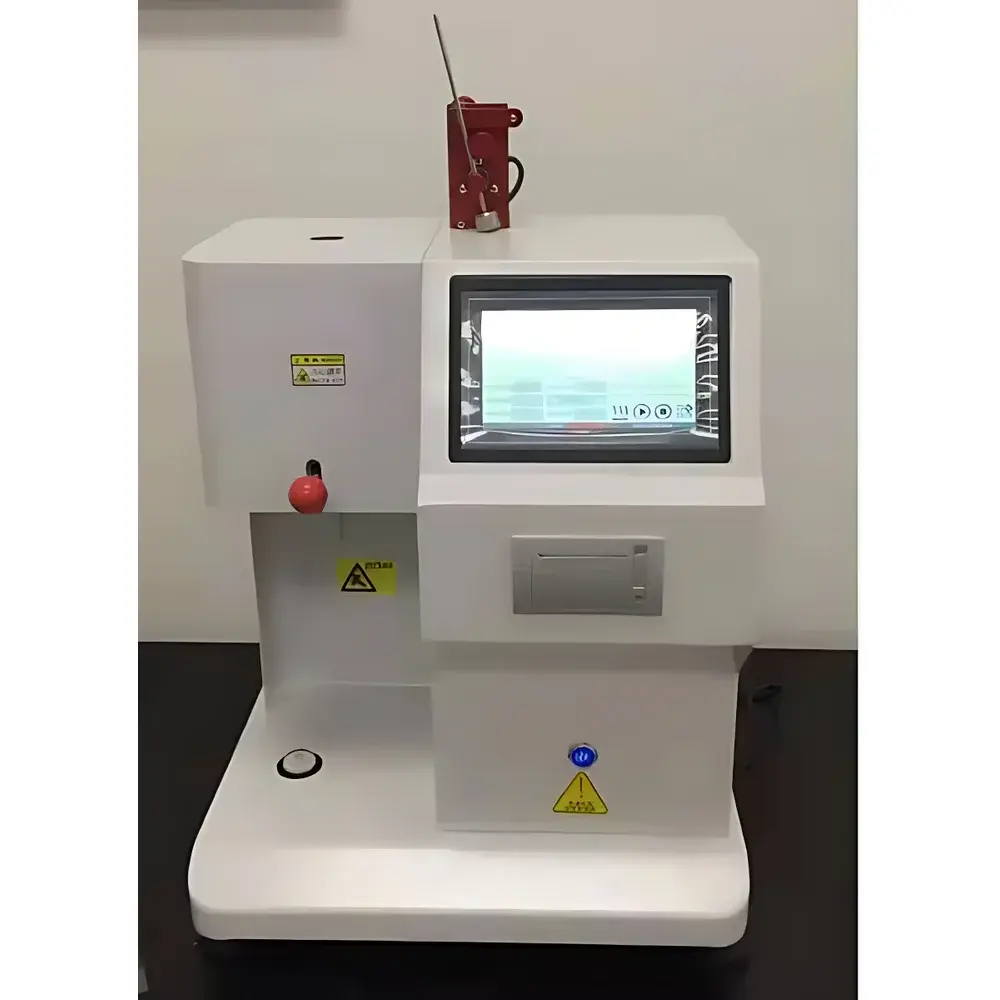
Yuelian YL-400WE Touchscreen Melt Flow Indexer (MFI) for PE, PP, PVC, PS, ABS, PC, POM, and Engineering Plastics
| Brand | Yuelian |
|---|---|
| Origin | Guangdong, China |
| Manufacturer Type | Authorized Distributor |
| Country of Origin | China |
| Model | YL-400WE |
| Temperature Range | 0–450 °C |
| Temp. Stability | ±0.2 °C |
| Temp. Uniformity | ±1 °C |
| Temp. Resolution | 0.1 °C |
| Time Resolution | 0.1 s |
| Displacement Accuracy | 0.001 mm |
| Volumetric Timing Resolution | 0.001 s |
| MFR Range | 0.1–150 g/10 min |
| MVR Range | 50–5000 cm³/10 min |
| Barrel ID | Φ2.095±0.005 mm |
| Die Length | 8.000±0.025 mm |
| Barrel Outer Diameter | Φ9.550±0.025 mm |
| Load Mass Tolerance | ±0.5% |
| Load Levels | 8 standard weights (0.325, 1.200, 2.160, 3.800, 5.000, 10.000, 12.000, 21.600 kg) |
| Display | 7-inch color TFT touchscreen |
| Cutting Mode | Manual & automatic |
| Data Output | Thermal printer + USB interface |
| Barrel Material | Nitrided Hastelloy C-276 |
| Die Material | Tungsten carbide |
| Insulation Chamber | Full SUS304 stainless steel |
Overview
The Yuelian YL-400WE is a precision-engineered melt flow indexer designed for standardized determination of melt mass flow rate (MFR) and melt volume flow rate (MVR) of thermoplastic polymers under controlled temperature and load conditions. Based on the fundamental principle of extrusion rheometry—where molten polymer is forced through a standardized capillary die under defined gravitational or applied load—the instrument quantifies flow behavior as an indicator of molecular weight distribution, processability, and batch-to-batch consistency. It operates in strict accordance with ISO 1133:1997, ASTM D1238, and GB/T 3682-2000, supporting both gravimetric (mass-based) and volumetric measurement modes. Its dual-zone PID-controlled heating system ensures stable thermal profiles across the barrel and die zones, critical for reproducible results in high-temperature engineering resins such as polycarbonate (PC), polyetherimide (PEI), polyphenylsulfone (PPSU), and fluoropolymers—as well as commodity plastics including polyethylene (PE), polypropylene (PP), polystyrene (PS), acrylonitrile-butadiene-styrene (ABS), polyoxymethylene (POM), and polyvinyl chloride (PVC).
Key Features
- 7-inch full-color TFT touchscreen interface with intuitive bilingual (English/Chinese) navigation and real-time parameter visualization
- Dual independent temperature control zones: upper barrel and lower die assembly, each equipped with imported platinum RTD sensors for gradient-aware thermal management
- Nitrided Hastelloy C-276 barrel material offering exceptional resistance to thermal degradation, oxidation, and abrasive wear at temperatures up to 450 °C
- Tungsten carbide capillary die (Φ2.095 mm × 8.000 mm) certified to ISO 1133 dimensional tolerances, ensuring long-term dimensional stability and flow repeatability
- Full SUS304 stainless-steel insulation chamber providing uniform thermal retention and corrosion resistance over extended operational cycles
- Integrated automatic cutting mechanism with manual override, enabling precise timing of extrudate collection for both MFR and MVR determinations
- High-resolution displacement transducer (0.001 mm) and timebase (0.1 s) for volumetric flow calculation compliant with ISO 1133-2 Annex A
- Comprehensive weight set (eight calibrated masses: 0.325–21.600 kg) traceable to national metrological standards with ±0.5% tolerance
- Onboard thermal printer with auto-result calculation and direct output; USB port supports data export to external PCs for LIMS integration or archival
Sample Compatibility & Compliance
The YL-400WE accommodates a broad spectrum of thermoplastic materials used in industrial compounding, injection molding, extrusion, and quality assurance laboratories. Validated test matrices include homopolymers and copolymers of PE (HDPE, LDPE, LLDPE), PP (homopolymer, random, impact-copolymer), PS, ABS, POM, PC, PET, PBT, PA6/66, PEEK, and specialty fluoroplastics (e.g., PTFE, FEP). All hardware components—including barrel, die, piston rod, and loading tray—meet mechanical and dimensional requirements specified in ISO 1133, ASTM D1238, and GB/T 3682. The system supports GLP-compliant operation when paired with audit-trail-enabled software (via USB-connected host PC), facilitating traceability for regulated environments governed by ISO/IEC 17025, FDA 21 CFR Part 11 (when electronic records are implemented), and internal QA/QC protocols.
Software & Data Management
While the YL-400WE operates autonomously via its embedded controller, its USB interface enables seamless connection to Windows-based laboratory PCs running third-party data acquisition or LIMS platforms. Raw time-stamped extrusion data—including cut timestamps, piston displacement, temperature logs per zone, and calculated MFR/MVR values—can be exported in CSV format. Users may configure report templates to include sample ID, operator name, test date/time, standard reference, load condition, and pass/fail status relative to specification limits. For regulated labs, integration with validated software solutions allows implementation of electronic signatures, user access controls, and audit trails—aligning with GMP/GLP documentation expectations and supporting regulatory submissions where required.
Applications
- Raw material acceptance testing for incoming polymer resin shipments
- In-process monitoring during polymerization, compounding, and masterbatch production
- Final product release testing in plastic manufacturing facilities
- Research and development of new formulations, stabilizer packages, or recycled content blends
- Comparative analysis of thermal degradation effects after multiple extrusion passes
- Correlation studies between MFR/MVR and mechanical properties (e.g., tensile strength, impact resistance)
- Calibration verification of inline rheometers in continuous extrusion lines
- Academic instruction in polymer physics, processing engineering, and materials characterization laboratories
FAQ
What standards does the YL-400WE comply with?
It fully conforms to ISO 1133:1997 (Parts 1 & 2), ASTM D1238, and GB/T 3682-2000 for both MFR (mass flow) and MVR (volume flow) determinations.
Can the instrument measure both MFR and MVR simultaneously?
Yes—using the integrated displacement sensor and high-resolution timer, it calculates MVR in real time while also supporting traditional gravimetric MFR measurement via manual or automatic cut-and-weigh procedures.
Is the die interchangeable for different polymer types?
The standard die meets ISO 1133 specifications for general-purpose testing; optional dies (e.g., micro-dies for low-flow materials) can be sourced separately but require recalibration and validation per ISO guidelines.
How is temperature uniformity verified across the barrel?
The dual-sensor architecture monitors top and bottom zones independently; users may perform routine verification using NIST-traceable immersion thermometers inserted at designated ports per ASTM D1238 Annex B.
Does the system support automated data archiving?
Yes—via USB export, all test metadata and raw measurements are saved in machine-readable CSV format, compatible with Excel, LabVIEW, or enterprise LIMS systems.





