
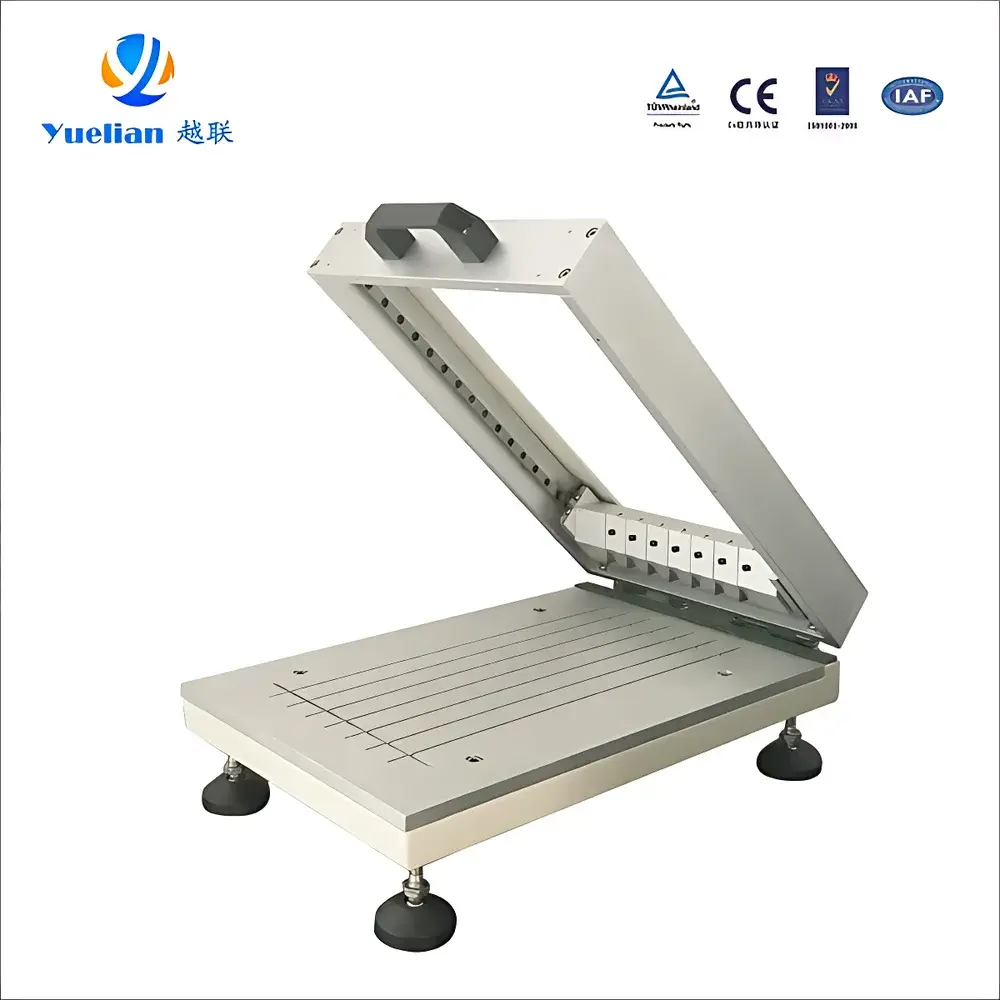
YL-8809A Film Quick Sampling Knife
| Origin | Guangdong, China |
|---|---|
| Manufacturer Type | Distributor |
| Origin Category | Domestic |
| Model | YL-8809A |
| Pricing | Upon Request |
| Sampling Thickness | 0.1–1.5 mm (foam tape), 0.1–0.25 mm (PET protective film), 0.1–0.6 mm (fabric tape) |
| Sampling Width | 15 mm, 24 mm, 25.4 mm (customizable) |
| Sampling Length | 300 mm |
| Sample Quantity per Cycle | 6 strips |
| Sampling Accuracy | ±0.1 mm |
| Dimensions (L×W×H) | 420 × 330 × 145 mm |
| Weight | 8 kg |
Overview
The YL-8809A Film Quick Sampling Knife is a manually operated, precision mechanical sampling device engineered for consistent, repeatable specimen preparation in packaging quality control laboratories and production floor environments. It operates on a guided shear-cut principle: samples are secured between a rigid template and a hinged pressure bracket; a calibrated linear knife carriage—fitted with a hardened stainless-steel blade—is drawn across the clamped material at controlled velocity and uniform downward force. This ensures clean, burr-free cuts without stretching or deformation—critical for tensile, peel, and adhesion testing where dimensional fidelity directly impacts measurement validity. Designed specifically for thin, flexible polymeric substrates—including pressure-sensitive adhesive tapes (PSA), release liners, PET-based protective films, and woven/fiber-reinforced tapes—the YL-8809A bridges the gap between manual dicing and automated die-cutting systems, offering laboratory-grade reproducibility without requiring compressed air, electrical power, or software integration.
Key Features
- Modular interchangeable width templates (15 mm, 24 mm, 25.4 mm) enable rapid adaptation to ASTM D3330, ISO 8510-2, and PSTC-101 test specimen requirements.
- Adjustable clamp pressure mechanism accommodates variable substrate compressibility—from low-density foam tapes (0.1–1.5 mm) to stiff polyester films (0.1–0.25 mm) and textile-backed tapes (0.1–0.6 mm)—without slippage or edge compression.
- Linear knife guide rail ensures straight-line motion with minimal lateral deviation, contributing to the stated ±0.1 mm dimensional tolerance across all cut specimens.
- Robust aluminum alloy frame and anodized steel components provide long-term dimensional stability and resistance to ambient humidity and minor solvent exposure common in packaging QC labs.
- Ergonomic lever-assisted blade actuation reduces operator fatigue during high-volume sampling sessions while maintaining consistent cutting force profile.
- Tool-free template swapping and blade replacement support quick changeover between material types and routine maintenance in accordance with ISO/IEC 17025 calibration interval recommendations.
Sample Compatibility & Compliance
The YL-8809A is validated for use with standard-width roll goods up to 300 mm in length per cut cycle, producing six parallel strips simultaneously. Its mechanical design conforms to the physical constraints defined in key international standards governing specimen geometry for mechanical testing: ASTM D3330 (peel adhesion), ASTM D6252 (tensile properties of PSA tapes), ISO 29862 (adhesive tape sampling), and PSTC Test Method 101 (loop tack). While the device itself does not require formal certification, its output specimens meet the dimensional acceptance criteria specified in GLP-compliant test protocols when used with traceably calibrated calipers and maintained per manufacturer guidelines. No electrical safety certifications (e.g., CE, UL) apply, as it is a Class I non-powered mechanical tool.
Software & Data Management
The YL-8809A is a standalone mechanical instrument with no embedded electronics, firmware, or connectivity interfaces. Consequently, it does not generate digital data logs, require software installation, or interface with LIMS or ELN platforms. All operational parameters—including sample width selection, clamping pressure setting, and blade alignment—are set manually and verified visually or via tactile feedback. This architecture eliminates cybersecurity risks, software validation burdens (e.g., FDA 21 CFR Part 11 compliance), and dependency on IT infrastructure—making it suitable for regulated environments where auditability relies on documented operator training, preventive maintenance records, and periodic verification of cut dimensions using certified metrology tools.
Applications
- Preparation of standardized specimens for peel strength testing (180° and 90°) per ASTM D903 and ISO 8510-1.
- Generation of uniform strips for tensile modulus and elongation-at-break analysis of backing materials in adhesive tapes.
- Production of identically dimensioned samples for comparative aging studies (e.g., thermal, UV, humidity exposure) prior to functional testing.
- Routine QC sampling in converter facilities processing release liners, masking tapes, and surface protection films.
- Supporting internal method validation exercises where inter-operator variability must be minimized through standardized physical sampling hardware.
FAQ
Is the YL-8809A compatible with ISO/IEC 17025-accredited testing laboratories?
Yes—provided that sampling procedures are documented in the laboratory’s SOPs, operators are trained and assessed for competency, and dimensional accuracy is verified at defined intervals using traceable calipers.
Can the blade be resharpened or must it be replaced?
The blade is designed for replacement only; resharpening is not recommended due to risk of altering the critical cutting edge geometry and compromising dimensional repeatability.
Does the device require calibration?
No formal calibration is required, but periodic verification of cut width, length, and parallelism against certified reference gauges is advised as part of a laboratory’s equipment management system.
What maintenance is recommended?
Monthly cleaning of the guide rail and template surfaces with isopropyl alcohol, inspection for blade wear or nicks, and lubrication of pivot points with dry-film lubricant per the user manual.
Is custom width tooling available beyond the standard options?
Yes—custom templates (e.g., 10 mm, 50 mm) can be fabricated upon request, subject to minimum order quantity and lead time confirmation.





