
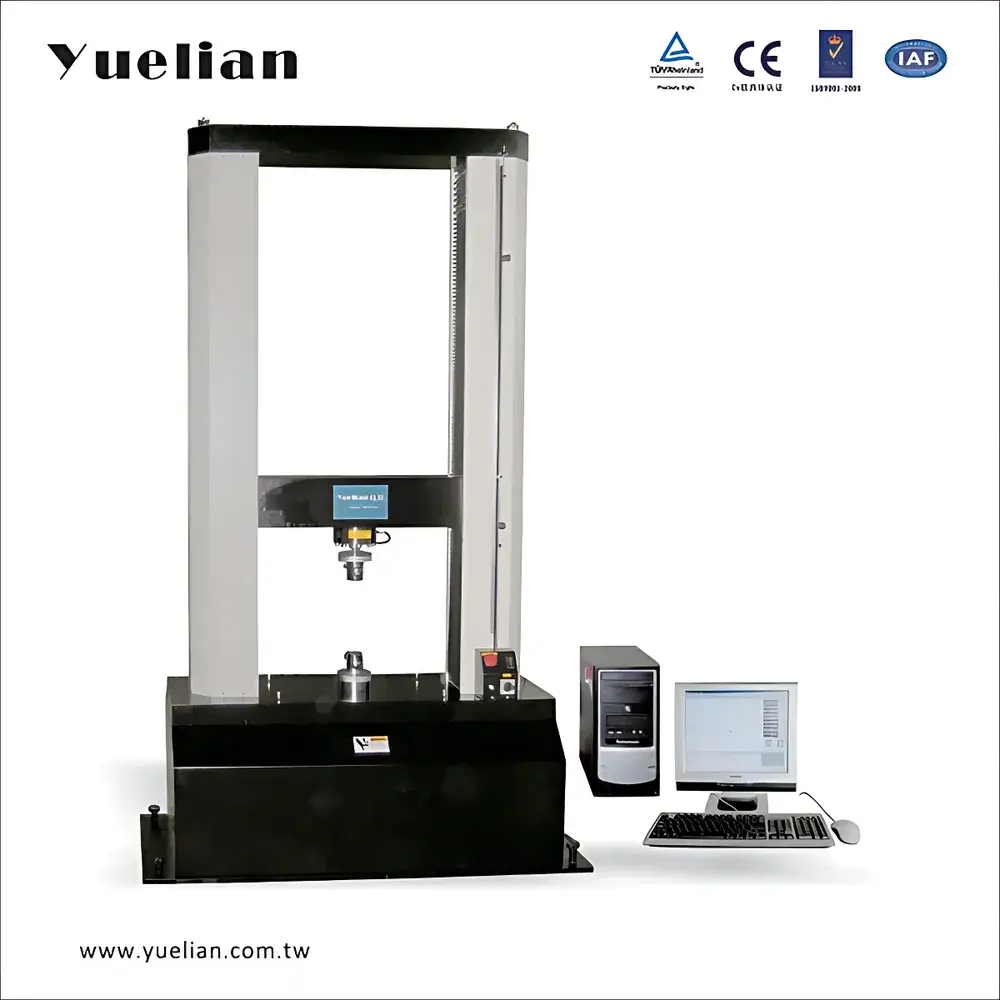
YL-1152 Yuelian Universal Testing Machine for Tempered Glass Compression Strength and Mechanical Property Evaluation
| Brand | Yuelian |
|---|---|
| Model | YL-1152 |
| Type | Electromechanical Universal Testing Machine (Compression-Focused Configuration) |
| Load Capacity Options | 1 kN, 2 kN, 5 kN, 10 kN, 20 kN, 50 kN, 100 kN, 200 kN (dual-range option available) |
| Force Resolution | 1/250,000 full scale |
| Force Accuracy | ≤ ±0.5% of reading |
| Displacement Resolution | 0.005 mm |
| Crosshead Travel | 1000 mm |
| Test Width | 550 mm |
| Speed Range | 0.5–500 mm/min (programmable) |
| Drive System | Servo motor + precision ball screw + synchronous timing belt |
| Power Supply | 220 V, 50/60 Hz, 10 A |
| Rated Power | 2500 W |
| Dimensions (W×D×H) | 108 × 85 × 205 cm |
| Weight | ~950 kg |
| Compliant Standards | ISO 7500-1, ASTM E4, EN 10002-1, EN 10002-2, DIN 51221, JIS B7721/B7733, GB/T 228.1, JJG 475 |
Overview
The YL-1152 Yuelian Universal Testing Machine is an electromechanically actuated, PC-controlled static mechanical testing system engineered for high-reproducibility compression, tensile, flexural, shear, peel, and tear evaluations—specifically configured and validated for tempered glass compressive strength assessment per ISO 7500-1 Class 1 accuracy requirements. Unlike generic load frames, this system integrates a rigid C-frame architecture with preloaded precision ball screws and high-inertia servo control to minimize frame deflection and maintain axial alignment during high-force glass fracture testing (up to 200 kN). Its force transduction relies on calibrated strain-gauge load cells traceable to national metrology institutes, ensuring compliance with ASTM E4 verification protocols for force measurement systems. The machine operates under closed-loop displacement or load control, enabling precise execution of standardized compression tests—including flatwise and edgewise loading configurations specified in EN 12150-1 for thermally toughened soda-lime silicate glass.
Key Features
- Rigid, two-column C-frame construction with reinforced base plate and crosshead—optimized for stability during brittle material failure events.
- High-resolution servo drive system delivering consistent speed accuracy across the full 0.5–500 mm/min range, critical for controlled crack propagation studies in glass substrates.
- Force measurement certified to ISO 7500-1 Class 1 (≤ ±0.5% error) with internal auto-calibration routines and zero-drift compensation.
- Displacement feedback via high-precision linear encoder (0.005 mm resolution), independent of screw pitch errors.
- Dual-capacity load cell support allows seamless switching between low-force (e.g., interlayer adhesion) and high-force (e.g., bulk compression) test regimes without hardware reconfiguration.
- Integrated emergency stop circuitry, overload cutoff, specimen rupture detection, and programmable upper/lower travel limits—all meeting EN ISO 12100 functional safety requirements.
- Modular fixture interface compatible with standardized compression platens (e.g., Ø100 mm hardened steel), anti-buckling guides, and edge-support fixtures per EN 1288-3 for flexural strength validation.
Sample Compatibility & Compliance
The YL-1152 accommodates flat, rectangular, or circular tempered glass specimens up to 550 mm wide and 1000 mm tall—sufficient for full-size architectural or automotive glazing samples. It supports both direct compression (ASTM C1036-compliant platen geometry) and indirect methods such as ring-on-ring (ISO 178) and ball-on-three-balls (EN 1288-5). All mechanical validations adhere to GLP-aligned documentation practices: audit trails record operator ID, calibration timestamps, environmental conditions (optional sensor integration), and raw force-displacement data streams. The system meets essential requirements of EU Machinery Directive 2006/42/EC and carries CE marking for conformity with harmonized standards including EN 61000-6-2 (EMC) and EN 61000-6-4 (emissions).
Software & Data Management
The embedded Windows-based control software provides ISO/IEC 17025-aligned test sequencing, real-time curve visualization, and automated report generation compliant with FDA 21 CFR Part 11 (electronic signatures, audit trail, data integrity controls). Raw data is stored in encrypted MS-ACCESS databases with versioned backups; export formats include CSV, PDF, XML, and ASTM E1434-compliant .tdf files. Multi-sensor synchronization supports concurrent acquisition from extensometers, temperature probes, or acoustic emission sensors. Curve analysis modules compute compressive yield stress, fracture load, modulus of elasticity (via initial linear slope), and post-peak energy absorption—parameters required by GB/T 15763.2 and EN 12150-2 for product certification.
Applications
- Quantitative determination of compressive strength and load-deflection behavior of monolithic and laminated tempered glass panels.
- Validation of thermal tempering uniformity through comparative edge-to-center compression response mapping.
- Mechanical qualification of glass used in façade systems, vehicle side/rear windows, and explosion-resistant barriers.
- Interlayer bond integrity assessment in PVB/SGP-laminated assemblies via controlled compression-induced delamination onset detection.
- Research-grade investigation of microcrack coalescence mechanisms under monotonic and cyclic loading profiles.
- Supplier qualification testing aligned with OEM specifications (e.g., Ford WSS-M327A, GM GMW14872, VW TL 226).
FAQ
Does the YL-1152 meet ISO 7500-1 Class 1 calibration requirements for glass compression testing?
Yes—the system undergoes factory verification using NIST-traceable deadweight standards and includes user-accessible calibration routines compliant with ISO 7500-1 Annex B.
Can the machine perform both compression and tensile tests on the same specimen set?
Yes, with appropriate fixture exchange (e.g., wedge-action grips for tensile, hardened platens for compression); all test modes share identical control architecture and data pipeline.
Is third-party certification available for regulatory submissions?
Yuelian provides optional UKAS-accredited calibration certificates and IQ/OQ documentation packages supporting GMP and ISO 9001 laboratory audits.
What environmental conditions are recommended during glass compression testing?
Testing should be conducted at 23 ± 2 °C and 50 ± 5% RH per ISO 291; optional environmental chamber integration is supported via analog I/O ports.
How is data integrity ensured during long-duration creep or relaxation tests?
The software implements cyclic memory buffering, automatic power-fail recovery, and SHA-256 hash logging of all acquired data points to prevent corruption or loss.



