
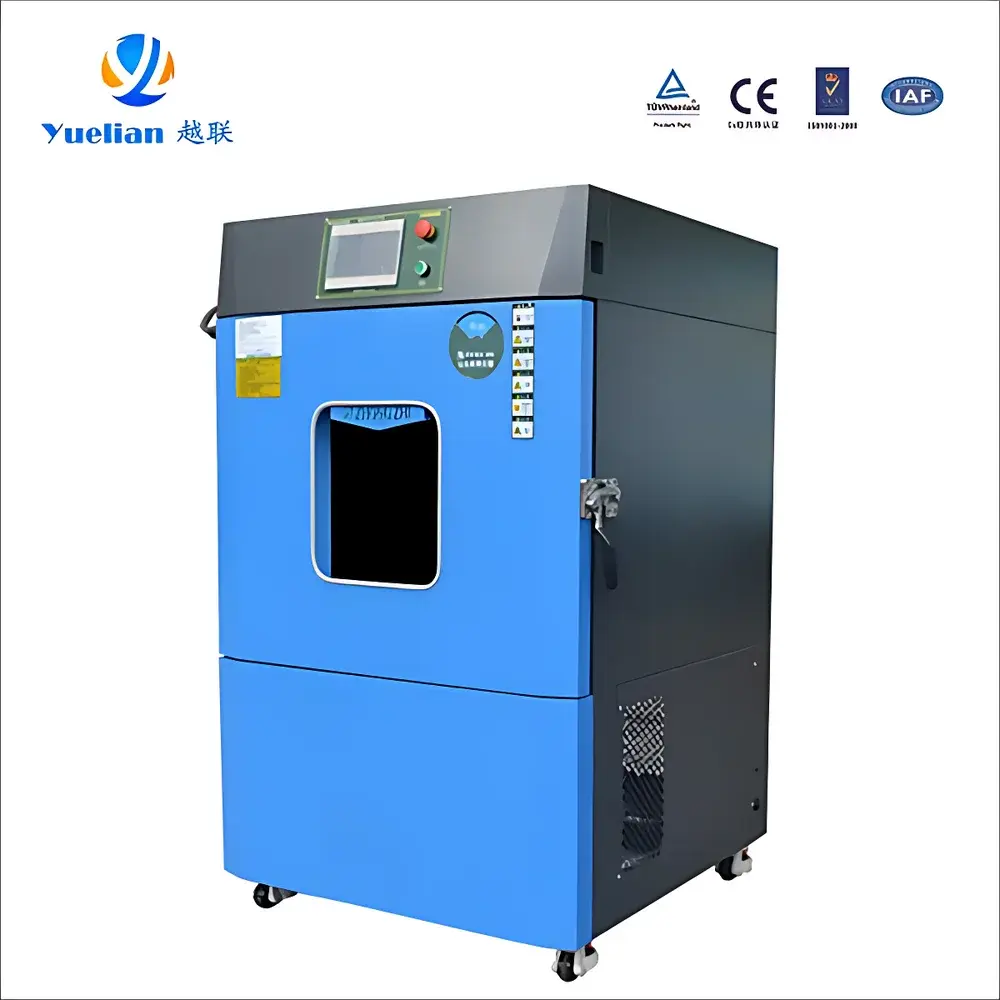
Yuelian YL-JP-01 Electric Vehicle Battery Seawater Immersion Test System
| Brand | Yuelian |
|---|---|
| Origin | Guangdong, China |
| Manufacturer Type | Authorized Distributor |
| Country of Origin | China |
| Model | YL-JP-01 |
| Tank Dimensions (W×H×D) | 500×600×500 mm |
| External Dimensions (W×H×D) | 880×1680×730 mm |
| Max Sample Size | 200×200×200 mm |
| Max Sample Weight | 10 kg |
| Chamber Material | Heavy-Gauge Stainless Steel (Interior), Powder-Coated Cold-Rolled Steel (Exterior, Grey/Blue) |
| Observation Window | 350×400 mm Dual-Layer Tempered Safety Glass |
| Lift Range | 0–700 mm (Motorized, Programmable) |
| Height Detection Accuracy | ±0.5 mm |
| Display Resolution | 0.1 mm |
| Immersion Duration Range | 0–99 h 59 min 59 s |
| Control System | PLC with Touchscreen HMI |
| Water Supply | Manual & Automatic Refill |
| Exhaust | Forced Ventilation System |
| Pressure Relief | Integrated Automatic Pressure Release Port |
| Power Supply | AC 220 V, 50 Hz |
Overview
The Yuelian YL-JP-01 Electric Vehicle Battery Seawater Immersion Test System is an engineered environmental test platform designed to evaluate the structural integrity, sealing performance, and electrochemical safety of lithium-ion battery cells under controlled seawater exposure conditions. It operates in strict accordance with GB/T 31485–2015, the Chinese national standard for safety testing of traction batteries used in electric vehicles. The system simulates real-world marine or coastal accident scenarios—such as submersion during flood events or maritime transport incidents—by immersing charged battery units in a 3.5% (mass fraction) NaCl aqueous solution at ambient temperature. This concentration replicates the average salinity of natural seawater (≈35 g/kg), enabling standardized corrosion, leakage, and thermal runaway assessment. Unlike generic water immersion chambers, the YL-JP-01 integrates precision vertical sample positioning, automated height-sensing lift mechanisms, and sealed chamber architecture to ensure consistent immersion depth, reproducible test boundary conditions, and operator safety during high-voltage battery handling.
Key Features
- Motorized programmable lift mechanism with 0–700 mm travel range and ±0.5 mm positional repeatability, enabling precise control over immersion depth relative to sample geometry.
- Integrated height-sensing module that automatically detects sample dimensions and adjusts lift position to maintain full submersion—critical for heterogeneous cell formats (prismatic, cylindrical, pouch).
- Dual-layer tempered safety observation window (350 × 400 mm) providing unobstructed visual monitoring without compromising chamber integrity or personnel safety.
- Corrosion-resistant internal chamber constructed from heavy-gauge stainless steel; exterior housing fabricated from powder-coated cold-rolled steel for mechanical durability and chemical resistance.
- Forced exhaust ventilation system with dedicated ducting to manage potential off-gas emissions (e.g., HF, CO, VOCs) generated during thermal events—aligned with laboratory fume management best practices.
- Automated pressure relief port activated upon internal overpressure detection, mitigating risks associated with gas accumulation during abnormal battery behavior.
- PLC-based touchscreen HMI interface supporting time-stamped test parameter logging, user-defined soak duration (0–99 h 59 min 59 s), and manual/automatic water replenishment modes.
Sample Compatibility & Compliance
The YL-JP-01 accommodates single-cell specimens up to 200 × 200 × 200 mm and 10 kg—covering common 18650, 21700, 32136, and mid-size prismatic formats. Its modular design ensures compatibility with post-charge conditioning protocols per GB/T 31485–2015 Section 6.1.3. While primarily aligned with Chinese national standards, the system’s controlled immersion methodology supports cross-referencing against international frameworks including ISO 12405-3 (electric vehicle battery testing), UL 2580 (battery safety), and UN GTR No. 20 (global technical regulation for EV battery safety). All operational parameters—including immersion duration, solution concentration, and temperature stability—are traceable and auditable, facilitating GLP-compliant documentation workflows.
Software & Data Management
The embedded PLC controller records timestamped event logs—including lift actuation cycles, immersion start/end times, and manual intervention flags—stored locally on non-volatile memory. Data export is supported via USB interface in CSV format for integration into LIMS or QA reporting systems. Though not FDA 21 CFR Part 11-certified out-of-the-box, the system architecture permits third-party validation for regulated environments: audit trails can be enabled through firmware configuration, and user access levels (operator, engineer, administrator) are configurable via password-protected HMI menus. All parameter changes generate immutable log entries with operator ID and timestamp—supporting ISO/IEC 17025 traceability requirements.
Applications
- Pre-certification safety validation of EV battery cells prior to GB/T 31485–2015 compliance submission.
- Comparative evaluation of sealant materials, housing gasket designs, and terminal encapsulation methods under saline immersion stress.
- Root-cause analysis of electrolyte leakage pathways following mechanical abuse or thermal propagation tests.
- Accelerated aging studies correlating saltwater exposure duration with impedance rise, capacity fade, and interfacial corrosion observed via post-test SEM/EDS analysis.
- Supporting OEM supplier qualification programs requiring documented evidence of environmental robustness under marine transport conditions (IMO MSC.1/Circ.1277).
FAQ
Does the YL-JP-01 meet international regulatory requirements beyond GB/T 31485?
It is engineered to support test execution aligned with ISO 12405-3, UL 2580, and UN GTR No. 20 methodologies, though formal certification requires site-specific validation by the end user.
Can the system accommodate battery modules or only single cells?
The YL-JP-01 is optimized for single-cell testing per GB/T 31485–2015 Annex A. For module-level immersion, the larger YL-JP-02 variant (with 1500 × 800 × 1200 mm capacity) is recommended.
Is the NaCl solution temperature controlled?
No—ambient temperature operation is specified in GB/T 31485–2015. Optional external chiller integration is available upon request for custom thermal profiles.
How is electrical isolation maintained during testing?
The chamber features insulated mounting interfaces and grounding provisions per IEC 61000-4-5; users must implement external high-voltage isolation cabinets or remote charging/discharging setups prior to immersion.
What maintenance intervals are recommended for the lift mechanism and seals?
Lift motor lubrication and silicone gasket inspection are advised every 500 operational cycles or biannually—whichever occurs first—to ensure positional accuracy and chamber integrity.



