
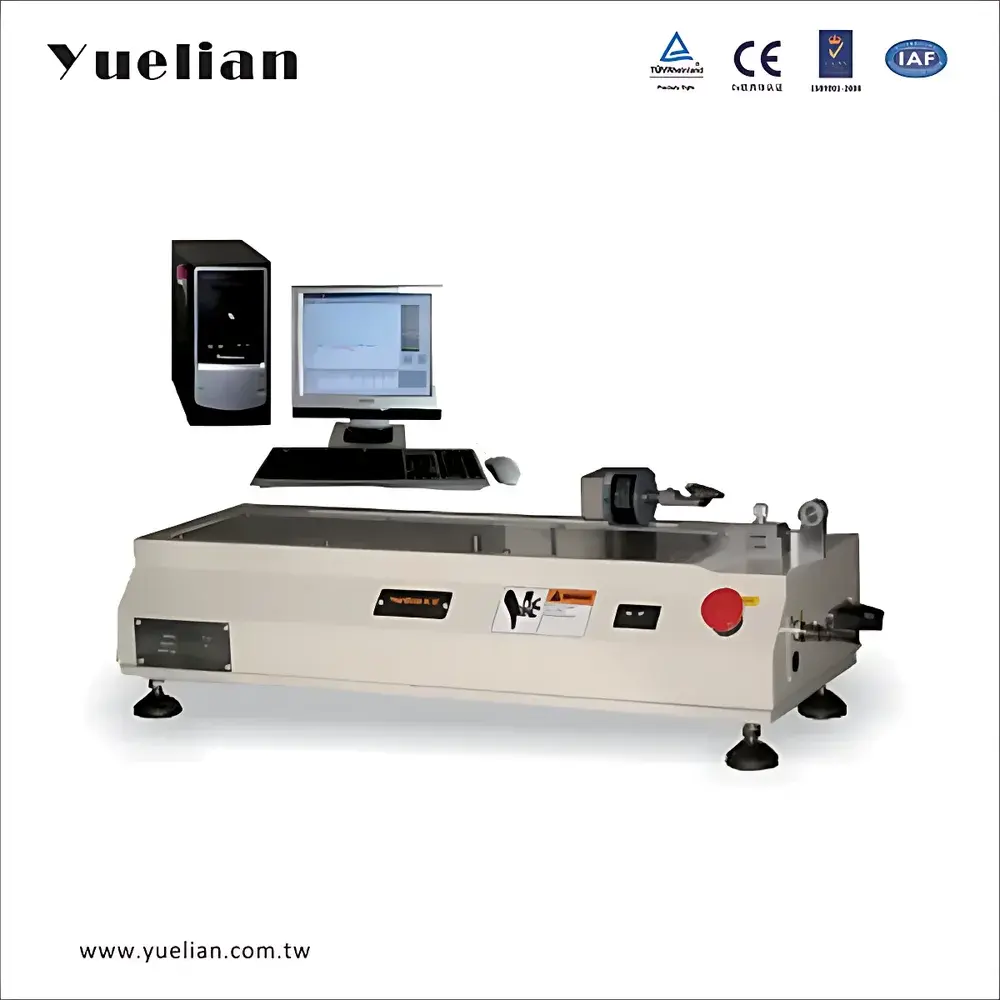
Battery Peel Test Machine Yuelian YL-1103S Electronic Universal Testing System
| Brand | Yuelian |
|---|---|
| Origin | Guangdong, China |
| Model | YL-1103S |
| Instrument Type | Electronic Universal Testing Machine |
| Load Capacity Options | 10 N, 20 N, 50 N, 100 N, 200 N (dual-range configuration available) |
| Force Resolution | 1/500,000 full scale |
| Force Accuracy | ±0.3% of reading |
| Travel Resolution | 1/500,000 full stroke |
| Crosshead Travel | 500 mm |
| Test Width | 140 mm |
| Test Speed Range | 5–500 mm/min (PC-programmable) |
| Power Supply | 220 V, 50/60 Hz, 5 A |
| Motor Type | Stepper motor with precision ball screw and timing belt drive |
| Rated Power | 180 W |
| Dimensions (W×D×H) | 1063 × 300 × 200 mm |
| Weight | ~45 kg |
| Compliance Standards | GB/T 2792, ASTM D3330, GB 2792–1981 |
| Data Acquisition | PC-based via USB interface |
| Software Features | Real-time curve plotting, multi-sensor support, MS-ACCESS database integration, automatic calculation of peak force, yield force, average peel force, maximum displacement, yield point, elastic modulus, auto-return, overload protection, specimen rupture detection, upper/lower limit stop logic |
Overview
The Yuelian YL-1103S Battery Peel Test Machine is a dedicated electronic universal testing system engineered for high-precision peel adhesion evaluation of photovoltaic cell interconnects, tabbing ribbons, encapsulant films, and laminated battery electrode assemblies. It operates on the principle of controlled tensile separation at a defined angle (typically 90° or 180° per ASTM D3330 and GB/T 2792), applying calibrated axial force to quantify interfacial bond strength between dissimilar layers—such as copper foil and active material coatings, aluminum current collectors and cathode slurries, or EVA/glass interfaces in module lamination. Unlike general-purpose mechanical testers, the YL-1103S integrates purpose-built motion control architecture, microprocessor-driven load cell signal conditioning, and real-time displacement feedback to ensure repeatability across low-force regimes critical for thin-film and flexible substrate characterization. Its design prioritizes metrological integrity in compliance with ISO/IEC 17025 traceability frameworks when paired with accredited calibration protocols.
Key Features
- High-resolution force measurement with ±0.3% accuracy and 1/500,000 internal resolution—optimized for sub-Newton peel force quantification typical of solar cell ribbon bonds and pouch cell laminate interfaces.
- Programmable crosshead speed (5–500 mm/min) enabling adherence to standardized test rates specified in ASTM D3330 Method A (200 mm/min) and GB/T 2792 (300 mm/min), with ramp-hold-sequence capability for creep or dwell-controlled peel profiling.
- Dual-capacity load cell support (10 N / 200 N standard options) allows seamless transition between delicate tab peel testing and robust backsheet delamination assessment without hardware recalibration.
- Stepper motor + precision ball screw actuation ensures minimal backlash, thermal drift stability, and consistent velocity linearity—critical for generating reproducible force-displacement curves under GLP-compliant laboratory conditions.
- Integrated safety logic includes overload cutoff, emergency stop, automatic specimen rupture halt, and programmable upper/lower travel limits—meeting IEC 61000-6-2 EMC and EN 61000-6-4 emission requirements for industrial lab environments.
- Full auto-return functionality eliminates manual repositioning between sequential tests, reducing operator-induced variability and increasing throughput in QC batch verification workflows.
Sample Compatibility & Compliance
The YL-1103S accommodates standard peel specimens up to 140 mm wide and 500 mm travel length, supporting common configurations used in PV and lithium-ion battery manufacturing: 90° T-peel of busbar-to-cell interfaces, 180° peel of laminated encapsulant edges, and modified loop-tack evaluations of pressure-sensitive conductive adhesives. Fixture adaptability includes quick-release jaw clamps compatible with ISO 2411-compliant peel grips and custom-machined fixtures for ribbon anchoring or edge-notched laminates. The system conforms to national and international peel test standards including GB/T 2792–2014 (equivalent to ISO 8510-2), ASTM D3330–14 (Standard Test Method for Peel Adhesion of Pressure-Sensitive Tape), and supports documentation alignment with FDA 21 CFR Part 11 requirements through audit-trail-enabled software logging of user actions, parameter changes, and raw data export timestamps.
Software & Data Management
Control and analysis are executed via Windows-compatible software with native USB 2.0 communication, eliminating external DAQ hardware dependencies. The application provides synchronized acquisition of force, displacement, and time vectors at ≥1 kHz sampling rate, rendering real-time L–F (load–displacement) and P–T (peel force–time) plots. Calculated outputs include average peel force over defined displacement windows, peak separation force, energy-to-peel (area under curve), and statistical summaries across multi-specimen batches. Data persistence utilizes embedded MS-ACCESS database architecture with field-level encryption, supporting structured queries, CSV/PDF report generation, and direct linkage to enterprise LIMS platforms via ODBC drivers. All test parameters, calibration coefficients, and operator metadata are digitally signed and version-stamped to satisfy ISO 17025 clause 7.7 record retention mandates.
Applications
- Quantitative peel strength validation of soldered or ultrasonically bonded interconnect ribbons on silicon photovoltaic cells.
- Adhesion performance screening of anode/cathode coatings on current collector foils during electrode slurry formulation development.
- Quality control of thermal lamination integrity in prismatic and pouch-type lithium-ion battery stacks.
- Evaluation of aging effects on encapsulant–glass or backsheet–encapsulant interfacial cohesion after damp heat (DH1000) or thermal cycling stress.
- Comparative analysis of adhesive alternatives—including conductive epoxies, sintered silver pastes, and thermoplastic films—in high-reliability power electronics packaging.
- Supporting root-cause analysis of field-failure modes linked to interlayer debonding, such as hot-spot formation in PV modules or swelling-induced delamination in EV battery packs.
FAQ
Does the YL-1103S support automated pass/fail judgment based on peel force thresholds?
Yes—the software enables user-defined upper and lower specification limits per test method; results are color-coded and flagged in summary reports with configurable tolerance bands.
Can test data be exported in formats compatible with statistical process control (SPC) software?
All raw and processed data export natively to CSV, Excel (.xlsx), and PDF; ASCII-delimited files include header metadata required for Minitab, JMP, and SPC cloud platforms.
Is third-party calibration certification available for ISO/IEC 17025 traceability?
Calibration services with NIST-traceable certificates (including uncertainty budgets per ISO/IEC 17025 Annex A.1) are provided by authorized metrology partners upon request.
What maintenance intervals are recommended for long-term force accuracy retention?
Annual verification of load cell linearity and crosshead positioning accuracy is advised; routine cleaning of ball screw and timing belt components every 6 months ensures mechanical longevity.
How does the system handle temperature-sensitive peel testing requiring environmental chamber integration?
The YL-1103S features analog I/O ports and Modbus RTU protocol support for synchronization with external environmental chambers—enabling coordinated temperature-ramp peel protocols per IEC 61215-2 MQT 14.
Related Products



