
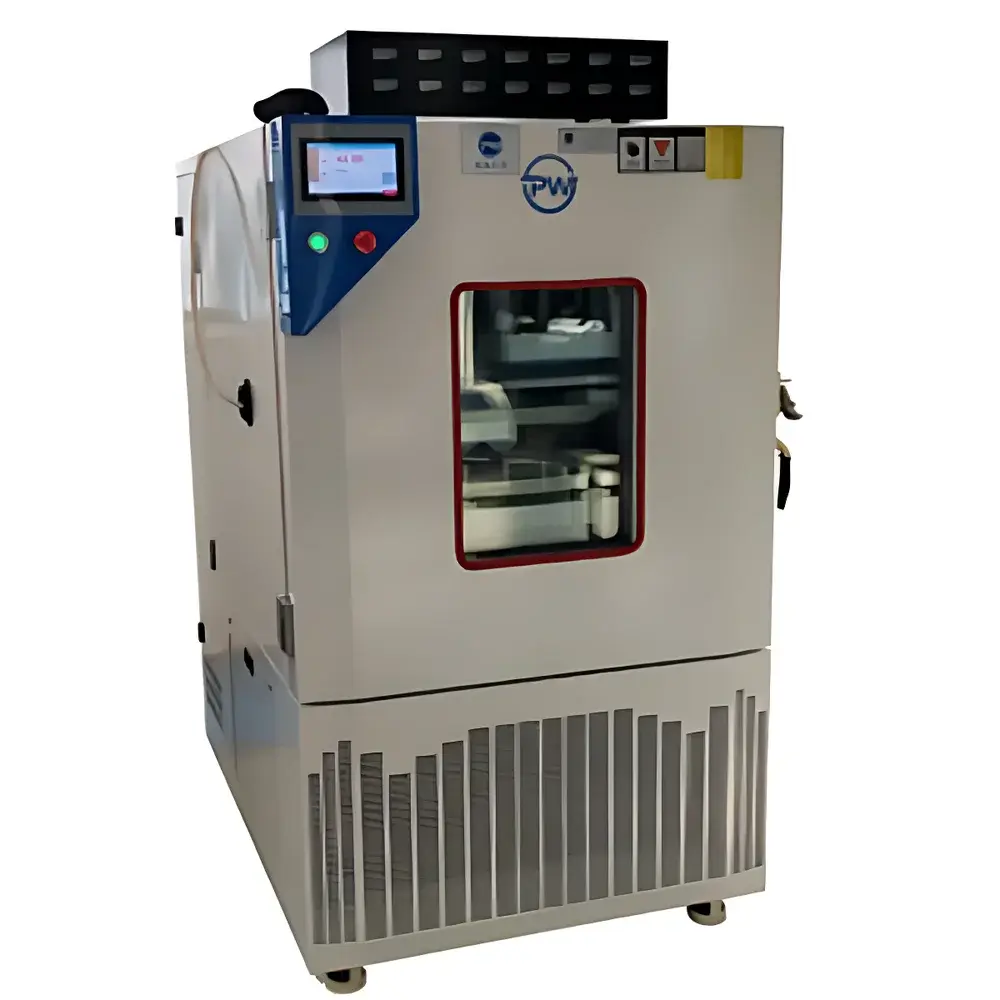
Yuelian PW-CSS14-40A Programmable Temperature and Humidity Controlled Adhesion Retention Tester
| Brand | Yuelian |
|---|---|
| Origin | Guangdong, China |
| Model | PW-CSS14-40A |
| Instrument Type | Vertical |
| Cooling Method | Air-cooled |
| Temperature Range | -40 °C to 150 °C |
| Humidity Range | 20–98 % RH |
| Temperature Uniformity | ≤ ±2 °C |
| Temperature Fluctuation | ±1 °C |
| Humidity Uniformity | ≤ ±3 % RH |
| Humidity Fluctuation | ±3 % RH |
| Heating Rate | 1.0–3.0 °C/min |
| Internal Chamber Dimensions | 400 × 500 × 400 mm (W × D × H) |
Overview
The Yuelian PW-CSS14-40A is a programmable temperature- and humidity-controlled adhesion retention tester engineered for standardized static load testing of pressure-sensitive adhesives under precisely regulated environmental conditions. It operates on the principle of vertical peel resistance measurement under constant gravitational loading—where a specimen (e.g., adhesive tape or medical patch) is affixed to a standardized stainless steel plate, suspended vertically, and subjected to a defined static mass. The system records either the time-to-failure (complete detachment) or displacement after a fixed duration, quantifying adhesive durability under thermal and hygroscopic stress. Unlike ambient-only testers, this instrument integrates full climatic simulation capabilities, enabling evaluation of adhesive performance across real-world service environments—including high-temperature/high-humidity storage, low-temperature shipping, or cyclic condensation scenarios. Its architecture conforms to the fundamental mechanical and metrological requirements of ASTM D3654, GB/T 4851, JIS Z0237, and PSTC-7, supporting both R&D validation and QC release testing in regulated manufacturing settings.
Key Features
- 14 independent test stations with synchronized environmental control—each equipped with dedicated 1 kg weights, precision-machined SUS304 test plates (75 × 50 × 1.6 mm), and individual digital timers (0.1-minute resolution, auto-hold on detachment)
- Advanced climate control system featuring imported hermetic compressors, Japanese鹭宫 (Rukuo) electronic expansion valves, and PID-driven humidity regulation—enabling stable, energy-efficient operation across the full -40 °C to +150 °C / 20–98 % RH range
- 7-inch color touchscreen controller with dual-language (English/Chinese) interface, graphical program curve display, real-time segment tracking, and cumulative runtime logging
- Programmable test profiles: up to 12 programs, 120 segments, 999 cycles per program—with support for partial looping, segment insertion, and inter-program linking
- Comprehensive safety architecture including over-temperature cutoff, dry-run protection, water-level monitoring, ground-fault interruption, and automatic power-resume after outage
- Modular internal construction using mirror-finish SUS304 stainless steel; external cabinet finished with electrostatic epoxy coating for corrosion resistance and cleanroom compatibility
Sample Compatibility & Compliance
The PW-CSS14-40A accommodates standard specimens sized 50 mm × 25 mm (L × W), compatible with pressure-sensitive tapes, transdermal patches, protective films, labeling adhesives, and biomedical dressings. Its test methodology aligns with internationally recognized standards for static shear adhesion assessment—including ASTM D3654 (Standard Test Method for Shear Adhesion of Pressure-Sensitive Tapes), GB/T 4851 (Chinese national standard for adhesive tape retention), JIS Z0237 (Japanese Industrial Standard for adhesive tapes), and PSTC-7 (Pressure Sensitive Tape Council specification). The chamber’s temperature and humidity uniformity (±2 °C / ±3 % RH) satisfies GLP-aligned environmental qualification protocols. While not inherently 21 CFR Part 11 compliant, audit-ready data export (via RS485/USB) and tamper-evident timer logs support traceability in GMP-regulated facilities when integrated into validated SOP workflows.
Software & Data Management
The embedded controller supports full test program definition, execution logging, and event-triggered data capture without external PC dependency. Timer outputs are stored locally with timestamped detachment events, accessible via on-screen history or exported as CSV files. Optional PC-based software (supplied with instrument) enables remote monitoring, multi-unit fleet management, and automated report generation—including pass/fail status against user-defined thresholds (e.g., “≥30,000 minutes retention at 70 °C/90 % RH”). All firmware updates and calibration parameter adjustments require password-protected access, ensuring configuration integrity during routine operation.
Applications
- Quality assurance of hot-melt, acrylic, and rubber-based PSAs under accelerated aging conditions
- Stability screening of transdermal drug delivery systems across ICH Q1A–Q1E climatic zones
- Comparative evaluation of adhesive formulations for automotive interior trim bonding
- Validation of label adhesion on beverage containers exposed to condensation cycles
- Research into humidity-induced plasticization effects on polymer tackifiers
- Pre-compliance testing for UL 969 (label permanence) and ISO 15378 (primary packaging for pharmaceuticals)
FAQ
What is the maximum number of simultaneous tests supported?
The system supports 14 parallel test stations, each with independent timing and identical environmental exposure.
Can the chamber be calibrated to NIST-traceable standards?
Yes—third-party calibration services are available for temperature and humidity sensors, with certificates traceable to national metrology institutes.
Is the test plate material compliant with ASTM D3654 specifications?
Yes—the supplied 75 × 50 × 1.6 mm plates are precision-ground SUS304 stainless steel, meeting surface roughness (Ra ≤ 0.4 µm) and dimensional tolerances specified in ASTM D3654 Annex A1.
Does the instrument support dynamic humidity ramping (e.g., 20% → 95% RH in 30 min)?
Yes—the controller allows linear or stepwise humidity transitions within programmed segments, with rate limits governed by chamber capacity and ambient dew point.
What maintenance intervals are recommended for long-term accuracy?
Monthly lubrication of lift mechanisms, quarterly verification of weight calibration (±0.1 g tolerance), and annual sensor recalibration are advised per ISO/IEC 17025-aligned maintenance schedules.



