
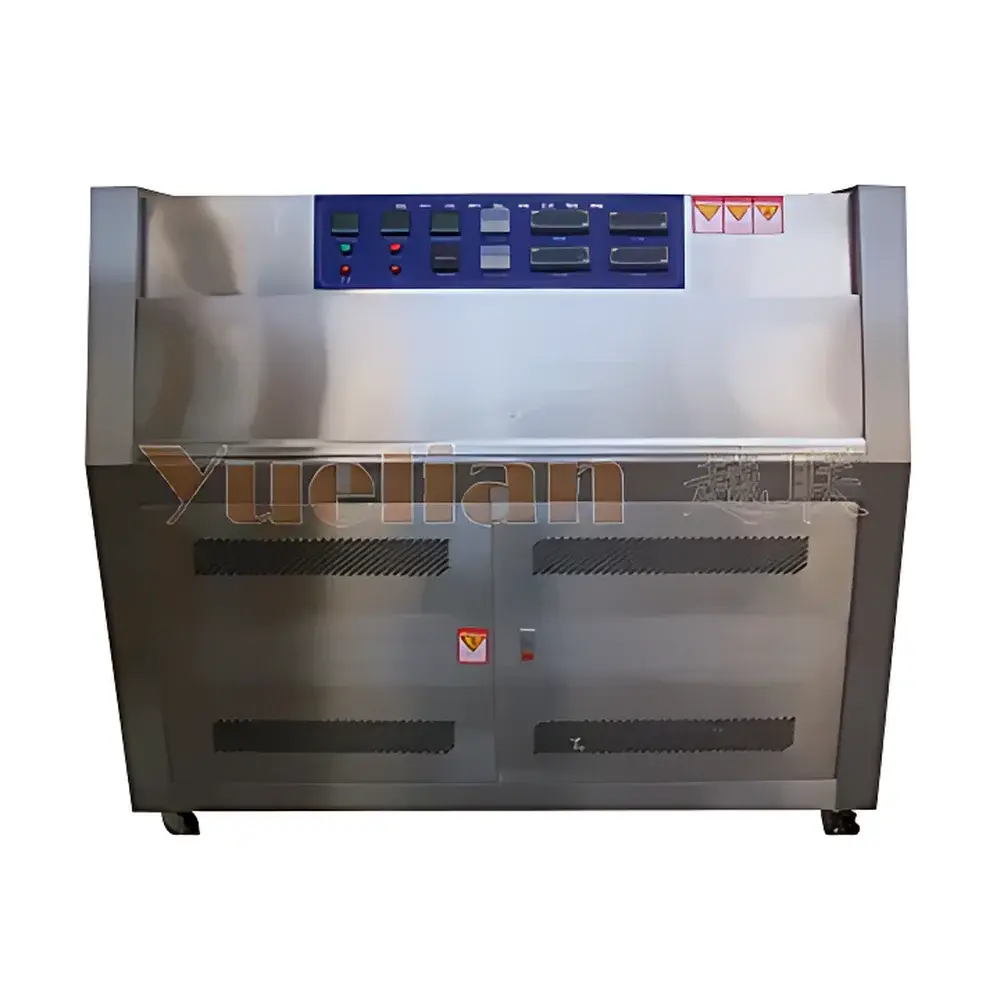
Yuelian YL2206QK UV Aging Test Chamber
| Brand | Yuelian |
|---|---|
| Origin | Guangdong, China |
| Model | YL2206QK |
| Temperature Range | RT+10°C to 70°C |
| Humidity Range | ≥95% RH |
| Temperature Uniformity | ≤±2°C |
| Temperature Fluctuation | ≤±0.5°C |
| Humidity Uniformity & Fluctuation | ≤±2% RH |
| Black Panel Temperature | 40°C–65°C |
| UV Wavelength Range | 290–400 nm (UVA-340 or UVB-313 selectable) |
| Lamp Power | 40 W × 8 |
| Lamp Spacing | 35 mm |
| Sample-to-Lamp Distance | 50 mm |
| Condensation Cycle Duration | 0–99 h |
| UV Exposure Time | 0–99 h |
| Total Test Duration | 0–9999 h |
| Irradiance | ≤50 W/m² |
| Chamber Interior Dimensions (W×D×H) | 1170×450×500 mm |
| Sample Capacity | ~40 pcs of 150×75 mm specimens |
Overview
The Yuelian YL2206QK UV Aging Test Chamber is an engineered environmental test system designed for accelerated weathering evaluation of non-metallic and organic materials under controlled ultraviolet (UV) radiation and condensation cycles. It operates on the principle of fluorescent UV lamp irradiation—specifically UVA-340 (peak at 340 nm) or UVB-313 (peak at 313 nm)—to replicate the most damaging portion of solar UV spectrum responsible for photochemical degradation. Unlike full-spectrum xenon arc systems, this chamber focuses on short-wavelength UV exposure combined with high-humidity condensation phases, enabling rapid simulation of outdoor aging mechanisms including polymer chain scission, pigment fading, surface chalking, and loss of mechanical integrity. The chamber’s thermal and humidity control architecture ensures stable black panel temperature (40–65°C) and ≥95% RH condensation conditions—key parameters defined in ISO 4892-3, ASTM G154, and GB/T 16422.3. Its design supports reproducible, comparative aging studies essential for QC labs, R&D departments, and regulatory compliance testing.
Key Features
- Eight 40 W fluorescent UV lamps (four per side), configurable with UVA-340 or UVB-313 spectral output to match application-specific degradation profiles
- Dynamic lamp replacement protocol: one lamp replaced every 25% of rated life (≈125 h for standard lamps; ≈400–450 h for imported lamps), maintaining consistent irradiance output over extended test durations
- Precise black panel temperature control (±0.5°C fluctuation, ±2°C uniformity) calibrated per ASTM G147 and ISO 4892-3 requirements
- Dedicated condensation system with adjustable cycle timing (0–99 h), generating realistic dew formation on specimen surfaces without water immersion
- Robust stainless-steel interior chamber (1170 × 450 × 500 mm W×D×H) with optimized lamp-to-sample geometry (50 mm distance, 35 mm inter-lamp spacing) for uniform irradiance distribution
- Manual keypad interface with independent time programming for UV exposure, condensation, and total test duration (0–9999 hours)
- Supports standardized 150 × 75 mm specimens; accommodates up to 40 samples per cycle without interference or shadowing
Sample Compatibility & Compliance
The YL2206QK is validated for use with coatings, paints, plastics, elastomers, adhesives, textiles, and composites—particularly those susceptible to UV-induced embrittlement, discoloration, or gloss loss. Its operational envelope aligns with major international standards for UV exposure testing, including GB/T 14522–1993 (Mechanical Properties of Paint Films After Artificial Weathering), GB/T 16422.3–1997 (Plastics—Methods of Exposure to Laboratory Light Sources—Part 3: Fluorescent UV Lamps), and GB/T 16585–1996 (Rubber—Artificial Weathering Tests). While not inherently compliant with FDA 21 CFR Part 11 or GLP audit trails due to its manual interface, the unit may be integrated into validated workflows where raw exposure parameters (time, temperature, lamp type) are documented externally per ISO/IEC 17025 traceability requirements.
Software & Data Management
This model features a dedicated keypad-based controller with no embedded software or data logging capability. All operational parameters—including UV exposure time, condensation duration, total test time, and setpoint temperatures—are entered manually and retained only during active operation. For laboratories requiring electronic recordkeeping, external data loggers (e.g., thermocouple + RH sensor arrays with timestamped acquisition) are recommended to capture real-time black panel temperature and chamber humidity. Exportable CSV logs from such devices support audit-ready documentation aligned with ISO 17025 Clause 7.7 (Results Reporting) and internal quality management systems.
Applications
- Accelerated evaluation of automotive interior trim durability against dashboard UV exposure
- Comparative ranking of architectural coating formulations for chalk resistance and color retention
- Validation of UV stabilizer efficacy in polyolefin packaging films
- Pre-certification screening of photovoltaic encapsulant materials per IEC 61215 damp heat + UV sequence
- Correlation studies between lab-based UV/condensation cycles and real-world field exposure in subtropical climates
- Quality conformance testing of rubber gaskets and seals used in outdoor electronics enclosures
FAQ
What UV lamp types are supported, and how do they differ in spectral output?
The YL2206QK accepts either UVA-340 or UVB-313 lamps. UVA-340 closely matches terrestrial sunlight down to 340 nm and is preferred for realistic outdoor simulation. UVB-313 emits more aggressive short-wavelength UV below 320 nm and is typically used for highly accelerated, worst-case stress testing.
Is irradiance monitoring or calibration included?
No built-in radiometer is provided. Users must employ a NIST-traceable UV-A or UV-B broadband meter (e.g., EIT PowerPuck® or Sper Scientific 850022) for periodic irradiance verification at sample plane, especially after lamp replacement.
Can this chamber meet ASTM G154 Cycle 1 or Cycle 4 protocols?
Yes—its independent UV exposure and condensation timers allow manual replication of ASTM G154-defined cycles, including 4-hour UV + 4-hour condensation (Cycle 1) or 8-hour UV + 4-hour condensation (Cycle 4), provided lamp type and black panel temperature settings comply with standard requirements.
What maintenance intervals are recommended for lamp replacement?
Standard lamps should be replaced every 500 hours; imported lamps every 1600–1800 hours. The staggered replacement strategy (one lamp per 25% interval) maintains irradiance stability but requires a logbook to track individual lamp service history.
Does the chamber include overtemperature or lamp-failure safety interlocks?
Yes—it incorporates dual-limit thermostats and lamp current monitoring to automatically terminate UV operation if black panel temperature exceeds setpoint by >5°C or if any lamp circuit fails open.



