
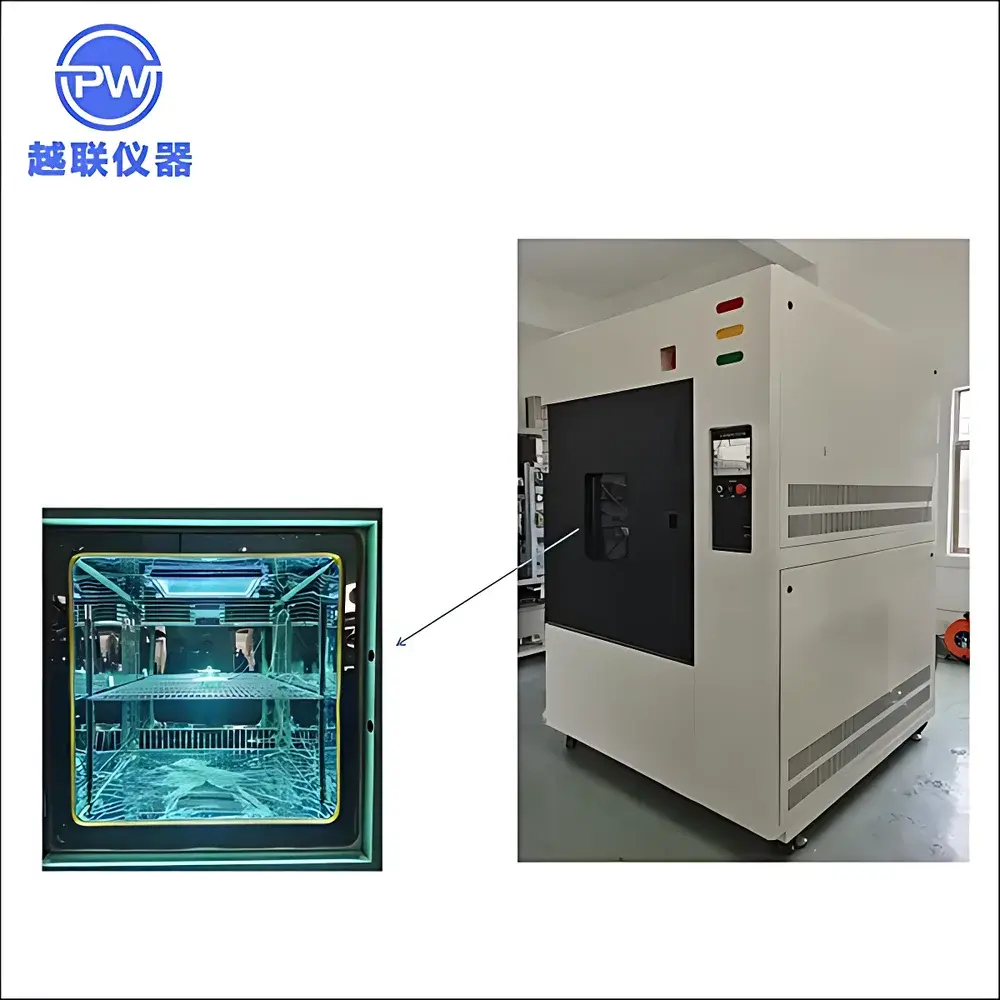
Yuelian / PW PW-SUN4000 Solar Radiation Weathering Chamber
| Brand | Yuelian / PW |
|---|---|
| Origin | Guangdong, China |
| Manufacturer Type | Authorized Distributor |
| Country of Origin | China |
| Model | PW-SUN4000 |
| Irradiance Range | 450–1200 W/m² |
| Spectral Range | 280–3000 nm |
| Lamp Power | 4 kW |
| Lamp Type | Imported Metal Halide Lamp (1 unit) |
| Internal Chamber Dimensions | 1000 × 1000 × 1000 mm (D×W×H) |
| Temperature Range (Light Cycle) | 10–80 °C |
| Temperature Range (Dark Cycle) | −10–80 °C |
| Humidity Range (Light Cycle) | 20–55 %RH |
| Humidity Range (Dark Cycle) | 45–95 %RH |
| Temperature Uniformity | ±3 °C |
| Humidity Uniformity | ±5 %RH |
| Lamp Lifetime | ≥1000 h |
| Control Interface | 7-inch Color Touchscreen (Weinview) |
| Data Export | USB port with Excel-compatible output |
| Remote Monitoring | Web-based & mobile APP support |
| Compliance Standard | DIN 75220 |
Overview
The Yuelian / PW PW-SUN4000 Solar Radiation Weathering Chamber is an engineered environmental simulation system designed for accelerated light-aging testing of automotive components, interior trim, electronic instrument panels, textiles, dyes, coatings, and architectural materials. It replicates key climatic stressors—including solar spectral irradiance, thermal cycling, humidity variation, and day/night alternation—based on the physical principles of controlled radiative exposure and thermohygrometric conditioning. Unlike broad-spectrum UV chambers, the PW-SUN4000 employs a high-power metal halide lamp coupled with proprietary optical filtering to deliver a solar-weighted irradiance spectrum (280–3000 nm) that matches natural sunlight with >98% spectral fidelity per DIN 75220 Annex A. This enables physiologically relevant degradation assessment—such as color fading, polymer chain scission, surface microcracking, embrittlement, and gloss loss—under reproducible, traceable test conditions aligned with automotive OEM validation protocols.
Key Features
- High-fidelity solar simulation using a single 4 kW imported metal halide lamp with electronic ignition and intelligent power regulation—achieving >95% higher lamp ignition efficiency versus conventional ballast systems.
- Optical system integrating scatter-type bean-pattern aluminum reflectors and custom multi-layer glass filters to emulate terrestrial solar irradiance across UV, visible, and near-IR bands (280–3000 nm).
- Closed-loop irradiance control via wireless fiber-optic “SolarEye” sensor and PID-driven automatic lamp output modulation—ensuring irradiance stability within ±5% over time and position.
- Dual-mode thermal management: independent light-cycle (10–80 °C) and dark-cycle (−10–80 °C) temperature control, with ±3 °C uniformity verified per IEC 60068-3-5.
- Nanotechnology-enhanced PTC humidification system delivering precise RH control (20–95 %RH) with <0.2 L/min water consumption at 38 °C/95 %RH—reducing operational cost and maintenance frequency.
- Robust stainless-steel (SUS316) chamber interior, corrosion-resistant construction, and silicone-sealed viewing window for safe real-time observation without irradiance leakage.
- Comprehensive safety architecture including lamp-cooling interlock, dry-run protection for humidifiers, refrigerant pressure monitoring, phase-loss detection, and overtemperature cutoffs on all critical subsystems.
Sample Compatibility & Compliance
The PW-SUN4000 accommodates three-dimensional, non-planar automotive parts—including bumpers, grilles, center consoles, and HVAC ducts—on its vertically adjustable flat sample tray (max. load: 30 kg). Its 1 m³ test volume supports full-scale component evaluation without geometric truncation artifacts. The system complies with DIN 75220 “Aging of Automotive Components in Sunlight Simulation Devices”, and its irradiance calibration traceability aligns with ISO/CIE 85, enabling use in supplier qualification audits under VW PV 3929, GMW 14124, and Ford CETP 00.00-L-467. All thermal and humidity profiles are programmable to replicate regional climatic cycles (e.g., Arizona desert, Florida subtropical, or European temperate), supporting both standard-compliant and custom-developed test methods. The chamber meets CE marking requirements and adheres to IEC 61000-6-3 (EMC) and IEC 61000-6-4 (immunity) standards.
Software & Data Management
The integrated Weinview HMI provides intuitive Chinese-language operation with dual-mode control: programmable cyclic (light/dark) or fixed-parameter operation. Eleven preloaded test protocols—including Z-OUT curve execution per DIN 75220 Tables 2–5—are stored permanently in non-volatile memory. Real-time data logging captures irradiance (W/m²), black-panel temperature (°C), chamber air temperature (°C), relative humidity (%RH), lamp voltage/current, and elapsed exposure time—with storage capacity for six months of continuous 10-second-interval records. Data export occurs via USB to Excel (.xlsx) format, preserving timestamped columns and metadata headers required for GLP documentation. Optional Ethernet/WiFi connectivity enables remote supervision through browser-based dashboards and native iOS/Android applications—supporting alarm push notifications, live curve streaming, and parameter override with role-based access control (RBAC). Audit trails comply with FDA 21 CFR Part 11 requirements when configured with electronic signature modules.
Applications
This chamber serves as a primary tool for material durability validation in Tier 1 automotive suppliers, OEM R&D labs, and third-party testing institutes. Typical use cases include: evaluating pigment stability in polypropylene dashboard skins under simulated summer noon exposure; assessing adhesion integrity of laminated touchscreens subjected to thermal shock from rapid light-to-dark transitions; quantifying gloss retention in exterior paint systems exposed to combined UV + humidity cycling; screening UV stabilizers in thermoplastic elastomers used in door seals; and qualifying textile dye fastness in sunroof lining fabrics. Its spectral accuracy and multi-stress capability also support research in photovoltaic encapsulant aging, aerospace polymer degradation, and conservation science for museum-grade artifact lighting studies.
FAQ
What standards does the PW-SUN4000 directly support?
It is fully configured to execute DIN 75220, including Z-OUT spectral weighting and Table 2–5 cycle definitions. Optional firmware upgrades enable ASTM G155, ISO 4892-2, and SAE J2412 protocols.
Is external pure water supply mandatory?
Yes—integrated deionized water generation is not included. Users must provide ≥1 MΩ·cm resistivity water via a dedicated reverse-osmosis or distillation system.
Can the chamber operate unattended for extended durations?
Yes—comprehensive fault detection, auto-shutdown sequences, and email/SMS alert integration permit 72+ hour无人值守 operation with full data continuity.
How is irradiance uniformity validated across the test plane?
A calibrated reference radiometer (traceable to NIM or PTB) is used during factory acceptance testing to map irradiance distribution at 100 mm intervals across the 800 × 800 mm usable area—reporting compliance with ±10% spatial deviation per DIN 75220 Section 6.2.
What maintenance intervals are recommended for the lamp and filter assembly?
Lamp replacement is advised after ≥1000 hours of cumulative operation; filter sets require annual inspection and replacement if optical transmission drops >5% below baseline (measured with spectroradiometer).



