
Combined Environmental Test Chamber – Temperature, Humidity & Vibration (Tri-Combination)
| Brand | OEM / Custom-Built |
|---|---|
| Origin | Imported |
| Manufacturer Type | Authorized Distributor |
| Price | USD 21,500 (FOB) |
Overview
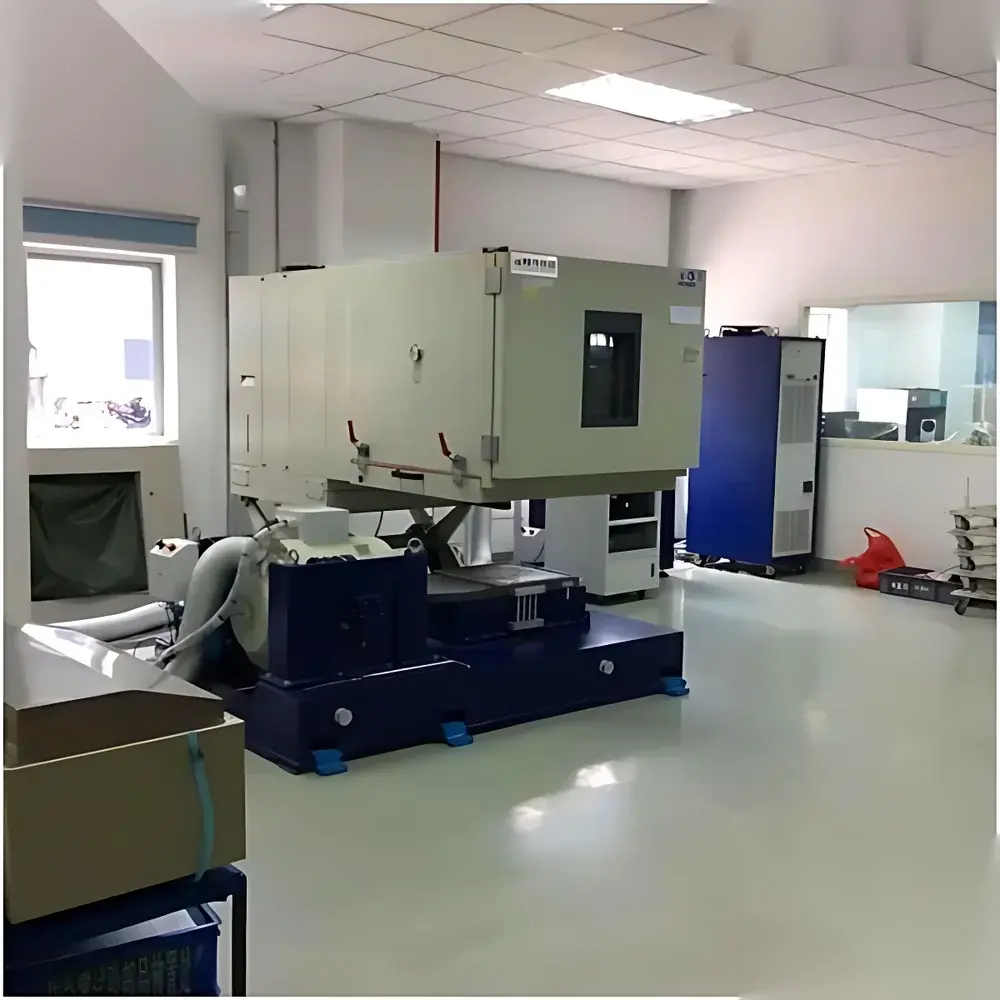
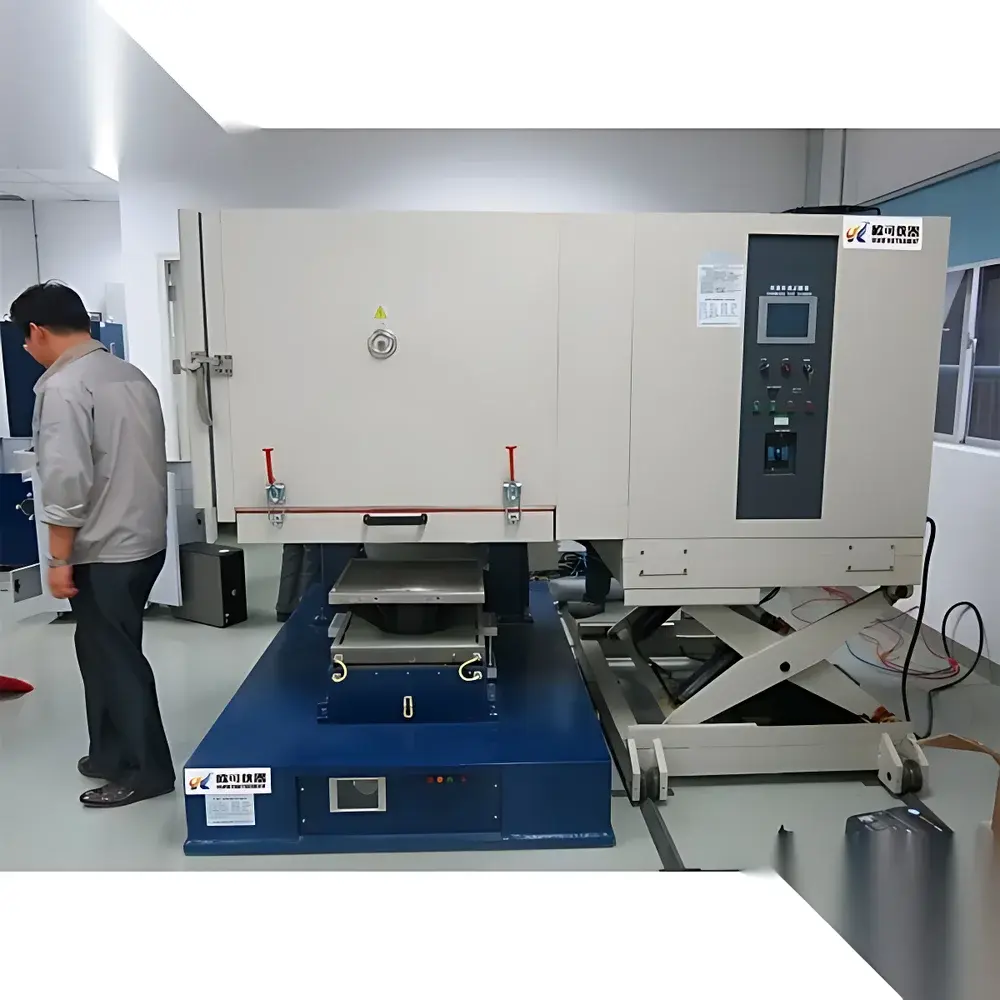
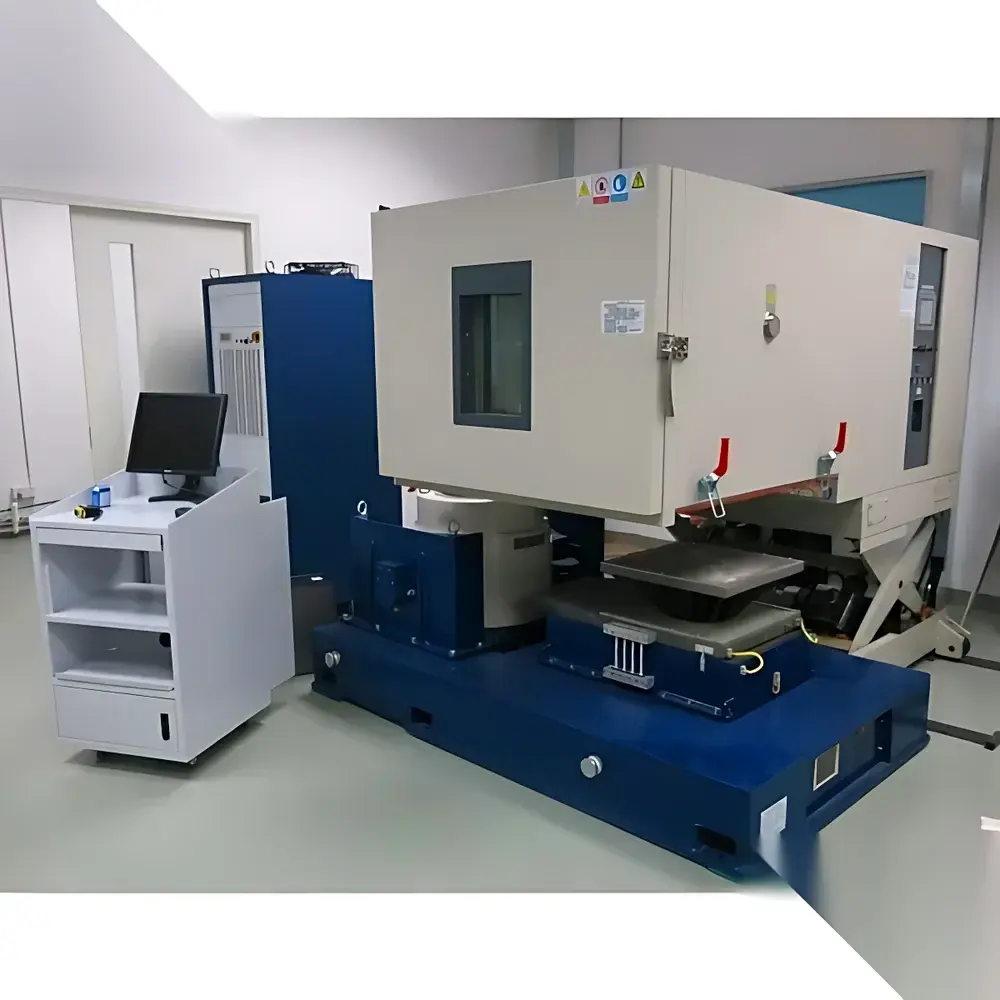
The Combined Environmental Test Chamber – Temperature, Humidity & Vibration (Tri-Combination) is an integrated reliability testing platform engineered for simultaneous and sequential exposure of test specimens to controlled thermal, hygrothermal, and dynamic mechanical stress conditions. It operates on the principle of coupled environmental simulation: a precision-engineered refrigeration system maintains temperature ranges from –70 °C to +180 °C, a steam-based humidification subsystem delivers relative humidity control from 10% to 98% RH, and a dynamically isolated electrodynamic or servo-hydraulic shaker table superimposes programmable vibration profiles—including sine, random, shock, and fatigue waveforms—while preserving environmental integrity across the chamber boundary. This tri-axial synergistic capability enables accelerated life testing, HALT/HASS protocols, and qualification per aerospace, automotive, and defense electronics standards where real-world operational environments involve concurrent thermal cycling, moisture ingress, and mechanical excitation.
Key Features
- Hermetically sealed French Tecumseh (formerly “Tecumseh France”, now part of Danfoss) reciprocating compressors with dual-stage cascade refrigeration architecture for stable sub-zero operation down to –70 °C.
- Dual-circuit refrigerant loop design with American Parker Hannifin (Aqua-Cool® series) desiccant filters, Taiwan Guanya oil separators, and Italian Castel solenoid valves ensuring long-term refrigerant purity and system reliability.
- Multi-blade centrifugal circulation fan array with adjustable vane diffusers, delivering uniform air velocity (>1.5 m/s) and minimizing thermal/hygrometric gradients (<±0.5 °C, <±2% RH) across the working volume.
- Independent heating (PID-controlled resistive elements), cooling (refrigerant expansion), and humidification (electric steam generator) subsystems—reducing cross-interference, extending component service intervals, and enabling faster ramp rates (up to 10 °C/min).
- Modular vibration interface: ISO 10816-compliant mounting flange with kinematic decoupling gasketing; supports integration of third-party shakers (e.g., LDS V875, TIRA TV 51120, or m+p Quattro systems) with force capacity up to 100 kN and frequency range 5–3000 Hz.
- Industrial-grade 10.4″ color TFT-LCD touchscreen HMI with embedded real-time OS, supporting multi-segment profile programming, alarm logging, and event-triggered data capture.
Sample Compatibility & Compliance
The chamber accommodates samples up to 1000 mm × 1000 mm × 1000 mm (W×D×H) with maximum payload of 150 kg on the shaker table. Internal stainless-steel construction (AISI 304) and double-wall vacuum-insulated panels meet UL 61010-1 and IEC 61000-6-3 EMC requirements. The system complies with and is validated against key international test standards including: MIL-STD-810H Method 502.7 (Temperature), Method 507.6 (Humidity), Method 514.7 (Vibration); RTCA DO-160G Sections 4, 5, and 7; ISO 16750-4; and EN 60068-2 series (e.g., EN 60068-2-1, -2-2, -2-14, -2-30, -2-64). Calibration traceability follows ISO/IEC 17025 via NIST-traceable reference sensors.
Software & Data Management
Control software runs on a deterministic real-time kernel and provides synchronized acquisition of temperature, humidity, acceleration (x/y/z), displacement, and chamber pressure at up to 10 kHz sampling rate. Data export formats include CSV, MATLAB .mat, and ASAM MDF4 for post-processing in tools such as MATLAB, Python (SciPy/Pandas), or NI DIAdem. Audit trail functionality meets FDA 21 CFR Part 11 requirements with user-level access control, electronic signatures, and immutable log archiving. Optional Ethernet/IP or Modbus TCP interfaces enable integration into factory MES or PLM ecosystems.
Applications
- Qualification testing of avionics modules under combined thermal shock, condensation, and resonance-induced fatigue.
- Validation of battery pack enclosures for electric vehicles per UN ECE R100 and GB/T 31467.3.
- Reliability screening of medical imaging subsystems (MRI, CT detectors) exposed to transport vibration and hospital-grade humidity cycles.
- Material compatibility studies for conformal coatings, adhesives, and potting compounds subjected to hygrothermal swelling and cyclic strain.
- Design verification of MEMS inertial sensors operating in harsh industrial IoT environments.
FAQ
What vibration standards does the system support out-of-the-box?
It natively executes MIL-STD-167-1A, ISO 10816-1, and SAE J1211 profiles; custom waveform synthesis (e.g., road load data, helicopter blade-pass spectra) is enabled via optional signal generation module.
Can the chamber operate with vibration active during rapid temperature transitions?
Yes—the structural isolation and thermal compensation algorithms maintain ±0.3 g peak acceleration fidelity even during 5 °C/min ramps, verified per ASTM E1823 Annex A3.
Is remote monitoring and control available?
Standard Ethernet interface supports secure HTTPS web interface and SNMPv3 alerts; optional 4G LTE gateway enables off-site diagnostics and firmware updates.
What is the typical lead time for configuration and factory acceptance testing (FAT)?
12–16 weeks from order confirmation, inclusive of FAT protocol execution with witness participation and full calibration certificate issuance.
Does the system support GLP/GMP-compliant validation documentation?
Yes—IQ/OQ/PQ protocols, URS alignment reports, and 21 CFR Part 11 compliance packages are available as optional deliverables.



