
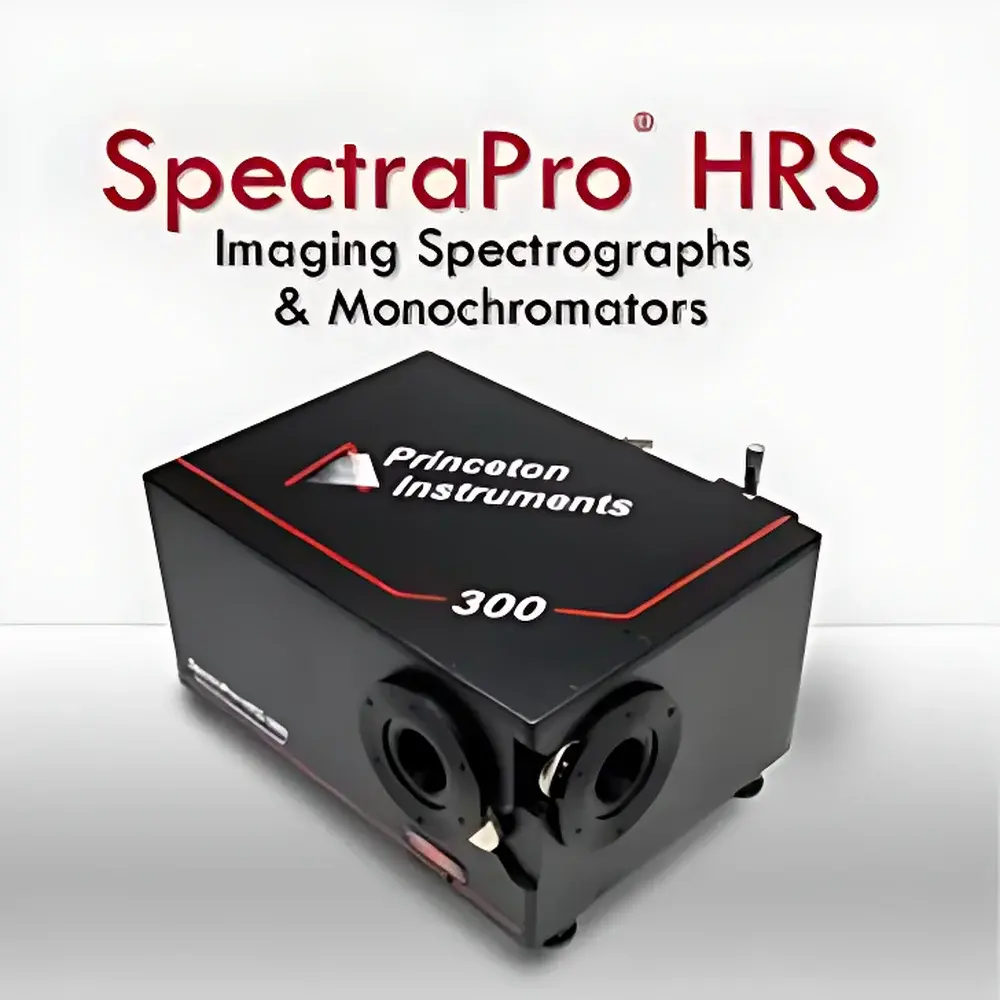
Teledyne Princeton Instruments SpectraPro HRS-300 and HRS-500 High-Resolution Imaging Spectrographs
| Brand | Teledyne Princeton Instruments |
|---|---|
| Origin | USA |
| Model | HRS-300, HRS-500 |
| Focal Length | 300 mm (HRS-300), 500 mm (HRS-500) |
| f-number | f/3.9 (HRS-300), f/6.5 (HRS-500) |
| Linear Dispersion | 2.38 nm/mm (HRS-300), 1.52 nm/mm (HRS-500) |
| PMT Resolution (1200 g/mm grating, 435.8 nm, 10 µm slit) | 0.09 nm (HRS-300), 0.05 nm (HRS-500) |
| CCD Resolution (1200 g/mm grating, 435.8 nm, 20 µm pixel & slit) | 0.10 nm (HRS-300), 0.07 nm (HRS-500) |
Overview
The Teledyne Princeton Instruments SpectraPro HRS-300 and HRS-500 are high-resolution, dual-output imaging spectrographs engineered for quantitative spectral analysis across research and industrial laboratories. Based on Czerny–Turner optical architecture with optimized aberration correction, these instruments deliver true imaging-grade spectral fidelity across the full focal plane—enabling simultaneous high-resolution spectral acquisition and spatially resolved spectroscopy. Unlike conventional scanning monochromators or fixed-grating spectrometers, the HRS platform integrates a precision-machined optical bench, thermally stable mechanics, and diffraction-limited optics to ensure consistent wavelength registration and photometric accuracy from UV (193 nm) through visible to short-wave infrared (SWIR, up to 1700 nm with InGaAs detection). The system’s modular design supports interchangeable gratings, motorized filter wheels, and synchronized detector triggering—making it suitable for time-resolved, multi-modal, and hyperspectral applications requiring traceable metrology.
Key Features
- AccuDrive™ grating positioning system: Achieves 10,000 actuation cycles without recalibration.
- ResXtreme™ spectral reconstruction algorithm: A proprietary, non-iterative deconvolution method applied in real time within LightField software; improves effective resolution by up to 60%, enhances peak intensity fidelity, and preserves total integrated signal energy—critical for quantitative absorbance, emission, and LIBS analysis.
- Dual 30-mm-wide output ports: Enable concurrent use of two detectors—for example, a back-illuminated deep-depletion CCD for UV–Vis and an InGaAs array for NIR, or a camera + PMT for gated detection—without optical reconfiguration.
- IntelliCal® wavelength and intensity calibration: An automated, hardware-integrated module performing in-situ, multi-point wavelength validation (traceable to NIST-certified emission lines) and flat-field intensity correction across the entire detector surface. Delivers >10× higher wavelength accuracy than standard Hg/Ar lamp-based methods.
- Acton optical coatings: Standard #1900 enhanced aluminum coating provides >85% average reflectance from 193 nm to 20 µm; optional protected silver (>98% avg. from 400–2000 nm) and gold coatings (optimized for 700–1700 nm) available for specific application requirements.
- Thermally compensated optical housing: Minimizes focus drift and grating alignment shift during extended acquisitions; validated for continuous operation over 8-hour thermal soak tests at ambient ±2 °C stability.
Sample Compatibility & Compliance
The SpectraPro HRS series accommodates free-space beam coupling, fiber-optic input (via SMA905 or FC/PC adapters), and direct microscope port integration—supporting solid, liquid, gas, and plasma samples. Its optical design conforms to ISO 17025 requirements for calibration traceability when used with IntelliCal and NIST-traceable sources. For regulated environments—including pharmaceutical QC, environmental monitoring, and defense-related R&D—the system supports full audit trails, electronic signatures, and data integrity features when operated under LightField v6.5+ compliant with FDA 21 CFR Part 11 and EU Annex 11 guidelines. All firmware and calibration metadata are embedded in vendor-neutral HDF5 file format, ensuring long-term readability and third-party interoperability.
Software & Data Management
LightField is a 64-bit, open-architecture acquisition and analysis platform developed exclusively for Princeton Instruments hardware. It provides deterministic timing control (<100 ns jitter), hardware-synchronized multi-device orchestration (spectrograph + camera + shutter + laser), and scriptable automation via Python API. ResXtreme processing is fully integrated and reversible—raw and reconstructed spectra are stored side-by-side with metadata logging every calibration event, grating position, and slit setting. Export options include CSV, ASCII, TIFF, and HDF5 with embedded EXIF-like spectral headers (wavelength array, dispersion, pixel scale, exposure, gain). Batch processing workflows support spectral subtraction, background correction, peak integration, and multivariate analysis (PCA, PLS) without external tools.
Applications
- Raman spectroscopy: High-throughput mapping with sub-2 cm⁻¹ spectral fidelity using 1800 g/mm gratings and notch-filter-coupled EMCCD detection.
- Fluorescence and photoluminescence: Quantitative quantum yield measurements enabled by IntelliCal intensity correction and dual-port photon budgeting.
- Plasma diagnostics: Time-resolved line-broadening analysis of Stark- and Doppler-shifted emissions in fusion and laser-ablation plasmas.
- Laser-induced breakdown spectroscopy (LIBS): Simultaneous multi-element detection with calibrated intensity ratios traceable to certified reference materials.
- Microspectroscopy: Coupling with inverted or confocal microscopes for sub-10 µm spatial resolution spectral imaging.
- Absorption/transmission spectroscopy: High-dynamic-range (10⁶) measurements using dual-beam referencing and real-time dark-current compensation.
FAQ
Is ResXtreme processing mandatory, or can raw data be acquired without it?
ResXtreme is optional and fully toggleable in LightField. Raw frames are always saved alongside processed versions, preserving original pixel values for independent validation or third-party analysis.
What grating options are supported, and how are they changed?
HRS models accept standard 1/4″ × 1/4″ ruled or holographic gratings (1200–3600 g/mm). Grating exchange is tool-free via front-access carousel; each position is auto-identified by AccuDrive during initialization.
Does the system support vacuum or purged operation for UV below 200 nm?
Yes—optional vacuum-compatible housing and MgF₂ windows enable operation down to 115 nm. Purge ports accept dry nitrogen or argon for routine UV-VIS stability.
Can LightField be deployed in a networked lab environment with centralized license management?
Yes—LightField supports floating license servers (FlexNet) and domain-authenticated login, enabling shared instrument access across Windows/Linux clients with role-based permissions.
How is wavelength calibration maintained after long-term use or transport?
IntelliCal performs full recalibration in <90 seconds using internal reference lamps; no user alignment or manual adjustment is required. Calibration validity is logged per acquisition and flagged if drift exceeds ±0.01 nm threshold.




