
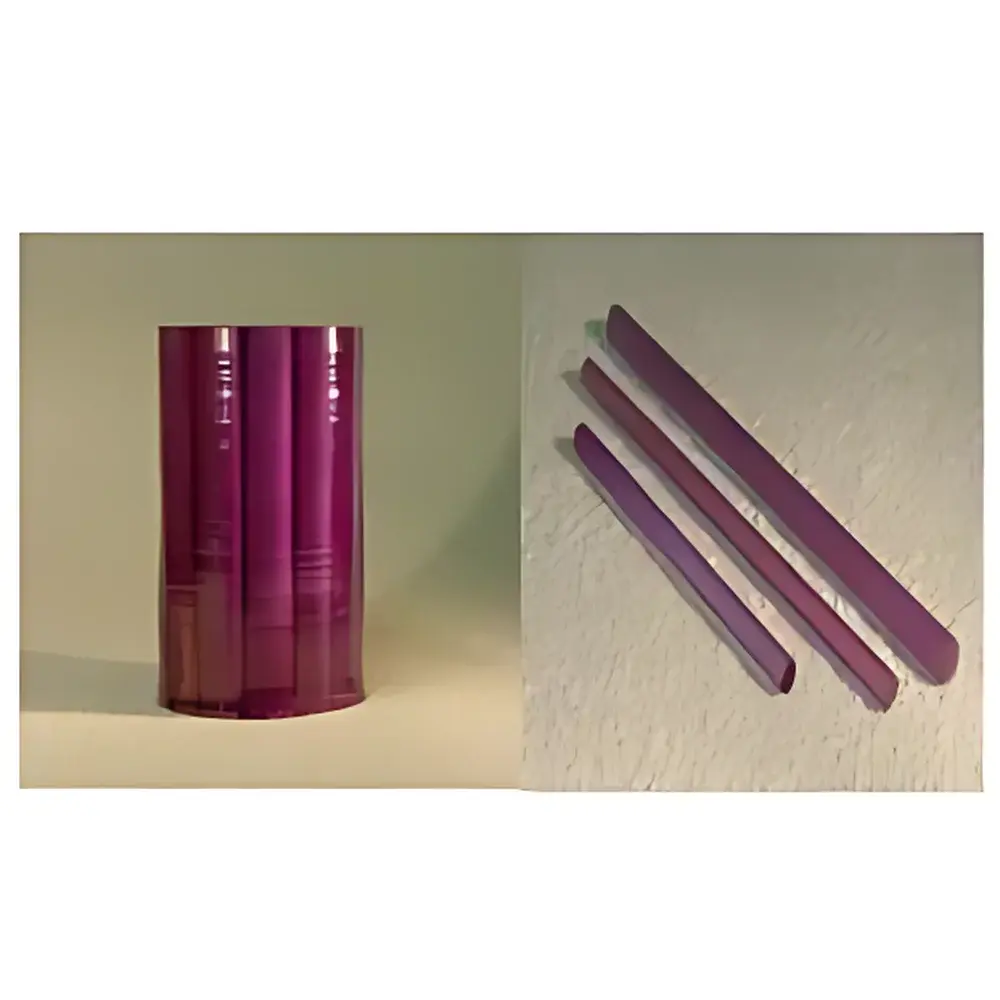
Synoptics Alexandrite (BeAl₂O₄:Cr³⁺) Laser Crystal
| Brand | Synoptics |
|---|---|
| Origin | USA |
| Manufacturer Type | Authorized Distributor |
| Import Status | Imported |
| Model | Alexandrite (BeAl₂O₄:Cr³⁺) |
| Price Range | USD 0 – 7,200 (FOB) |
| Wavelength Tuning Range | 710–800 nm |
| Pulse Energy Capability | Multi-joule level |
| Thermal Shock Resistance | 5× higher than Nd:YAG |
| Crystal Structure | Orthorhombic |
| Chemical Formula | Be(Al₁₋ₓCrₓ)₂O₄ |
| Cr³⁺ Doping Concentration | 0.01–0.20 at.% (standard: 0.10 at.%, optimum: 0.83/d % where d = diameter in mm) |
| Diameter Tolerance | +0.000″ / −0.002″ |
| Edge Chamfer | 0.005″ ± 0.003″ @ 45° |
| Surface Finish | 55 ± 5 μin Ra (ground & polished) |
| Surface Flatness | λ/10 @ 632 nm |
| Parallelism | ≤30 arc-seconds |
| Perpendicularity | within 5 arc-minutes |
| Scratch-Dig | 10–5 per MIL-O-13830 |
| Wavefront Distortion | <0.5 wave/inch (measured at 1 µm) |
| Coating Options | Single-layer MgF₂ AR |
| Refractive Index (750 nm) | nₐ = 1.7367, n_b = 1.7421, n_c = 1.7346 (birefringent, biaxial) |
| Density | 3.7 g/cm³ |
| Melting Point | 1870 °C |
| Thermal Expansion (α) | αₐ = 5.9 × 10⁻⁶ K⁻¹, α_b = 6.1 × 10⁻⁶ K⁻¹, α_c = 6.7 × 10⁻⁶ K⁻¹ |
| Thermal Conductivity | 0.23 W/cm·K |
| Vickers Hardness | 2000 kg/mm² |
| Young’s Modulus | 469 GPa |
| Fracture Stress | 0.457–0.948 GPa |
| dn/dT | ~8 × 10⁻⁶ K⁻¹ |
| Nonlinear Refractive Index (n₂) | ~10⁻¹³ esu |
| Findlay-Clay Insertion Loss | <0.3 cm⁻¹ |
Overview
Synoptics Alexandrite (BeAl₂O₄:Cr³⁺) laser crystal is a chromium-doped tunable solid-state gain medium engineered for high-energy pulsed laser systems operating in the near-infrared spectrum. Based on orthorhombic beryllium aluminate host lattice, Alexandrite exhibits intrinsic vibronic broadening that enables continuous wavelength tuning from 710 nm to 800 nm—making it uniquely suited for applications requiring spectral agility without optical parametric conversion. Its exceptional thermal shock resistance (5× greater than Nd:YAG), combined with favorable thermo-optic coefficients and mechanical robustness, supports stable operation under multi-joule pulse regimes in flashlamp-pumped architectures. Unlike Ti:sapphire, Alexandrite operates efficiently at room temperature and requires no cryogenic stabilization, significantly reducing system complexity and operational overhead.
Key Features
- Wide tunability across 710–800 nm with high gain cross-section (~6.5 × 10⁻¹⁹ cm² at 755 nm)
- High damage threshold: >500 MW/cm² (10 ns, 10 Hz) for standard MgF₂-coated surfaces
- Precision-ground and polished geometry: surface flatness λ/10 @ 632 nm, parallelism ≤30 arc-seconds, perpendicularity within 5 arc-minutes
- Controlled Cr³⁺ doping (0.01–0.20 at.%) with certified homogeneity (≤±3% variation across aperture)
- Low insertion loss (<0.3 cm⁻¹) verified via Findlay-Clay methodology per ISO 11146-2
- Customizable AR coatings: single-layer MgF₂ (R < 0.17% @ 755 nm) or broadband variants covering 700–800 nm (R < 0.25% avg.)
- Full traceability: batch-specific certificates of conformance include XRD phase verification, refractive index mapping, and interferometric wavefront analysis
Sample Compatibility & Compliance
All Synoptics Alexandrite crystals are grown using the Czochralski method under inert atmosphere, followed by controlled annealing to minimize color-center formation. Each crystal undergoes non-destructive testing per ASTM F265–22 (Optical Crystal Quality Standard) and MIL-PRF-13830B (Surface Quality). Final inspection includes spectral transmission (200–3000 nm, PerkinElmer Lambda 1050+), laser-induced damage threshold (LIDT) validation per ISO 21254-2, and dimensional metrology using Zeiss UMC 850 coordinate measuring machine. Synoptics maintains ISO 9001:2015 certification (certificate #QMS-2023-0871), ensuring full compliance with GLP-aligned documentation practices—including lot traceability, raw material sourcing records, and environmental control logs during post-growth processing.
Software & Data Management
While Alexandrite is a passive gain medium, Synoptics provides comprehensive technical documentation packages compatible with industry-standard laser design workflows. Delivered digital assets include: (1) wavelength-dependent Sellmeier coefficients for all three principal axes (nₐ, n_b, n_c), (2) temperature-dependent dn/dT datasets calibrated from −40°C to +80°C, (3) thermal lensing simulation parameters (dN/dT, ∂n/∂T, α) for ZEMAX OpticStudio and LASCAD modeling, and (4) LIDT spectral maps referenced to ANSI Z136.1 exposure limits. All data files conform to IEEE 1596.2 metadata standards and are archived with SHA-256 checksums for audit readiness. No proprietary software is required; outputs integrate natively with MATLAB, Python (SciPy), and commercial ray-tracing platforms.
Applications
- Dermatology & Aesthetic Medicine: Selective photothermolysis for pigmented lesion removal and vascular treatments, leveraging strong melanin absorption at 755 nm
- Lithotripsy: High-peak-power Q-switched operation enabling efficient kidney stone fragmentation with reduced tissue ablation
- Atmospheric LIDAR: Eye-safe, tunable source for differential absorption LIDAR (DIAL) targeting water vapor and ozone absorption lines
- Fiber Characterization: Broadband pump source for supercontinuum generation in soft-glass and fluoride fibers
- Nonlinear Frequency Conversion: Pumping of OPOs and OPAs in mid-IR generation (3–5 µm) due to high peak intensity tolerance
- Materials Processing: Precision ablation of polymers and thin-film semiconductors with minimal thermal diffusion
- Scientific Research: Ultrafast amplifier seeding, time-resolved spectroscopy, and pump-probe studies requiring sub-100 fs pulse compatibility
FAQ
Is this crystal suitable for diode-pumping?
No—Alexandrite has weak absorption bands in the 630–680 nm range; it is optimized for flashlamp excitation. Diode pumping is not commercially viable due to low absorption cross-section and thermal management constraints.
What is the maximum recommended repetition rate for Q-switched operation?
For 4 mm diameter rods at 1064 nm fundamental, sustained operation above 10 Hz requires active cooling. At room temperature, reliable performance is demonstrated up to 5 Hz with 10–20 mJ/pulse.
Can Synoptics provide crystals with custom doping gradients?
Yes—radial or axial Cr³⁺ concentration gradients can be implemented for tailored thermal lensing compensation; minimum order quantity applies.
Are coating specifications compliant with MIL-C-48497A?
All standard MgF₂ AR coatings meet MIL-C-48497A Class 1 requirements for environmental durability, including humidity cycling (MIL-STD-810G Method 507.6) and abrasion resistance (CS-10 wheel test).
Do you supply crystals with wavefront correction for resonator integration?
Yes—custom wavefront-compensated optics (e.g., λ/20 RMS residual error) are available with interferometric verification per ISO 10110-5.





