
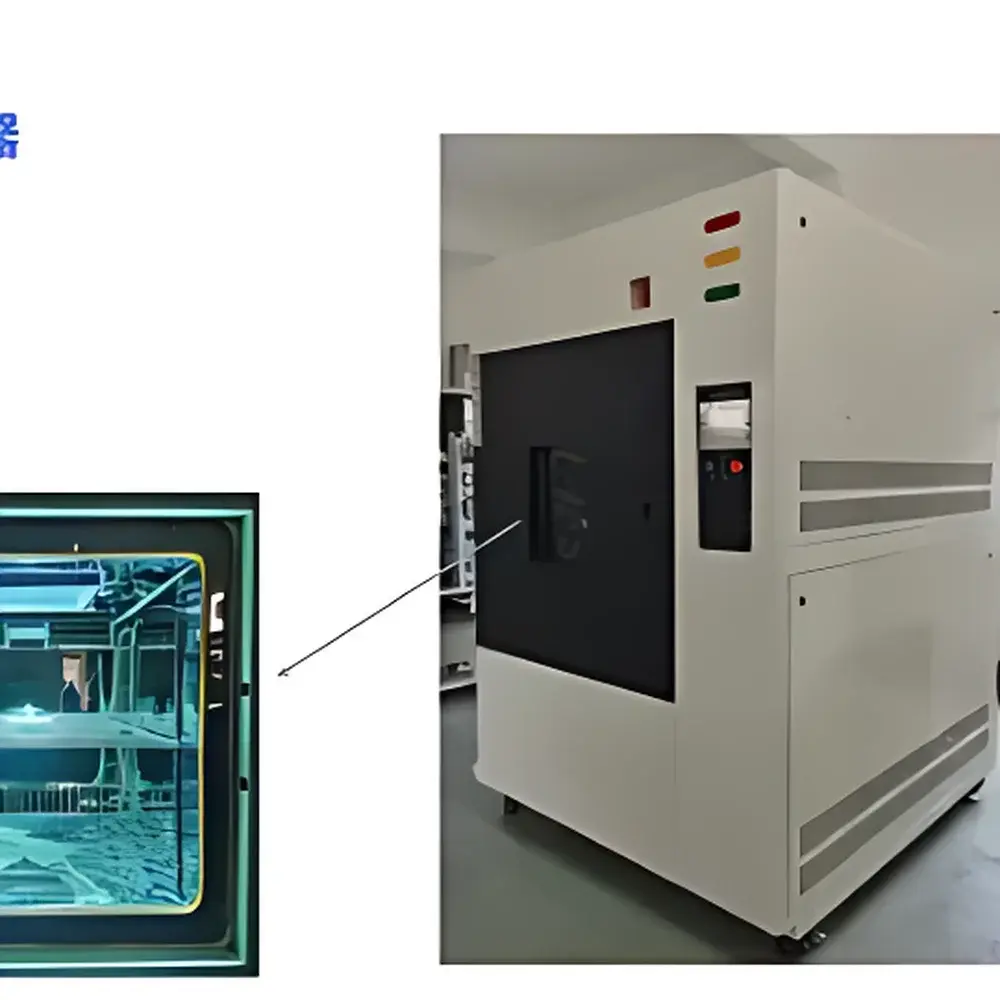
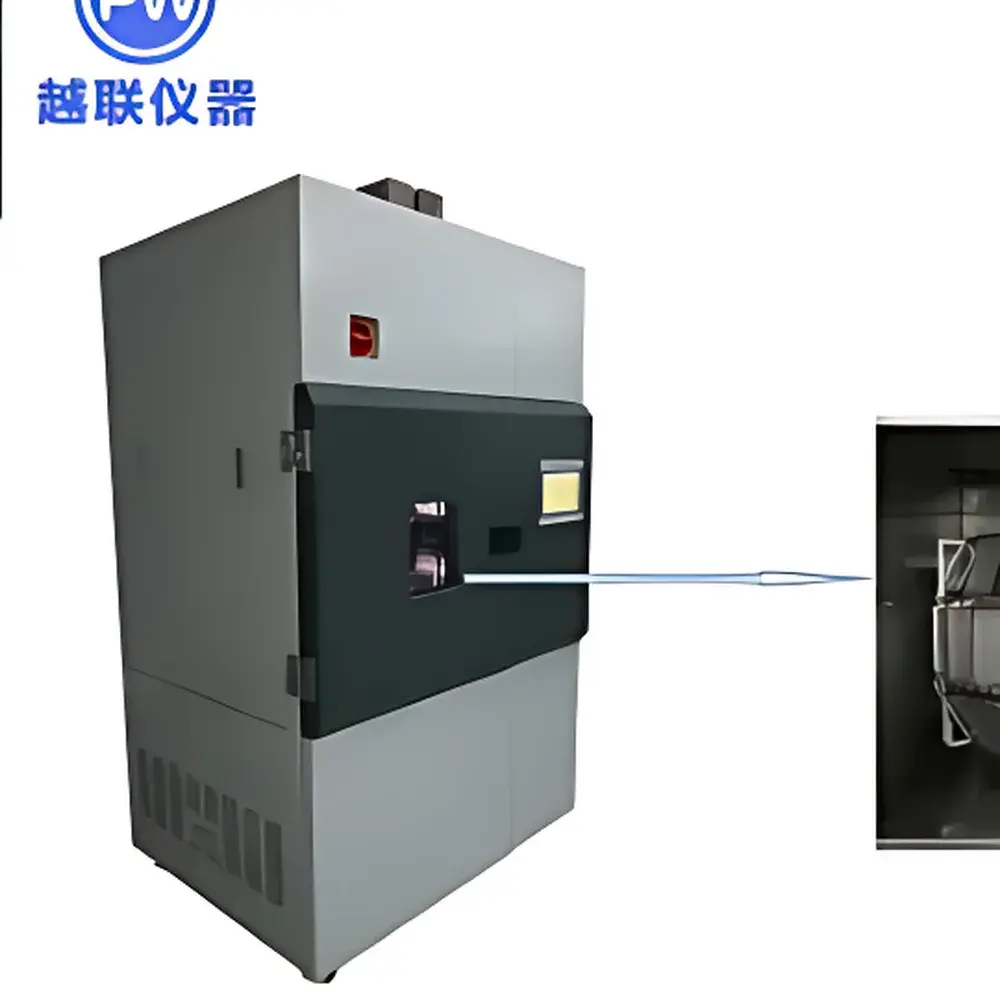
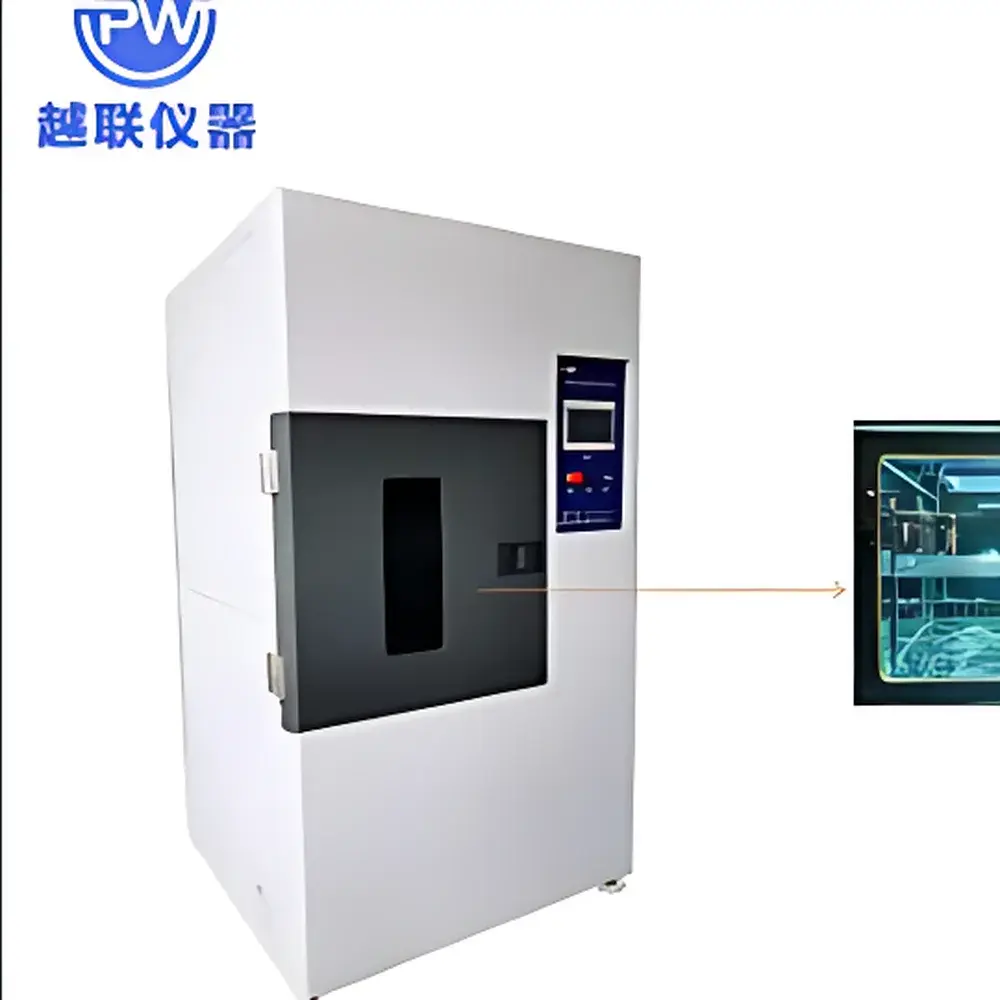
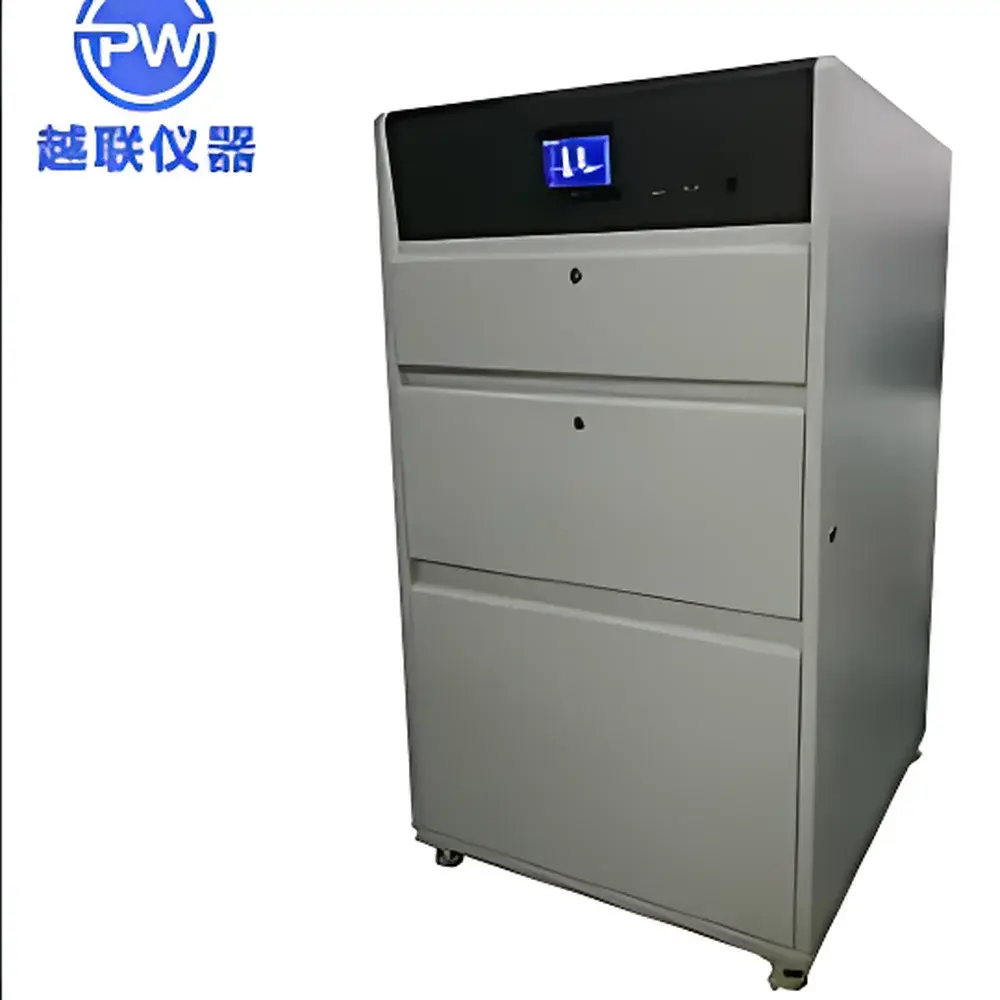
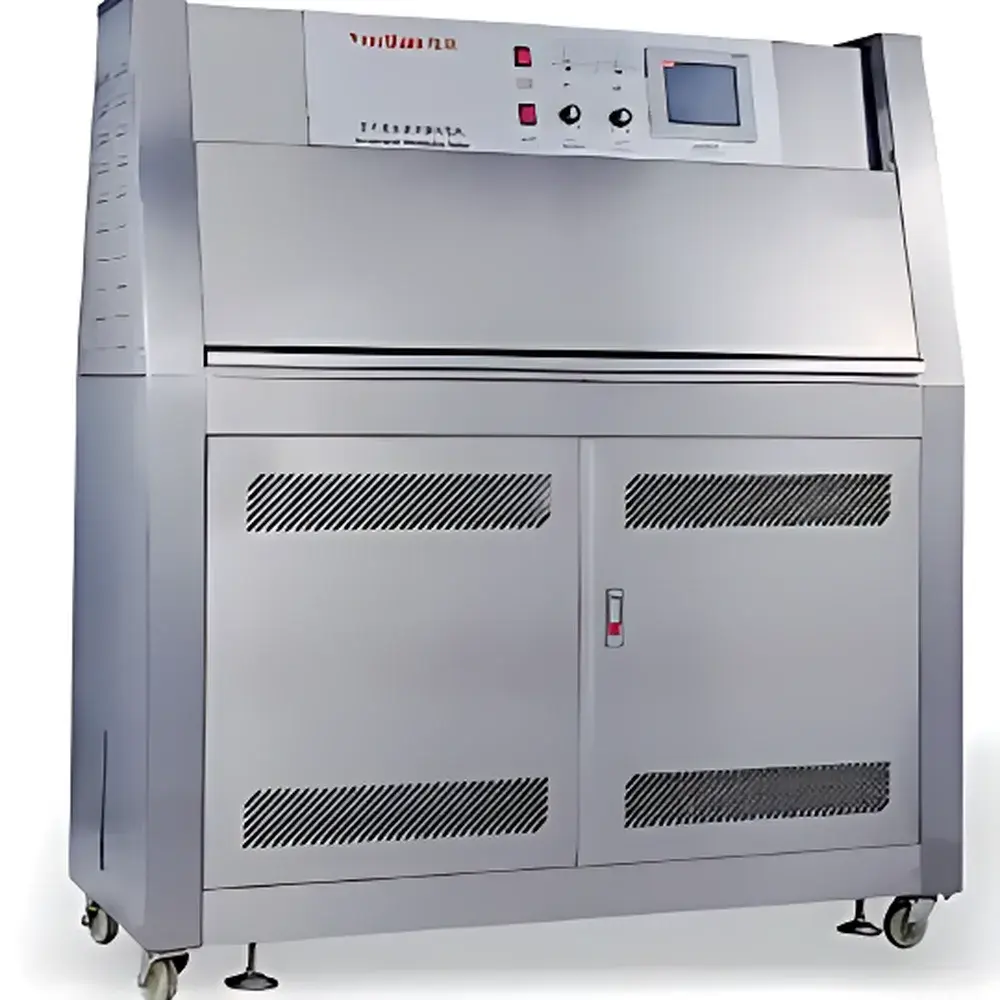
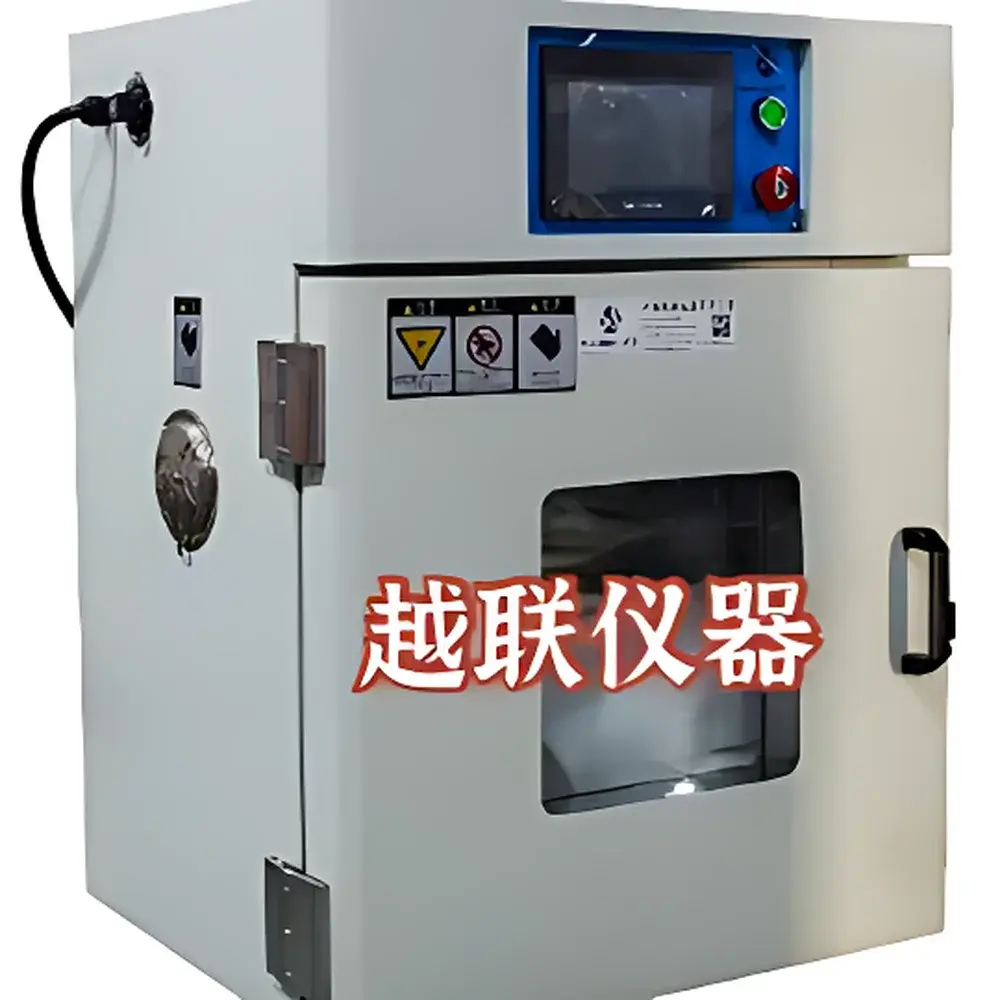
Yuelian / PW PW-SUN4000B DIN 75220-Compliant Xenon Arc Weathering Chamber for Automotive Component Aging Simulation
| Brand | Yuelian / PW |
|---|---|
| Origin | Guangdong, China |
| Manufacturer Type | Authorized Distributor |
| Country of Origin | China |
| Model | PW-SUN4000B |
| Price | USD 42,000 (FOB Shenzhen) |
| Internal Chamber Dimensions | 1000 × 1000 × 1000 mm (D × W × H) |
| External Dimensions | 1825 × 1200 × 2190 mm (D × W × H) |
| Xenon Lamp Power | 4 kW |
| Lamp Quantity | 1 (German-sourced metal halide xenon arc lamp) |
| Spectral Range | 280–3000 nm |
| Irradiance Control Range | 450–1200 W/m² |
| Temperature Range (Light Cycle) | 10–80 °C |
| Temperature Range (Dark Cycle) | −10–80 °C |
| Extreme Temp. Capability (Dark) | −20–100 °C |
| Humidity Range (Light Cycle) | 30–55 %RH |
| Humidity Range (Dark Cycle) | 45–95 %RH |
| Temperature Uniformity | ±3 °C |
| Humidity Uniformity | ±5 %RH |
| Lamp Lifetime | ≥2500 h |
| Control Interface | 7-inch Weinview color touchscreen (Chinese UI) |
| Data Export | USB port with Excel-compatible output |
| Remote Monitoring | Web-enabled control via PC and mobile app |
| Compliance | DIN 75220:2019 “Aging of Automotive Components in Solar Simulation Devices” |
Overview
The Yuelian / PW PW-SUN4000B Xenon Arc Weathering Chamber is an engineered environmental simulation system designed specifically to replicate accelerated solar exposure conditions in accordance with DIN 75220:2019 — the German standard governing aging tests for automotive interior and exterior components. Unlike generic UV or fluorescent-based testers, this chamber employs a high-intensity 4 kW metal halide xenon arc lamp to generate a continuous spectrum closely matching natural sunlight (280–3000 nm), with spectral fidelity exceeding 98% across critical UV-A, visible, and near-infrared bands. The system integrates tightly coupled irradiance, temperature, and humidity control loops to emulate realistic diurnal cycling — including outdoor daylight, indoor stress zones (Zone 1 & Zone 2), and nighttime condensation phases — as defined in DIN 75220 Tables 2–5. Its primary function is to quantify material degradation mechanisms such as color fading, surface cracking, embrittlement, softening, and gloss loss under reproducible, traceable climatic stress profiles. The chamber’s architecture supports both research-grade validation and production-line quality assurance in compliance with automotive OEM specifications and tier-1 supplier test protocols.
Key Features
- High-fidelity solar simulation using a single 4 kW German-manufactured xenon arc lamp with proprietary electronic ignition and stabilized power supply (XD4KW-AT), delivering >95% higher ignition efficiency versus conventional magnetic ballasts.
- Advanced optical train comprising custom B-type daylight or A-type window-glass filter assemblies and a scattering-type bean-textured aluminum reflector to ensure uniform irradiance distribution and spectral compliance.
- Real-time closed-loop irradiance control via a wireless fiber-optic solar eye sensor (HQTBQ-100), enabling dynamic PID adjustment across the full 280–3000 nm band with ±5% measurement accuracy per ISO/CIE calibration traceability.
- Dual-mode thermal management: precision air-cooled refrigeration (Danfoss valves, Emerson oil separator, Tecumseh TAG2522Z-T compressor) paired with nickel-chrome heating elements and SSR-driven PID regulation for stable black-panel temperature control (±3 °C uniformity).
- Nano-enhanced PTC humidification system (SUS316 stainless steel core) achieving ≤0.2 L/min water consumption at 38 °C/95 %RH — reducing operational cost and maintenance frequency by up to 80% versus conventional steam-based systems.
- Five independent black-standard temperature probes (BST/BPT) mounted directly on sample surfaces, each individually monitored and regulated via embedded PID algorithms to replicate real-world thermal loading on heterogeneous automotive parts.
- Full-cycle programmability with 11 preloaded DIN 75220-compliant test profiles (e.g., outdoor dry/humid, indoor Zone 1/2, night/day transitions), plus user-defined multi-step sequences with variable ramp rates and dwell times.
- Integrated safety architecture featuring lamp-cooling interlock, anti-dry-burn humidifier protection, phase-loss detection, motor overcurrent cutoff, and automatic fault logging with on-screen diagnostic guidance per IEC 61000-6-2 EMC standards.
Sample Compatibility & Compliance
The PW-SUN4000B accommodates three-dimensional automotive components — including instrument panels, door trims, center consoles, headlamp housings, and seat fabrics — on its adjustable stainless-steel flat sample tray (950 × 950 mm). Its 1 m³ internal volume permits simultaneous testing of multiple specimens under identical spectral and climatic conditions, ensuring inter-sample comparability. All operational parameters are aligned with DIN 75220:2019 Annex A requirements for irradiance homogeneity, spectral power distribution (SPD), and temporal stability. The chamber also supports supplementary conformance to ISO 4892-2, SAE J2412, and ASTM G155 where applicable — provided users configure appropriate filter sets and calibration intervals. Full traceability is maintained through built-in audit trails compliant with GLP principles; all test logs include timestamps, operator IDs, parameter setpoints, and deviation alerts — supporting FDA 21 CFR Part 11 readiness when paired with validated software extensions.
Software & Data Management
Control is executed via a 7-inch Weinview MT8071IE touchscreen interface running a custom XD5-48RT-E controller firmware with dual-language (Chinese default) support. Real-time data visualization includes numeric readouts, time-series curves (irradiance vs. time, black-panel temp vs. RH), and tabular status summaries. All measurements — including irradiance (W/m²), black-panel temperature (°C), chamber humidity (%RH), and elapsed cycle time — are logged at user-selectable intervals (1 s to 60 min) into non-volatile memory with six-month retention capacity. Data export occurs via USB 2.0 to FAT32-formatted drives in native .CSV or Excel-compatible .XLSX format. Remote operation is enabled through encrypted HTTP/HTTPS web access and a dedicated Android/iOS application, permitting real-time monitoring, parameter adjustment, and alarm acknowledgment without physical presence. System-generated reports include test ID, start/stop timestamps, pass/fail flags against DIN thresholds, and raw dataset metadata — suitable for inclusion in PPAP documentation packages.
Applications
This chamber serves as a core validation tool for Tier 1 suppliers and OEM engineering labs conducting material qualification per automotive industry requirements. Typical use cases include: accelerated lightfastness evaluation of polypropylene (PP), thermoplastic olefin (TPO), and polyurethane (PU) interior trim; UV resistance screening of LED display overlays and touch-sensitive membranes; weathering performance benchmarking of exterior paint systems and clearcoats; thermal-hygric stress analysis of adhesives and laminated composites; and regulatory compliance verification for REACH SVHC and RoHS-restricted substance migration under solar load. It is routinely deployed in R&D departments for formulation optimization, in QA/QC labs for incoming material inspection, and in durability testing centers for correlation studies against real-world vehicle fleet data.
FAQ
Does the PW-SUN4000B comply with DIN 75220:2019 out-of-the-box?
Yes — all optical, thermal, and humidity subsystems are factory-calibrated to meet the spectral irradiance, temperature ramp rate, and RH transition criteria specified in DIN 75220 Tables 2–5.
What is the recommended recalibration interval for the solar eye sensor and black-panel thermocouples?
Per ISO/IEC 17025 guidelines, annual third-party calibration is advised; field verification using NIST-traceable reference sensors is supported via the USB diagnostics port.
Can the chamber operate unattended for extended cycles (e.g., 1000+ hours)?
Yes — its redundant safety architecture (water level monitoring, lamp-cooling interlock, phase-loss detection) enables fully autonomous operation with remote alarm notifications via email or push alert.
Is distilled or deionized water required for the humidification system?
Yes — only purified water (conductivity <5 µS/cm) must be supplied; the integrated auto-fill reservoir prevents scaling and ensures long-term reliability of the nano-PTC humidifier.
Are test reports generated by this system acceptable for PPAP submissions to major automakers?
When operated under documented SOPs with calibrated instruments and version-controlled firmware, output files satisfy AIAG PPAP Level 3 requirements for environmental test evidence.
Related Products



