
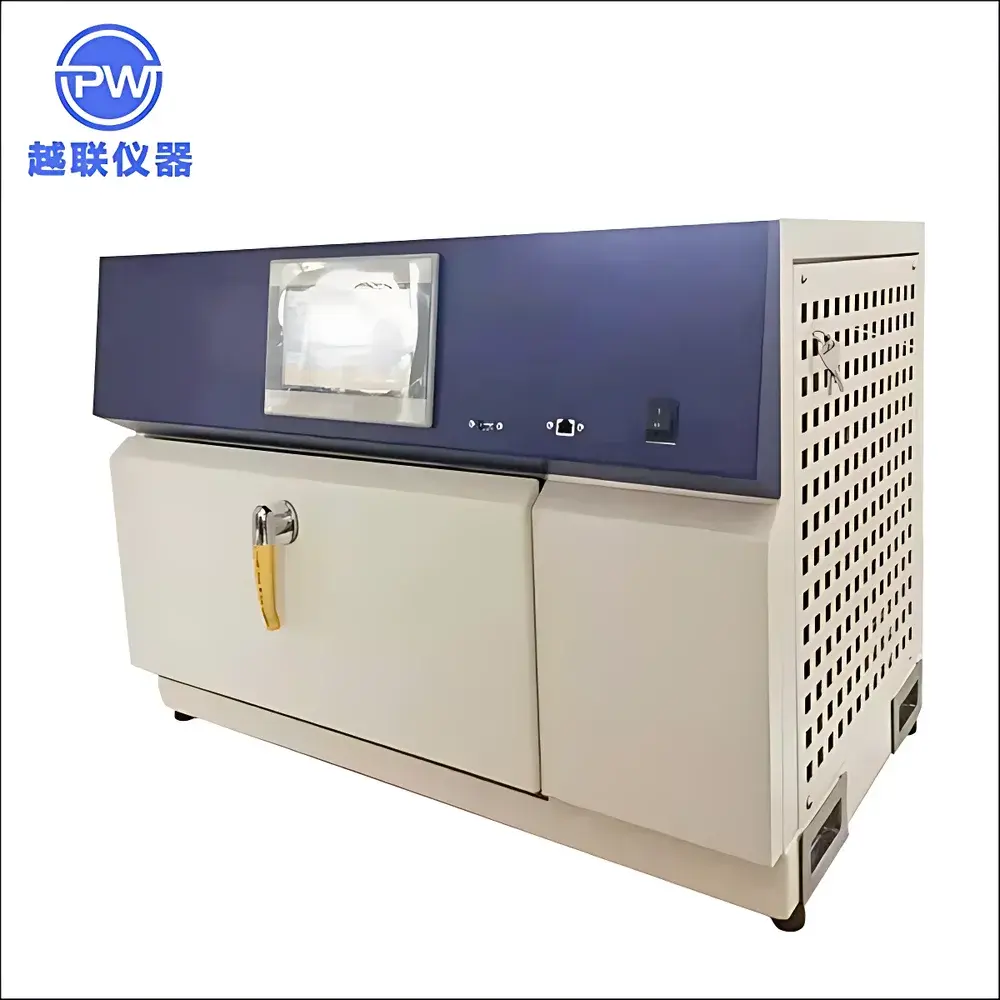
Yuelian PW-CX1800B Air-Cooled Xenon Arc Weathering Chamber
| Brand | Yuelian / PW |
|---|---|
| Origin | Guangdong, China |
| Model | PW-CX1800B |
| Lamp Power | 1.8 kW (air-cooled long-arc xenon lamp) |
| Lamp Life | 1200 hours |
| Irradiance Control Points | @340 nm, @420 nm, @300–400 nm, or @300–800 nm (user-selectable at order) |
| Irradiance Range | 0.25–0.38 W/m² (@340 nm), 0.45–0.71 W/m² (@420 nm), 20–51 W/m² (@300–400 nm), 500–650 W/m² (@300–800 nm) |
| Black Panel Temperature Range | 38–89 °C |
| Temperature Uniformity | ±3 °C |
| Temperature Fluctuation | ±2 °C |
| Chamber Dimensions (W×D×H) | 350 × 320 × 320 mm |
| External Dimensions (W×D×H) | 600 × 580 × 650 mm |
| Sample Tray | 290 × 315 mm stainless steel flat plate |
| Cycle Timing | 0–9999 h (light/dark programmable) |
| Display | 7-inch Weinview color touchscreen HMI |
| Data Export | USB port with direct Excel-compatible file export |
| Compliance | GB/T 16422.2, ISO 4892-2, AATCC TM16, JIS D 0205, FZ/T 01041 |
| Filter System | Custom optical glass filter assembly for CIE daylight spectral match |
Overview
The Yuelian PW-CX1800B Air-Cooled Xenon Arc Weathering Chamber is an engineering-grade benchtop instrument designed to replicate the photochemical and thermal stresses of natural sunlight under controlled laboratory conditions. It employs a 1.8 kW air-cooled long-arc xenon lamp as its primary radiation source, generating a continuous spectrum closely aligned with terrestrial solar irradiance (CIE Standard Illuminant D65). Unlike UV fluorescent or metal halide systems, xenon arc technology delivers full-spectrum output from 290 nm to 800 nm—enabling accurate simulation of photodegradation mechanisms including polymer chain scission, pigment bleaching, and oxidative crosslinking. The chamber is engineered for precision irradiance control via closed-loop feedback using a calibrated solar sensor (“Solar Eye”) and PID-regulated lamp power modulation. Its compact footprint (600 × 580 × 650 mm external) makes it suitable for QC labs, R&D facilities, and university testing centers where space and operational reliability are critical constraints.
Key Features
- Three-dimensional sample positioning: Adjustable top-and-bottom sample trays accommodate irregular or assembled components—including automotive interior modules, safety helmets, and molded plastic housings—without requiring specimen disassembly.
- High-fidelity spectral filtering: Multi-layer fused quartz and borosilicate glass filter assemblies ensure spectral distribution compliance with ISO 4892-2 (Method A), AATCC TM16-2021, GB/T 16422.2, and JIS D 0205, minimizing non-solar UV-B excess and IR-induced thermal artifacts.
- Dual black standard temperature monitoring: Integrated black panel thermometer (BPT) and black standard thermometer (BST) sensors co-located with test specimens provide real-time surface temperature measurement, eliminating extrapolation error common in ambient-air-based controls.
- Full-cycle programmability: Independent light/dark sequence timing (0–9999 h per phase) supports complex aging protocols such as ISO 11341 wet/dry cycles (when paired with optional external humidity chamber) and AATCC 16E multi-step irradiance ramping.
- Robust thermal management: Dedicated axial cooling fans maintain stable lamp envelope temperature and prevent premature arc tube degradation; interlocked fan-lamp shutdown prevents catastrophic lamp failure during airflow interruption.
- Comprehensive fault diagnostics: Real-time monitoring of lamp overtemperature, heater overcurrent, fan stall, power phase loss, and thermal runaway triggers automatic shutdown with on-screen fault code display and actionable remediation guidance.
Sample Compatibility & Compliance
The PW-CX1800B accommodates flat-panel specimens up to 290 × 315 mm or stacked 3D assemblies within its 350 × 320 × 320 mm test chamber. Its stainless-steel interior (SUS304) and silicone-sealed downward-opening door ensure corrosion resistance and long-term dimensional stability under repeated thermal cycling. The system meets the physical and metrological requirements of multiple international standards for accelerated weathering, including ISO 4892-2 Annex B (xenon arc exposure apparatus specifications), ASTM G155 Class A (air-cooled xenon arc), and GB/T 16422.2 Clause 5.3 (spectral irradiance verification methodology). While the base configuration does not include humidity control or water spray, its open architecture allows integration with external humidification units or condensation modules for full ISO 11341-compliant testing when required by application-specific validation protocols.
Software & Data Management
Operation is managed through a 7-inch Weinview color touchscreen HMI running embedded Linux firmware. The interface supports bilingual (English/Chinese) operation and provides three concurrent data visualization modes: numeric readouts, real-time trend curves (irradiance, BPT/BST, chamber temperature), and tabular logging. All operational parameters—including irradiance setpoint, black standard temperature target, cycle duration, and alarm thresholds—are stored non-volatile memory and persist across power cycles. Test data—including timestamped irradiance values, temperature profiles, and runtime status logs—is recorded at user-defined intervals (1 s to 60 min resolution) and exported directly to USB flash drives in CSV format compatible with Microsoft Excel, MATLAB, and LIMS platforms. Audit trails are maintained per GLP principles, though native 21 CFR Part 11 electronic signature functionality requires third-party middleware integration.
Applications
This chamber serves as a primary tool for evaluating material durability across regulated and industrial sectors. In automotive OEM supply chains, it validates colorfastness and gloss retention of dashboard polymers per SAE J2412 and GMW14124. Textile laboratories use it to assess lightfastness of dyed fabrics under AATCC TM16 Option III (xenon arc, dry condition). Coatings manufacturers perform ISO 12944-6 corrosion protection system qualification by correlating xenon exposure hours with electrochemical impedance spectroscopy (EIS) degradation onset. Rubber compounders rely on its reproducible UV dose delivery to rank antioxidant efficacy in EPDM and silicone elastomers. Additionally, the system supports research into photostabilizer migration kinetics, additive depletion profiling via FTIR mapping, and accelerated yellowing index (YI) development in polycarbonate lenses—providing traceable, repeatable input for predictive service-life modeling.
FAQ
Does the PW-CX1800B include humidity control or water spray functionality?
No—the standard configuration features only irradiance and black standard temperature regulation. Humidity and water spray must be added externally via auxiliary equipment to meet ISO 11341 or ASTM D4329 requirements.
What is the recommended recalibration interval for the irradiance sensor?
Per ISO 4892-2 Section 8.2, the solar eye sensor should be verified annually against a NIST-traceable reference radiometer; field calibration is performed using the built-in self-test routine prior to each test series.
Can the chamber operate continuously for extended durations (e.g., >1000 h)?
Yes—provided scheduled lamp replacement occurs at 1200-hour intervals and cooling airflow remains unobstructed. Continuous operation is validated under IEC 60068-2-5 environmental stress screening protocols.
Is the touchscreen interface compatible with remote monitoring or SCADA integration?
The unit lacks native Ethernet or Modbus RTU ports; however, its USB data export enables periodic batch synchronization with enterprise MES or LabVantage systems via script-driven automation.
How is spectral match verified during installation and routine maintenance?
A spectroradiometer scan (300–800 nm, 1 nm resolution) is conducted per ISO 4892-2 Annex C to confirm irradiance uniformity ≥85% across the sample plane and spectral deviation ≤±10% from CIE D65 reference curve.



