
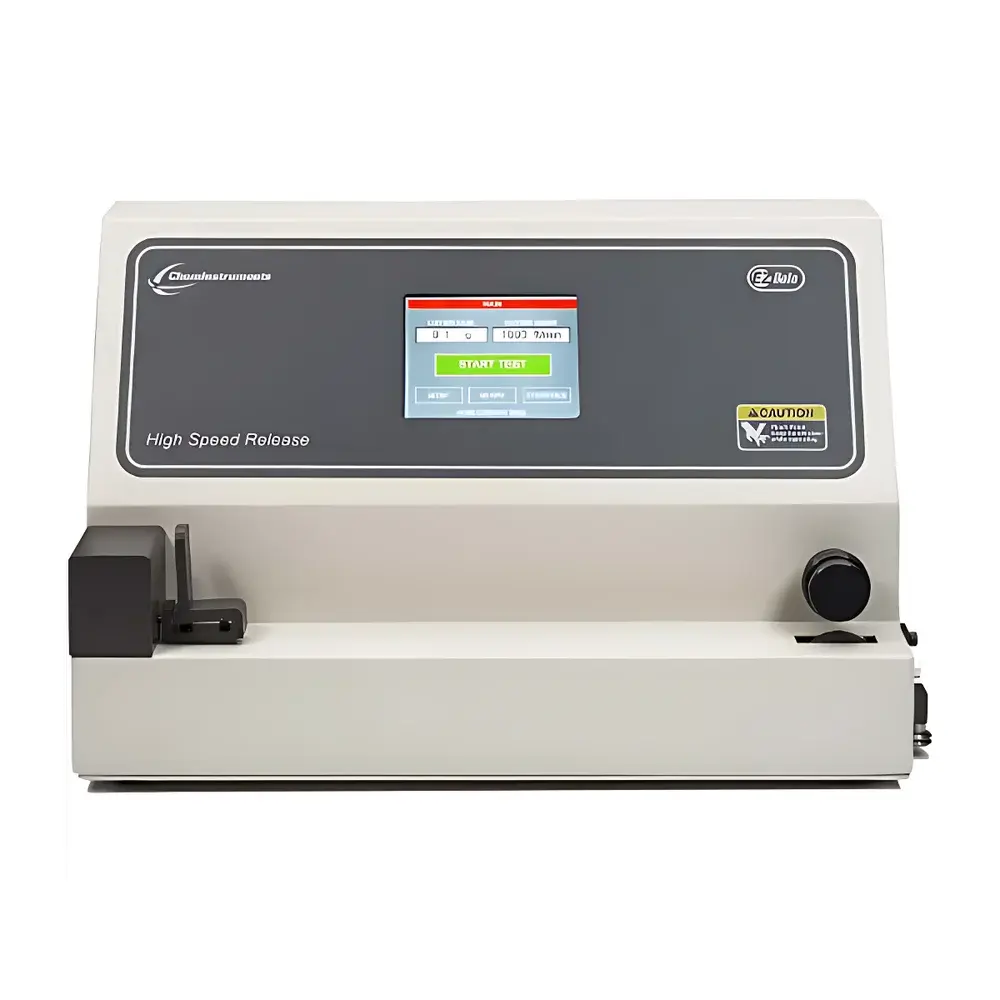
PW HSR-200 High-Speed Peel Adhesion Tester
| Brand | PW |
|---|---|
| Origin | Guangdong, China |
| Manufacturer Type | Authorized Distributor |
| Country of Origin | China |
| Model | HSR-200 |
| Price | Upon Request |
| Force Sensor Standard | 5 lbf (2.2 kN) |
| Optional Sensors | 2 lbf / 10 lbf |
| Force Accuracy | ±0.1% of full scale |
| Speed Modes | Constant & Ramp |
| Constant Speed Range | 30–1000 fpm (10–300 m/min) |
| Ramp Speed Profiles | 0–1, 0–2, 0–3, 0–4, 0–5 m/s |
| Test Compliance | FINAT FTM 4 |
| Operating Temperature | 0–70 °C |
| Power Input | 85–265 VAC, 50/60 Hz |
| Dimensions (H×W×D) | 35 × 53 × 28 cm |
| Weight | 11 kg |
| Display | 5.7" capacitive touchscreen |
| Data Sampling | Up to 400 points per test (adaptive rate) |
| Output Units | g, kg, oz, lb, N |
| Data Export | USB to EZ Data software |
| Standalone Operation | Yes |
Overview
The PW HSR-200 High-Speed Peel Adhesion Tester is an industrial-grade, microprocessor-controlled instrumentation system engineered for precise quantification of peel adhesion performance in pressure-sensitive adhesive (PSA) materials—including tapes, labels, release liners, and functional laminates—under dynamically controlled velocity conditions. Unlike conventional static or low-speed peel testers, the HSR-200 implements a dual-mode electromechanical drive architecture that supports both constant-velocity and programmable ramp-speed testing protocols, enabling direct correlation with real-world converting, die-cutting, and high-speed packaging line behaviors. Its measurement principle is grounded in ASTM D903 and FINAT FTM 4 methodologies: a standardized 180° or 90° peel geometry is maintained while the substrate is pulled at user-defined rates across a calibrated load cell. The integrated ChemInstruments electronic data acquisition module ensures traceable force transduction with ±0.1% full-scale accuracy, synchronized motion control, and real-time digitization of mechanical response—critical for evaluating viscoelastic interfacial failure mechanisms in PSA systems.
Key Features
- Robust steel-frame construction rated for continuous operation in manufacturing floor environments, including exposure to ambient dust, vibration, and incidental impact.
- Dual-mode speed control: selectable constant-velocity mode (10–300 m/min) and five discrete linear ramp profiles (0–1 to 0–5 m/s), each programmable via the embedded 5.7″ capacitive touchscreen interface.
- High-fidelity force measurement using a factory-calibrated 5 lbf (2.2 kN) load cell; optional 2 lbf and 10 lbf sensors available for extended dynamic range applications.
- Adaptive sampling architecture captures up to 400 discrete force data points per test cycle, with sampling frequency automatically adjusted to maintain temporal resolution across varying test speeds.
- On-device graphical display of real-time peel force curves, with post-test summary statistics: arithmetic mean, maximum, and minimum peel forces—all reported in user-selectable units (g, kg, oz, lb, N).
- Universal AC power input (85–265 VAC, 50/60 Hz) eliminates need for voltage converters in global deployment scenarios.
Sample Compatibility & Compliance
The HSR-200 is explicitly configured to accommodate FINAT FTM 4 standard specimen dimensions (25 mm wide × ≥150 mm long) and supports both 180° and 90° peel configurations via interchangeable fixture kits. It accommodates rigid and flexible substrates—including PET, PP, PE, paperboard, and metallized films—as well as silicone-coated release liners and acrylic or rubber-based PSAs. The system meets mechanical and metrological requirements referenced in ISO 8510-2, ASTM D3330, and PSTC-101. While not certified to GLP or GMP out-of-the-box, its deterministic firmware architecture, non-volatile memory logging, and timestamped test records support audit-ready documentation when operated within a validated laboratory quality system.
Software & Data Management
All test data are stored locally in non-volatile memory and exportable via USB 2.0 to the vendor-supplied EZ Data desktop application (Windows-compatible). EZ Data provides raw CSV export, statistical summary reports (mean ± SD, CV%), comparative overlay of multiple peel curves, and configurable pass/fail thresholds aligned with internal QC specifications. The software maintains full traceability: each exported file includes instrument ID, operator ID (manually entered), test date/time, sensor calibration ID, and environmental temperature reading. For regulated environments, users may configure EZ Data to generate audit trails compliant with FDA 21 CFR Part 11 requirements—provided appropriate organizational controls (e.g., role-based access, electronic signatures) are implemented at the site level.
Applications
- Quality assurance of roll-fed label stocks during incoming inspection and process validation.
- R&D evaluation of new adhesive formulations under accelerated peel kinetics to predict high-line-speed delamination risk.
- Comparative analysis of liner release force consistency across production batches.
- Failure mode analysis of edge-lift, cohesive splitting, or adhesive transfer during high-velocity unwinding.
- Validation of thermal stability of PSA bonds across 0–70 °C operational envelope.
- Supporting technical documentation for ISO 9001:2015 clause 8.5.1 (control of production and service provision).
FAQ
What peel angles does the HSR-200 support?
The system is mechanically compatible with both 90° and 180° peel fixtures; angle selection is determined by the physical fixture installed—not by software configuration.
Can the HSR-200 perform shear or tack testing?
No. The HSR-200 is purpose-built for peel adhesion measurement only. Shear and probe-tack require distinct mechanical configurations and are outside its scope of design and calibration.
Is firmware upgrade capability available?
Yes. Firmware updates are distributed via USB stick and applied through the onboard menu system; version history and checksum verification are displayed prior to installation.
Does the unit include calibration certification?
Each shipped unit includes a factory calibration certificate traceable to NIST standards, valid for 12 months from date of shipment. Field recalibration requires optional calibration kit (PW-CAL-KIT-5LBF) and trained personnel.
What is the maximum sample thickness the HSR-200 can accommodate?
The standard test stage accepts total stack-up thicknesses up to 3.5 mm, including substrate, adhesive layer, and liner—sufficient for >95% of commercial label constructions.





