
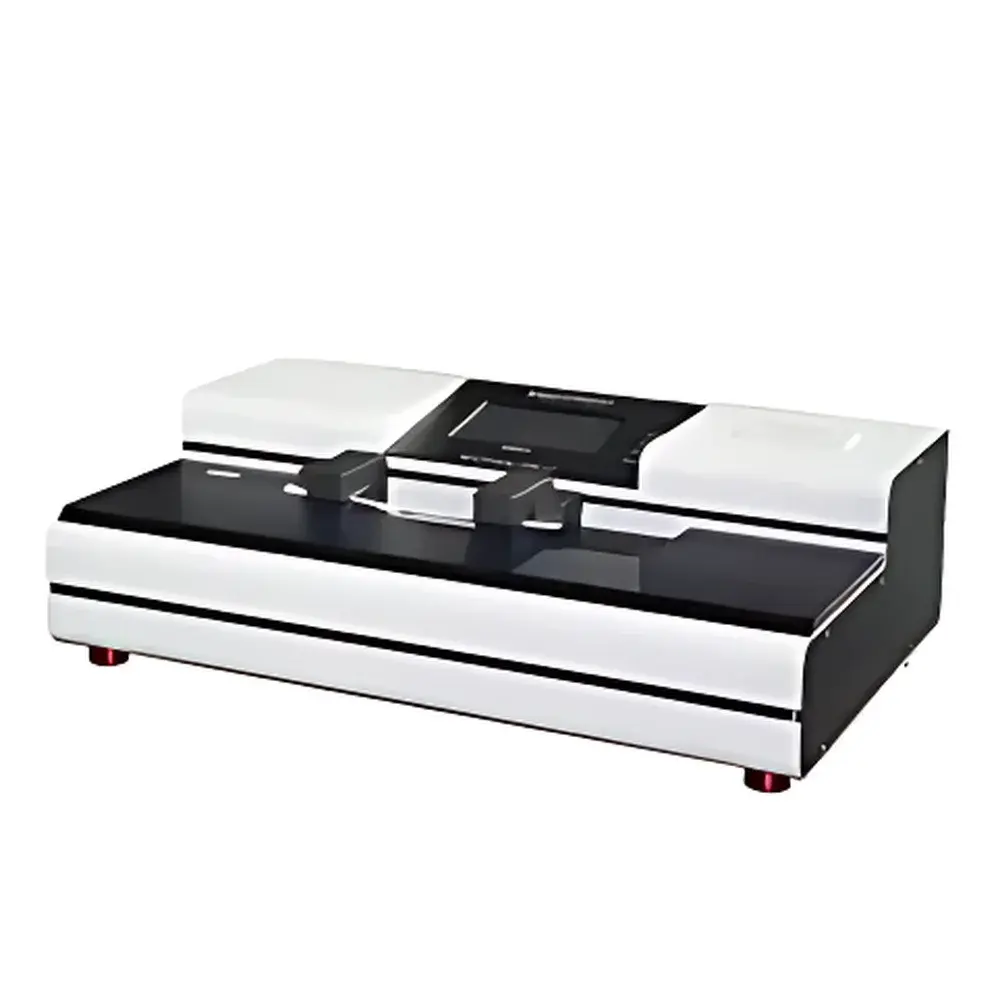
Yuelian PW-6621 Horizontal Tensile Strength Tester
| Brand | Yuelian / PW |
|---|---|
| Origin | Guangdong, China |
| Manufacturer Type | Authorized Distributor |
| Region of Manufacture | Domestic (China) |
| Model | PW-6621 |
| Pricing | Upon Request |
Overview
The Yuelian PW-6621 Horizontal Tensile Strength Tester is an ISO- and GB-compliant mechanical testing instrument engineered for precision tensile property characterization of flexible sheet materials. Based on the fundamental principle of uniaxial static tensile loading under controlled displacement rate, it measures force response as a function of elongation to derive standardized mechanical parameters including tensile strength, tensile index, elongation at break, tensile energy absorption (TEA), breaking length, elastic modulus, and peel strength for pressure-sensitive adhesives. Its horizontal configuration minimizes gravitational interference on specimen alignment and clamping—critical for low-stiffness, high-ductility materials such as tissue paper, aluminum foil, and nonwovens. Designed in strict accordance with GB/T 12914 (paper and board), GB/T 2792 (adhesive tape peel), GB/T 24218.3 (nonwovens), GB/T 1040 (plastics), and TAPPI T 494 (tissue wet tensile), the system supports routine QC/QA, R&D validation, and regulatory conformance testing across packaging, pulp & paper, flexible packaging, and medical nonwoven manufacturing sectors.
Key Features
- Horizontal dual-column architecture with preloaded ball-screw drive and linear guide rail system ensures minimal friction, high positional repeatability (< ±0.02 mm), and long-term mechanical stability.
- Servo-controlled stepper motor enables precise, programmable crosshead speed from 1 to 500 mm/min—fully adjustable in 0.1 mm/min increments for compliance with variable test standards.
- Triple-range load cell configuration (0.15–30 N, 1–300 N, 3–1000 N) with automatic range switching and resolution down to 0.01 N (at 30 N range) ensures optimal signal-to-noise ratio across diverse material stiffnesses.
- ARM-based embedded controller delivers real-time data acquisition at ≥100 Hz sampling rate, enabling accurate capture of peak load, yield point, and full stress–strain curve morphology.
- 7-inch capacitive color touchscreen interface with intuitive icon-driven navigation supports standalone operation—no PC required for basic test execution, result display, or thermal printout.
- Integrated power-loss recovery: all active test data—including time-stamped force/displacement points—are automatically saved to non-volatile memory during unexpected shutdown; resumed testing preserves original sample ID and protocol context.
- Comprehensive hardware safeguards include overload cutoff (110% FS), auto-return-to-initial-position post-test, self-diagnostic boot sequence, and mechanical end-stop protection.
Sample Compatibility & Compliance
The PW-6621 accommodates specimens up to 50 mm wide (standard 15 mm, optional 25 mm/50 mm grips) and 300 mm maximum travel distance—sufficient for elongation measurement of highly extensible films and tissues. It is validated for use with paper, cardboard, aluminum foil, laminated foils, plastic films (BOPP, PET, PE), synthetic fibers, geotextiles, and medical-grade spunbond/meltblown nonwovens. All reported metrics comply with internationally recognized methodologies: tensile strength (kN/m) per GB/T 12914 and ISO 1924-3; wet tensile strength of tissue per GB/T 465.2; peel adhesion per GB/T 2792 and ASTM D903; and tensile properties of nonwovens per GB/T 24218.3 and ISO 9073-3. The instrument meets electromagnetic compatibility (EMC) requirements per GB/T 18268.1 and safety standards per GB 4793.1.
Software & Data Management
While fully functional as a stand-alone tester, the PW-6621 supports bidirectional RS232 communication (USB and Wi-Fi modules available as optional upgrades) for integration with Yuelian’s PC-based TensileLab v3.2 software. This Windows application provides GLP-compliant audit trail logging, user role management (admin/operator), electronic signature support, customizable report templates (PDF/Excel), raw data export (CSV), statistical process control (SPC) charts, and automated pass/fail evaluation against user-defined specification limits. Data files retain full metadata—including operator ID, calibration timestamp, environmental conditions (manually entered), and instrument firmware version—to satisfy FDA 21 CFR Part 11 and ISO/IEC 17025 documentation traceability requirements.
Applications
- Quality control of paper machine output: dry/wet tensile strength, stretch, TEA, and breaking length for newsprint, kraft, tissue, and specialty papers.
- Aluminum foil and foil-laminated packaging validation: tensile yield behavior, ductility assessment, and lamination integrity via peel strength testing.
- Plastic film development: comparative analysis of biaxially oriented polypropylene (BOPP), polyester (PET), and polyethylene (PE) under varying draw ratios and heat treatment conditions.
- Nonwoven product certification: tensile performance verification for surgical gowns, wipes, filtration media, and hygiene absorbent cores per ISO 9073 series.
- R&D of pressure-sensitive adhesive tapes: 90° and 180° peel adhesion quantification under controlled temperature/humidity environments.
FAQ
What standards does the PW-6621 directly support out-of-the-box?
It is factory-configured to execute GB/T 12914, GB/T 2792, GB/T 24218.3, GB/T 1040, and TAPPI T 494 test protocols—including automatic calculation of derived indices (e.g., tensile index, TEA index) and unit conversion.
Can the instrument perform wet tensile testing on tissue paper?
Yes—when used with optional humidity-controlled conditioning chamber and wet specimen handling fixtures, it complies with GB/T 465.2 for wet tensile strength determination.
Is calibration traceable to national metrology institutes?
Load cells are supplied with factory calibration certificates traceable to CNAS-accredited laboratories; annual recalibration services—including uncertainty budgeting per ISO/IEC 17025—are available through authorized service centers.
Does the system support multi-specimen batch testing?
Yes—the embedded OS allows sequential test setup with unique IDs; PC software extends this capability with automated batch reporting and statistical summarization across 100+ specimens.
What environmental conditions are required for valid measurements?
Standard operation requires ambient temperature 10–35 °C and relative humidity ≤85% RH (non-condensing); for standards-compliant testing (e.g., ISO 187), use with certified climate-controlled lab environment is mandatory.






