
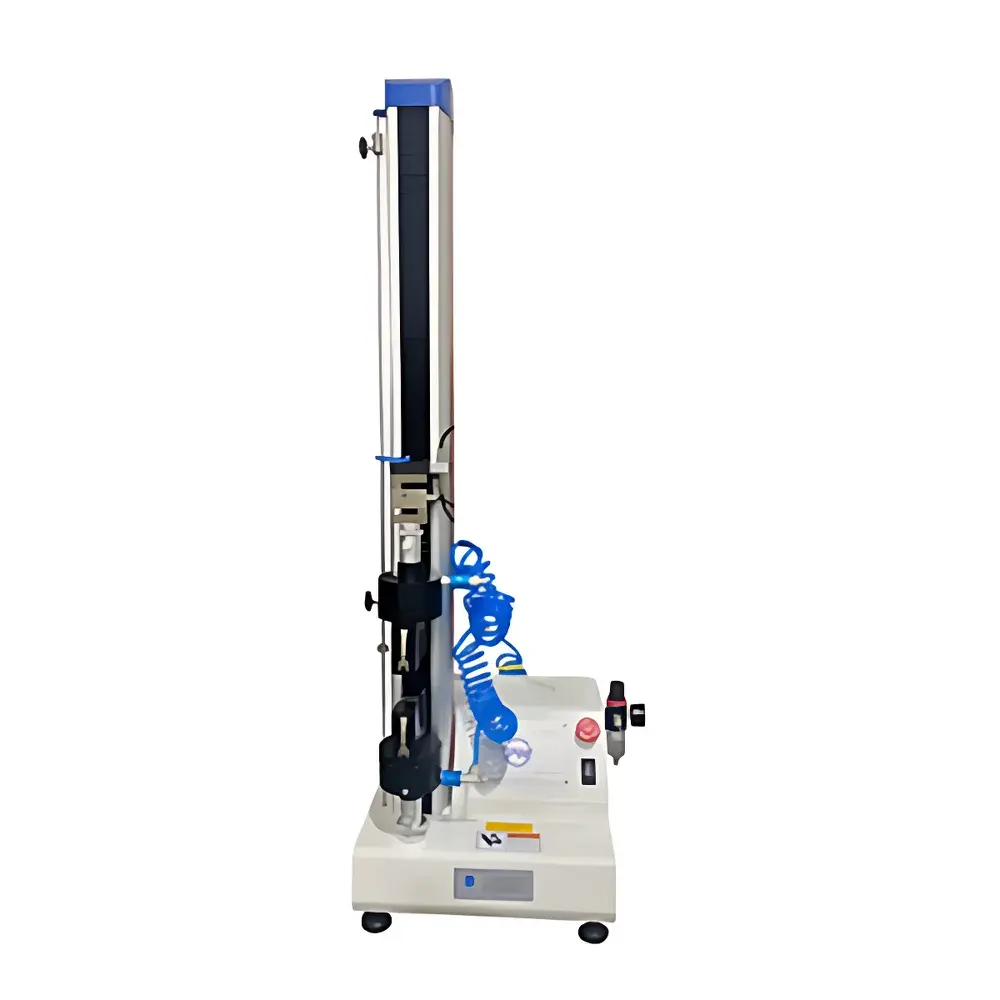
Yuelian PW-US91 Advanced Electronic Tensile Testing Machine
| Brand | Yuelian (PW) |
|---|---|
| Origin | Guangdong, China |
| Manufacturer Type | Authorized Distributor |
| Instrument Type | Electronic Tensile Testing Machine |
| Maximum Test Load | 10 kN |
| Force Accuracy | ±0.5% of full scale |
| Test Stroke | 700 mm |
| Displacement Resolution | 1/500,000 mm |
| Force Resolution | 1/500,000 FS |
| Displacement Accuracy | ±0.1% |
| Speed Range | 0.01–500 mm/min |
| Test Space Diameter | Φ115 mm |
| Power Supply | 220 V, 50–60 Hz |
| Net Weight | 35 kg |
| Dimensions (W×D×H) | 400 × 370 × 1250 mm |
Overview
The Yuelian PW-US91 Advanced Electronic Tensile Testing Machine is a precision-engineered universal testing system designed for static mechanical property evaluation of solid materials under uniaxial loading conditions. Based on servo-controlled electromechanical actuation and high-fidelity signal acquisition architecture, it implements standardized force-displacement measurement principles compliant with ISO 7500-1 (static calibration of force-proving instruments) and ASTM E4 (practices for force verification of testing machines). The system employs a high-rigidity 45# steel frame with sandblasted and electrostatically coated finish, ensuring long-term dimensional stability and environmental resistance. Its dual high-resolution analog-to-digital conversion system—capable of 500,000-count subdivision for both load and displacement channels—enables traceable, repeatable measurements across the full 0.5–100% full-scale range, meeting Class 0.5 accuracy requirements per ISO 7500-1 and JJG 475. Designed for laboratory and quality control environments, the PW-US91 supports deterministic test execution, real-time data synchronization, and audit-ready documentation workflows.
Key Features
- Servo motor-driven motion control with precision ground ball screw transmission, delivering smooth, low-noise operation and minimal mechanical hysteresis.
- Dual-channel 24-bit high-speed AD converter with continuous, unsegmented sampling—achieving 1/500,000 resolution for both force and displacement signals without range switching.
- Modular fixture interface compatible with ASTM D3330 (peel adhesion), ASTM D882 (thin plastic film tensile), ISO 527 (plastics tensile), ISO 1133 (melt flow index correlation), and GB/T 228.1 (metallic materials tensile testing) configurations.
- Optically isolated USB 2.0 communication interface ensures galvanic separation between PC and machine electronics, eliminating ground-loop interference and enabling hot-plug-safe data exchange.
- Multi-tier software permission management (operator, supervisor, manufacturer) enforces role-based access control in compliance with GLP and internal QA protocols.
- Real-time auto-return function triggers immediate return to pre-test position upon specimen rupture, minimizing operator intervention and cycle time.
Sample Compatibility & Compliance
The PW-US91 accommodates specimens ranging from thin polymer films (<10 µm) to rigid thermoset composites and metallic wires (up to Φ5 mm diameter), within a maximum test space of Φ115 mm and 700 mm vertical stroke. It meets mechanical verification standards including ISO 7500-1, EN 10002-1, ASTM E4, DIN 51221, JIS B7721/B7733, and GB/T 228.1. For regulated environments, its software supports 21 CFR Part 11-compliant electronic signatures, audit trail logging (user actions, parameter changes, test events), and raw data preservation in native binary format with metadata embedding (timestamp, operator ID, calibration certificate ID). All force transducers are factory-calibrated against NIST-traceable deadweight standards and certified to ISO/IEC 17025-accredited laboratories.
Software & Data Management
The embedded Windows-compatible test software provides full parametric control over test profiles—including displacement-controlled, load-controlled, and cyclic fatigue modes—with programmable hold steps, ramp rates, and conditional termination logic (e.g., break detection via slope threshold). Data output includes standardized engineering parameters: tensile strength (MPa), yield strength (MPa), elongation at break (%), Young’s modulus (GPa), peel strength (N/mm), shear strength (MPa), and tear resistance (kN/m). Curve overlay, differential analysis, and statistical comparison across batches are supported. Reports export directly to PDF, Word (.docx), and Excel (.xlsx) with customizable templates; unit systems include SI (N–mm–MPa), imperial (lbf–in–kpsi), and metric gravitational (kgf–cm–kgf/cm²). Raw data files retain full 500 kHz acquisition fidelity and support third-party post-processing in MATLAB or Python.
Applications
The PW-US91 serves as a primary mechanical characterization platform across R&D and QC labs in polymers, packaging, medical devices, adhesives, and automotive component manufacturing. Typical use cases include: tensile testing of polyethylene terephthalate (PET) films per ASTM D882; 180° peel adhesion assessment of pressure-sensitive tapes per ASTM D3330; compression testing of foam cushions per ISO 3386; three-point bending of composite laminates per ASTM D7264; and shear strength validation of structural adhesives per ISO 4587. Its modular design allows rapid reconfiguration for ISO 2285 (rubber elasticity), GB/T 7124 (adhesive shear strength), and HGT 2-163 (rubber-to-metal bond testing) without hardware modification.
FAQ
What international standards does the PW-US91 comply with for force calibration?
It conforms to ISO 7500-1:2018 (Class 0.5), ASTM E4-22, and JJG 475-2008 for static force verification.
Can the system perform cyclic fatigue testing?
Yes—the software supports programmable load/displacement waveforms (sine, triangle, trapezoidal) with up to 10 million cycle logging and failure detection thresholds.
Is raw data export available for independent analysis?
All acquired force and displacement time-series data are stored in uncompressed binary format with embedded metadata, supporting import into MATLAB, Python (NumPy/Pandas), or OriginLab.
Does the software meet FDA 21 CFR Part 11 requirements?
Yes—audit trails, electronic signatures, user authentication, and data integrity controls are fully implemented and configurable per regulatory validation protocols.
What is the warranty coverage and service support structure?
Standard 24-month parts-and-labor warranty; extended service contracts include annual metrological recalibration, preventive maintenance, and remote diagnostics support.



