
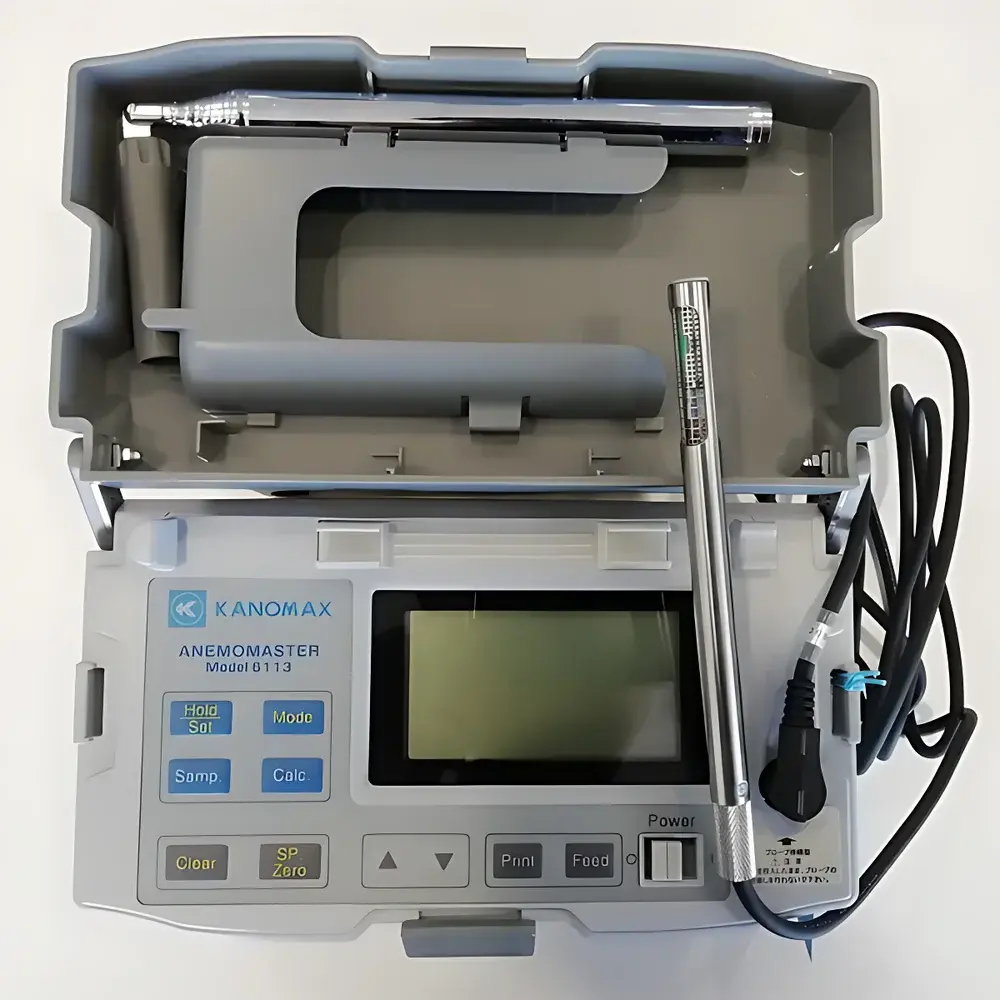
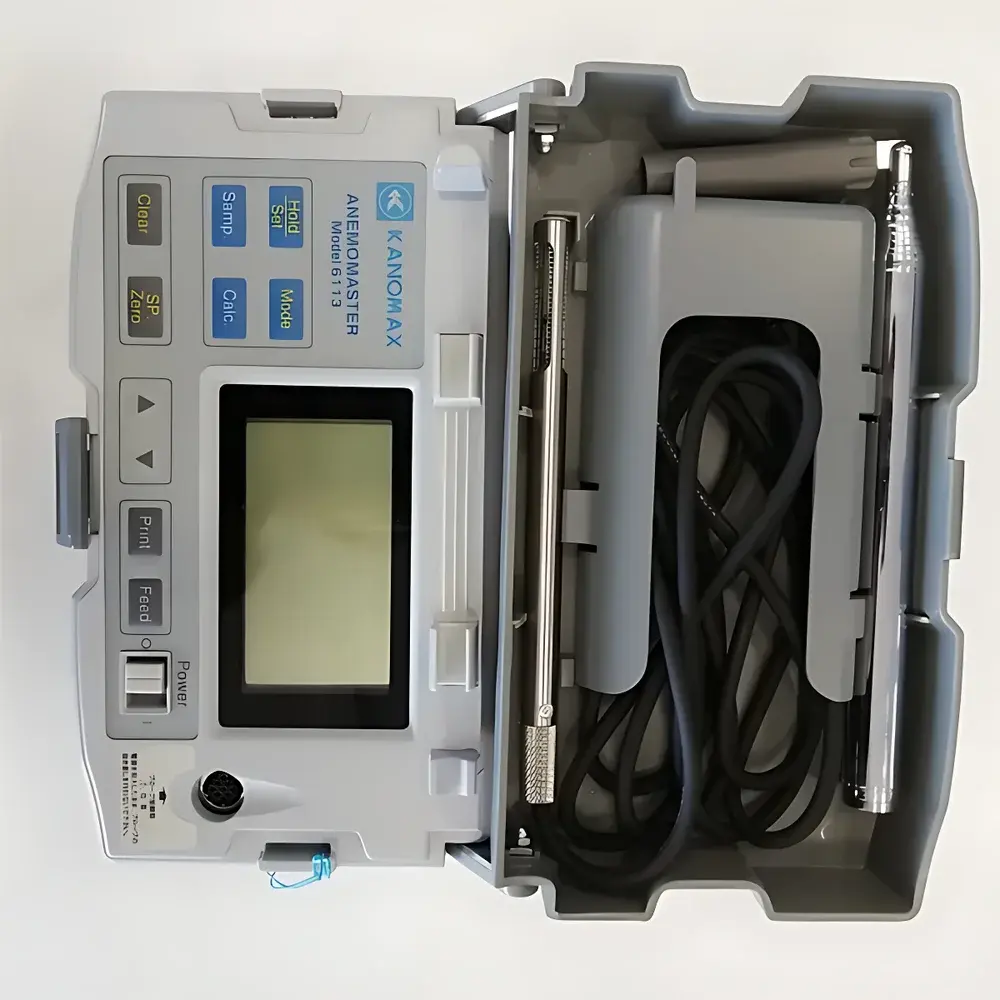
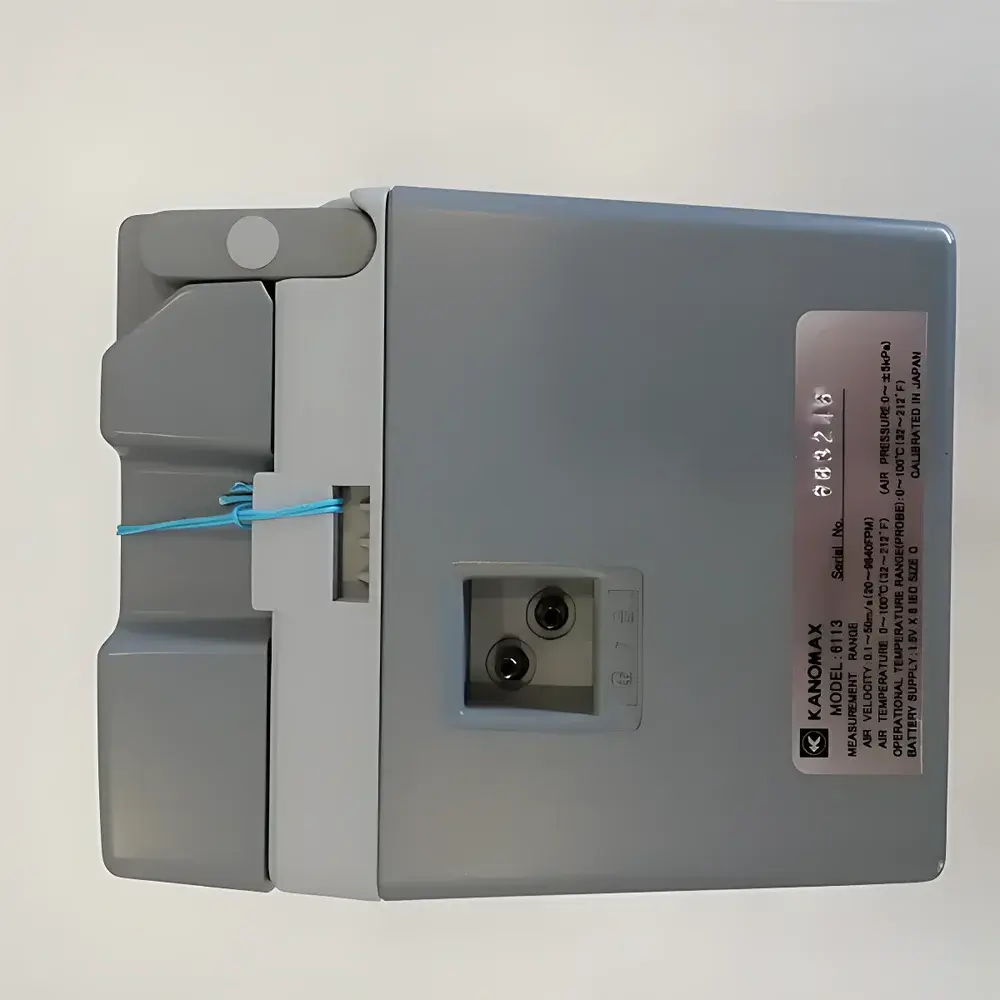
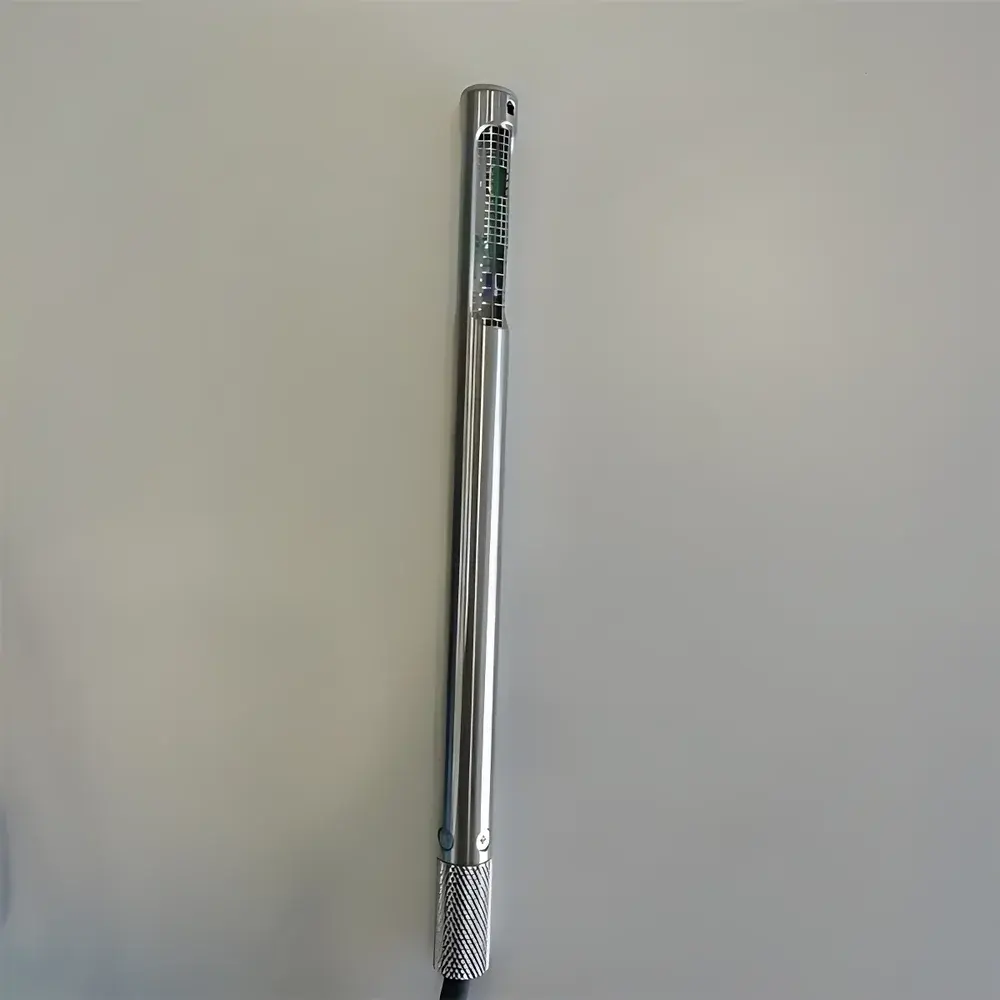
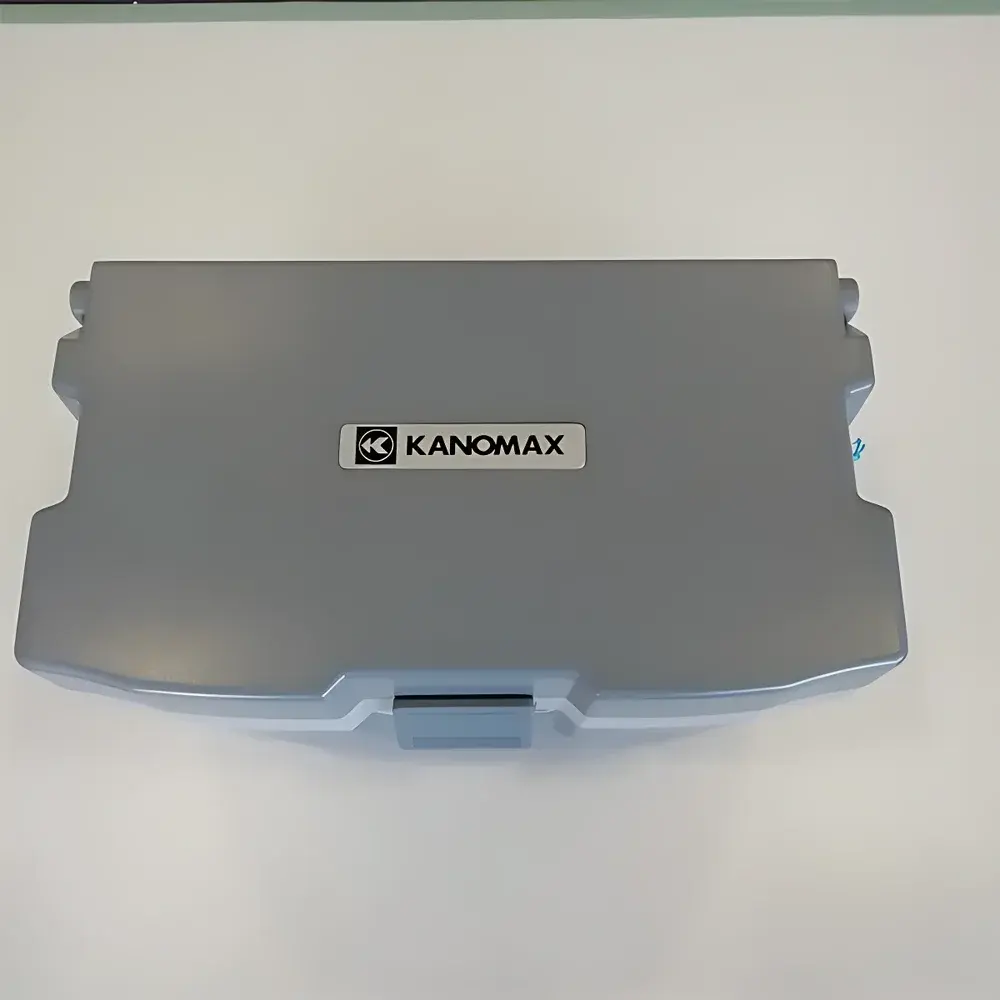
Kanomax Model 6113 Intelligent Hot-Wire Anemometer
| Brand | Kanomax |
|---|---|
| Origin | Japan |
| Model | 6113 |
| Instrument Type | Hot-Wire Anemometer |
| Velocity Range | 0.1–50.0 m/s |
| Accuracy | ±(3% of reading + 0.1) m/s |
| Temperature Range | 0–100 °C |
| Temperature Accuracy | ±1 °C |
| Pressure Range | −5 to +5 kPa |
| Pressure Accuracy | ±(3% of reading + 0.01) kPa |
| Communication Interface | RS-232C |
| Data Storage Capacity | 100 measurement sets |
| Analog Output | 0–1 V (optional) |
| Built-in Thermal Printer | Yes |
| Power Supply | 6 × AA batteries |
| Dimensions | 210 × 120 × 133 mm |
| Weight | 1.0 kg |
Overview
The Kanomax Model 6113 is an intelligent, portable hot-wire anemometer engineered for high-reliability environmental airflow characterization in industrial hygiene, HVAC commissioning, cleanroom validation, and laboratory ventilation assessments. It operates on the principle of constant-temperature anemometry (CTA), where a fine platinum-coated tungsten wire is electrically heated to a fixed temperature differential above ambient; convective heat loss from the wire—directly proportional to local air velocity—is measured via feedback-controlled current modulation. This method delivers rapid response (<100 ms), low-flow sensitivity down to 0.1 m/s, and immunity to directional dependence typical of vane or cup sensors. Unlike thermal dispersion or ultrasonic variants, the hot-wire design ensures stable calibration across turbulent, low-velocity, and thermally stratified flows commonly encountered in ductwork, fume hoods, and laminar flow cabinets.
Key Features
- Simultaneous real-time measurement of air velocity, temperature, and differential pressure (−5 to +5 kPa) using integrated, field-replaceable probes—enabling comprehensive airflow profiling without instrument swapping.
- Modular probe-body architecture with full interchangeability: any Model 6113 main unit accepts compatible hot-wire, thermistor, or pressure-sensing probes (e.g., 6114/6115 variants), minimizing downtime during maintenance or field failure.
- Large backlit LCD display with intuitive single-button navigation for data logging, statistical computation (max/min/mean), and on-device printing—designed for glove-compatible operation in constrained mechanical spaces.
- Built-in thermal printer supports immediate hardcopy generation of test records at point-of-measurement, satisfying traceability requirements under ISO 17025 and GLP-compliant workflows.
- RS-232C serial interface enables bidirectional communication with PCs or data acquisition systems for automated report generation, long-term trend analysis, and audit-ready export (CSV/ASCII).
- Ruggedized housing (IP54-rated against dust and water splashes) and compact form factor (210 × 120 × 133 mm, 1.0 kg) facilitate handheld use inside ducts, ceiling plenums, and exhaust stacks.
Sample Compatibility & Compliance
The Model 6113 is validated for use with standard 10-mm diameter hot-wire probes suitable for duct velocities up to 50 m/s and ambient temperatures from 0 °C to 100 °C. Its pressure sensor module meets IEC 61000-4-2 (ESD immunity) and IEC 61000-4-3 (radiated RF immunity) standards. Measurement uncertainty complies with ISO 8549-2:1996 (hot-wire anemometer performance specifications) and ASTM D1078-22 (standard test method for airflow velocity in ventilation systems). Calibration certificates traceable to NMIJ (National Metrology Institute of Japan) are available upon request. The device supports FDA 21 CFR Part 11–compliant data integrity when used with validated software platforms for electronic recordkeeping.
Software & Data Management
Raw data—including timestamped velocity, temperature, and pressure values—is stored internally in non-volatile memory (100 datasets maximum). Each record includes statistical parameters (maximum, minimum, arithmetic mean) calculated onboard. Via RS-232C, users can export datasets to Kanomax’s proprietary KanView software (Windows-based) or third-party tools such as LabVIEW, MATLAB, or Excel-compatible applications. Optional analog output (0–1 V, factory-installed) allows integration into building management systems (BMS) or PLC-controlled monitoring loops. All exported files retain metadata (probe ID, operator tag, calibration date) to support ISO/IEC 17025 clause 7.7 (result reporting) and internal QA audits.
Applications
- HVAC system balancing and TAB (Testing, Adjusting, Balancing) per ASHRAE Guideline 111-2020.
- Cleanroom ISO Class verification (ISO 14644-3) through uniformity mapping of supply air velocity at diffusers and return grilles.
- Fume hood face velocity surveys per ANSI/ASHRAE 110-2016 and OSHA 1910.1450 compliance checks.
- Industrial stack and flue gas velocity profiling under EPA Method 2 (stack gas velocity determination).
- Research-grade boundary layer studies in wind tunnels or environmental chambers where transient flow resolution is critical.
- Validation of laminar flow workstations (LFWS) per ISO 14644-1:2015 Annex B.
FAQ
Is the Model 6113 suitable for explosive or corrosive atmospheres?
No. It is rated for general indoor/outdoor industrial environments only (non-hazardous locations per NEC Class I, Division 2). Intrinsically safe variants are not available.
Can the built-in printer operate without a PC connection?
Yes. Printing is fully autonomous and triggered via front-panel button press; no external host or driver installation is required.
How often does the hot-wire probe require recalibration?
Kanomax recommends annual calibration against NIST-traceable standards or after 500 hours of cumulative operation—whichever occurs first—as specified in the user manual’s maintenance schedule.
Does the RS-232C interface support Modbus RTU protocol?
No. The interface implements a proprietary ASCII command set; Modbus compatibility requires external protocol conversion hardware.
Are replacement probes certified for traceable calibration?
Yes. All genuine Kanomax probes (e.g., 6114, 6115) ship with individual calibration certificates referencing JCSS-accredited laboratories and include serial-number-matched correction coefficients embedded in firmware.
Related Products







