
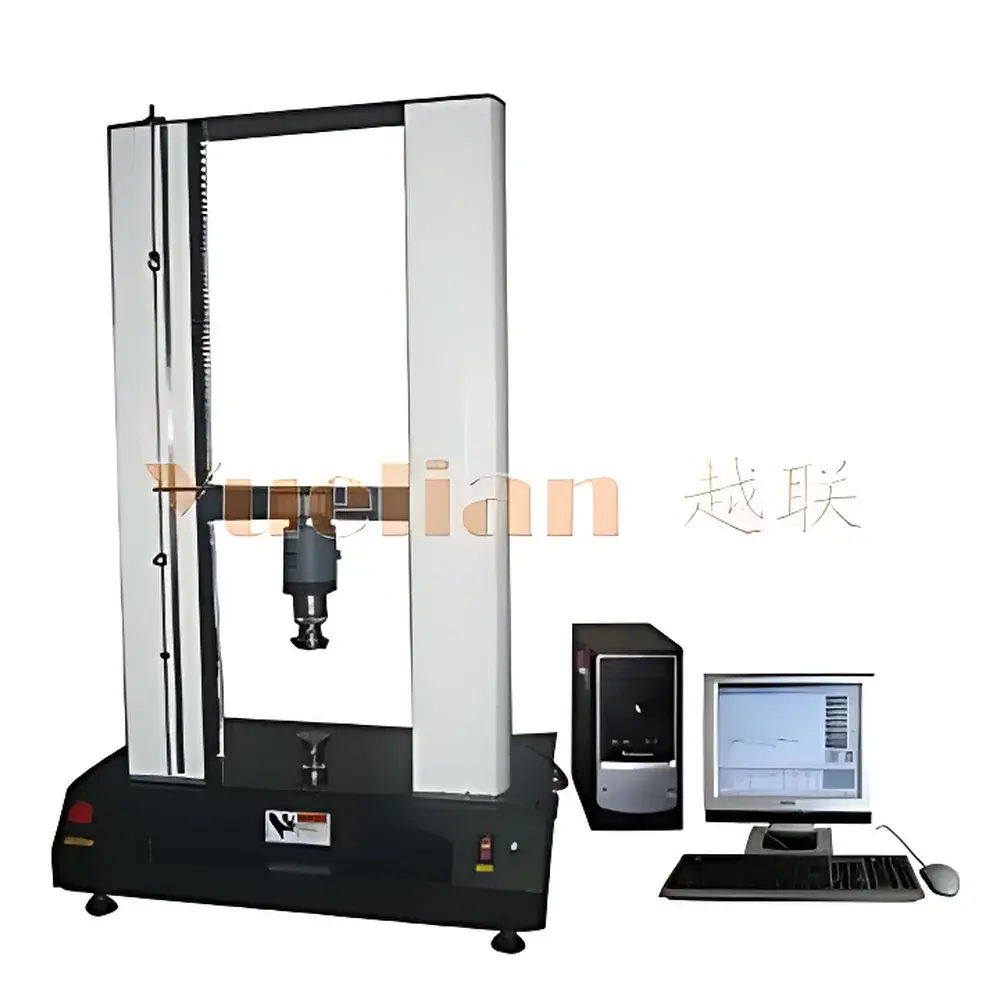
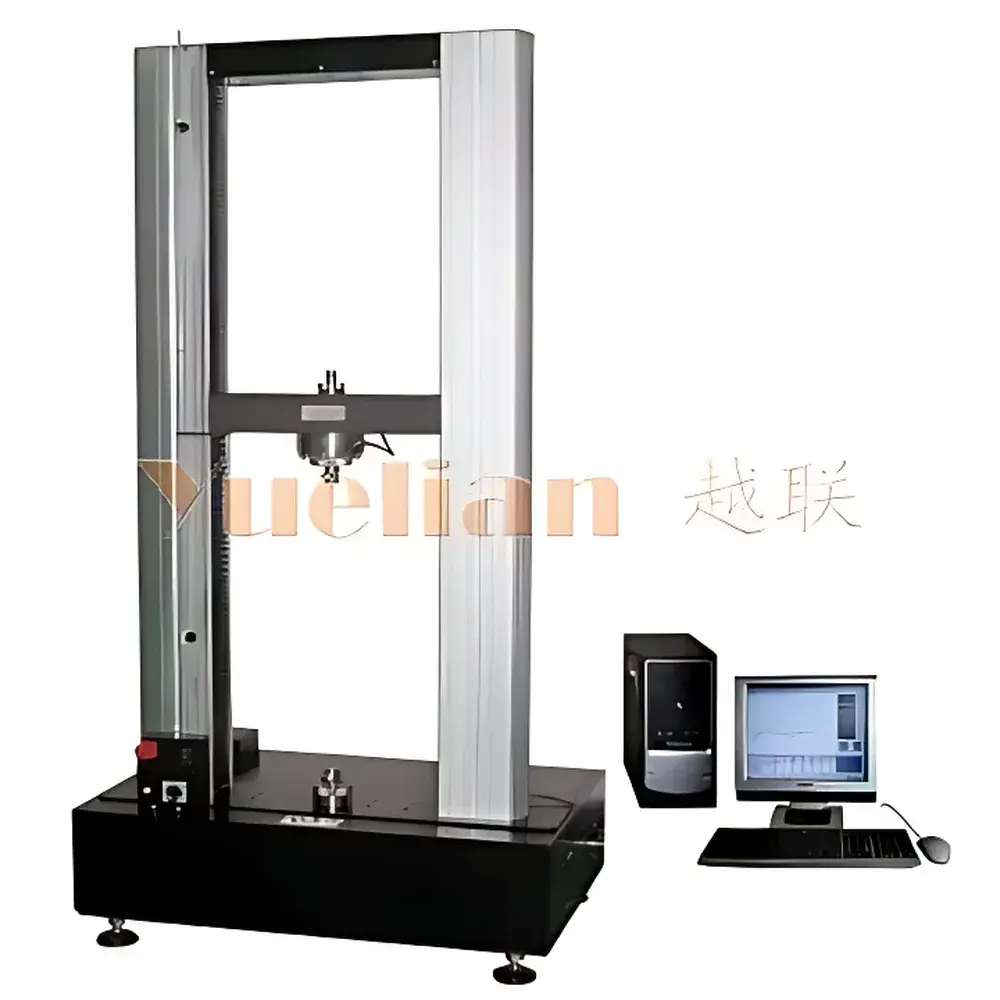
YL-1123 Universal Testing Machine (2 Ton) – Yuelian Servo-Controlled Electromechanical Tensile Tester
| Brand | Yuelian |
|---|---|
| Origin | Guangdong, China |
| Model | YL-1123 |
| Load Capacity | 2 kN (2 Ton) |
| Force Resolution | 1/500,000 full scale |
| Force Accuracy | ≤ ±0.5% FS |
| Stroke Resolution | 0.005 mm |
| Test Speed Range | 0.01–1000 mm/min (PC-programmable) |
| Maximum Travel | 700 mm |
| Test Width | 350 mm |
| Drive System | AC servo motor + precision ball screw + synchronous timing belt |
| Power Supply | 220 V, 50/60 Hz, 10 A |
| Rated Power | 400 W |
| Dimensions (W×D×H) | 72 × 52 × 130 cm |
| Weight | ~115 kg |
| Standard Accessories | One set of universal grips, proprietary test software, USB interface cable |
Overview
The YL-1123 Universal Testing Machine is a fully computer-controlled electromechanical tensile and compression tester engineered for precision mechanical property evaluation across diverse material classes. Based on the fundamental principles of uniaxial force-displacement transduction, it applies controlled quasi-static loads via a high-rigidity frame, servo-driven actuation system, and calibrated load cell to measure stress–strain behavior in tension, compression, flexure, shear, peel, tear, and adhesion modes. Designed to meet the operational rigor required by QC laboratories, R&D centers, and incoming inspection departments, the YL-1123 complies with core mechanical testing framework standards—including ASTM E4 (load verification), ASTM E8/E8M (tensile testing of metallic materials), ASTM D638/D3039 (plastics and composites), ISO 6892-1, ISO 178, and GB/T 228.1—enabling traceable, repeatable, and auditable test execution in regulated environments.
Key Features
- AC servo motor drive with precision ground ball screw and synchronous belt transmission ensures smooth, low-noise, backlash-free motion control and long-term mechanical stability.
- High-resolution force measurement system with 1/500,000 internal resolution and ≤ ±0.5% full-scale accuracy meets ISO 7500-1 Class 1 requirements for static force verification.
- Programmable crosshead speed from 0.01 to 1000 mm/min enables compliance with both slow-rate ductility tests (e.g., ASTM D882) and high-speed peel protocols (e.g., ASTM D903).
- 700 mm effective stroke and 350 mm test width accommodate standard specimen geometries per ISO and ASTM dimensional guidelines, including dog-bone, dumbbell, and strip configurations.
- Dual-capacity load cell support (optional) allows seamless switching between high-sensitivity micro-force ranges (e.g., 10 N) and high-load applications (up to 20 kN), minimizing recalibration frequency.
- Integrated hardware safety logic includes overload cutoff, emergency stop, automatic rupture halt, programmable upper/lower displacement limits, and auto-return-to-initial-position functionality—critical for GLP/GMP-aligned workflows.
Sample Compatibility & Compliance
The YL-1123 supports standardized mechanical characterization of polymers (thermoplastics, elastomers, films), metals (foils, wires, thin sheets), textiles (woven/nonwoven fabrics), paperboard, composites, adhesives, biomedical tubing, and automotive gaskets. Its modular grip interface accommodates wedge-action, pneumatic, hydraulic, and custom fixtures—enabling ASTM D1876 (T-peel), D1781 (climbing drum peel), D624 (tear resistance), and ISO 11337 (flexural modulus) test configurations. All firmware and calibration procedures are documented per ISO/IEC 17025 requirements, and system validation reports include as-found/as-left data, linearity verification, and repeatability assessments at multiple load points.
Software & Data Management
The embedded PC-based control and analysis suite provides real-time force–displacement curve acquisition, multi-channel sensor synchronization (load, extensometer, environmental feedback), and automated parameter extraction—including ultimate tensile strength (UTS), yield point (0.2% offset), Young’s modulus, elongation at break, peel average/max force, and energy-to-break. Data export conforms to ASTM E1434 and ISO 10360-6: CSV, XML, and native .MDB (Microsoft Access) formats ensure interoperability with LIMS and ERP systems. Audit trail logging—recording user ID, timestamp, method version, calibration status, and raw data hash—is enabled to satisfy FDA 21 CFR Part 11 and EU Annex 11 electronic record integrity mandates.
Applications
- Quality assurance of extruded polymer profiles and injection-molded components in Tier-1 automotive supply chains.
- Incoming inspection of aluminum alloy foils and copper-clad laminates used in PCB manufacturing.
- Mechanical validation of pressure-sensitive adhesive tapes per PSTC-101 and AFERA 4001.
- Research-grade tensile fatigue pre-screening of biodegradable scaffold materials under ISO 13781.
- Compression testing of corrugated fiberboard (ASTM D642) and honeycomb core structures per MIL-STD-1660.
- Educational use in university materials science labs for hands-on stress–strain curve derivation and failure mode analysis.
FAQ
Does the YL-1123 support extensometer integration for strain measurement?
Yes—both contact-type clip-on and non-contact video extensometers can be synchronized via analog/digital I/O or USB interface; strain resolution down to 0.1 µm is achievable with compatible third-party sensors.
Is the software compliant with 21 CFR Part 11 for electronic signatures?
The system supports role-based user authentication, electronic signature capture with audit-trail-enforced timestamping, and immutable raw data archiving—fully configurable to meet Part 11 predicate rule requirements.
Can test methods be saved and recalled as reusable templates?
Yes—users define and store complete test protocols (speed profile, trigger conditions, calculation routines, report layout) as XML-based method files, enabling rapid re-execution without manual reconfiguration.
What maintenance intervals are recommended for long-term accuracy?
Load cell recalibration every 12 months or after 10,000 cycles; ball screw lubrication every 6 months; annual mechanical alignment verification using certified gauge blocks and dial indicators.
Is technical documentation available in English with metrological traceability statements?
Full English-language operation manual, calibration certificate (NIST-traceable reference standards), and ISO/IEC 17025-accredited verification report are supplied with each unit.



