
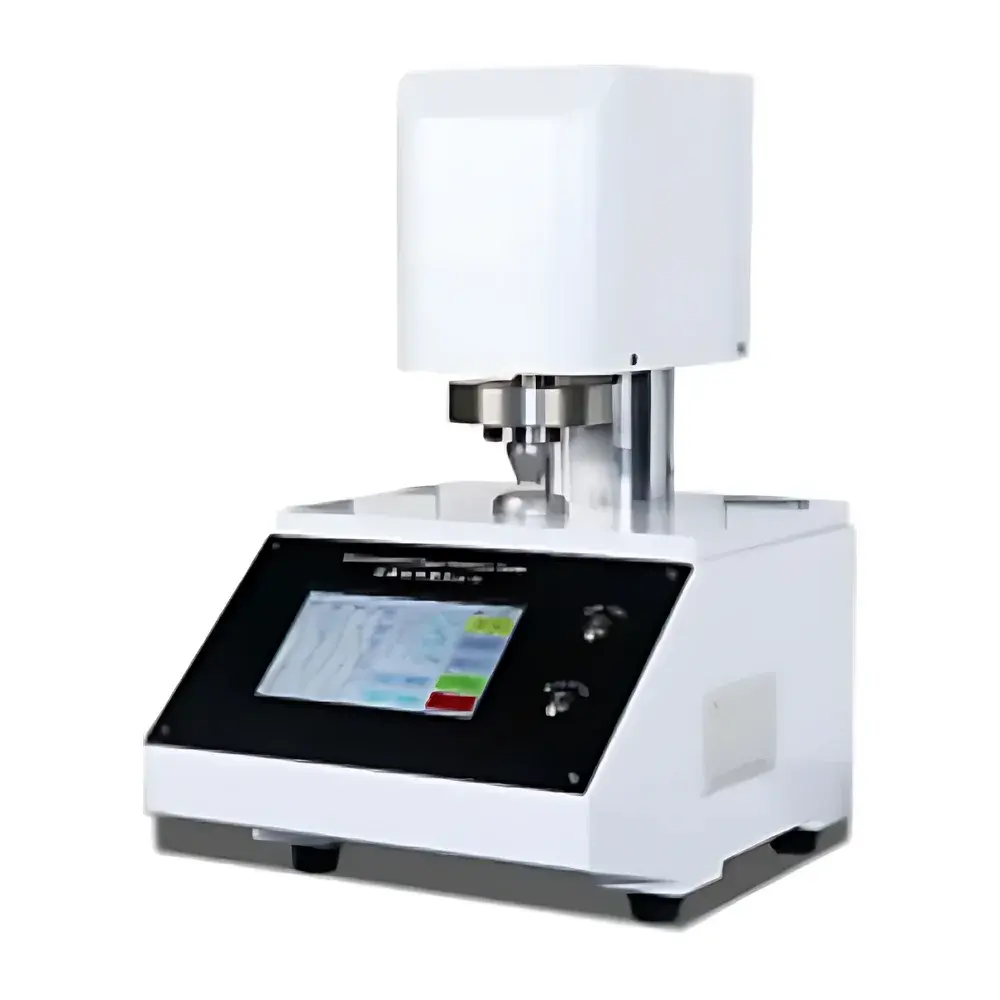
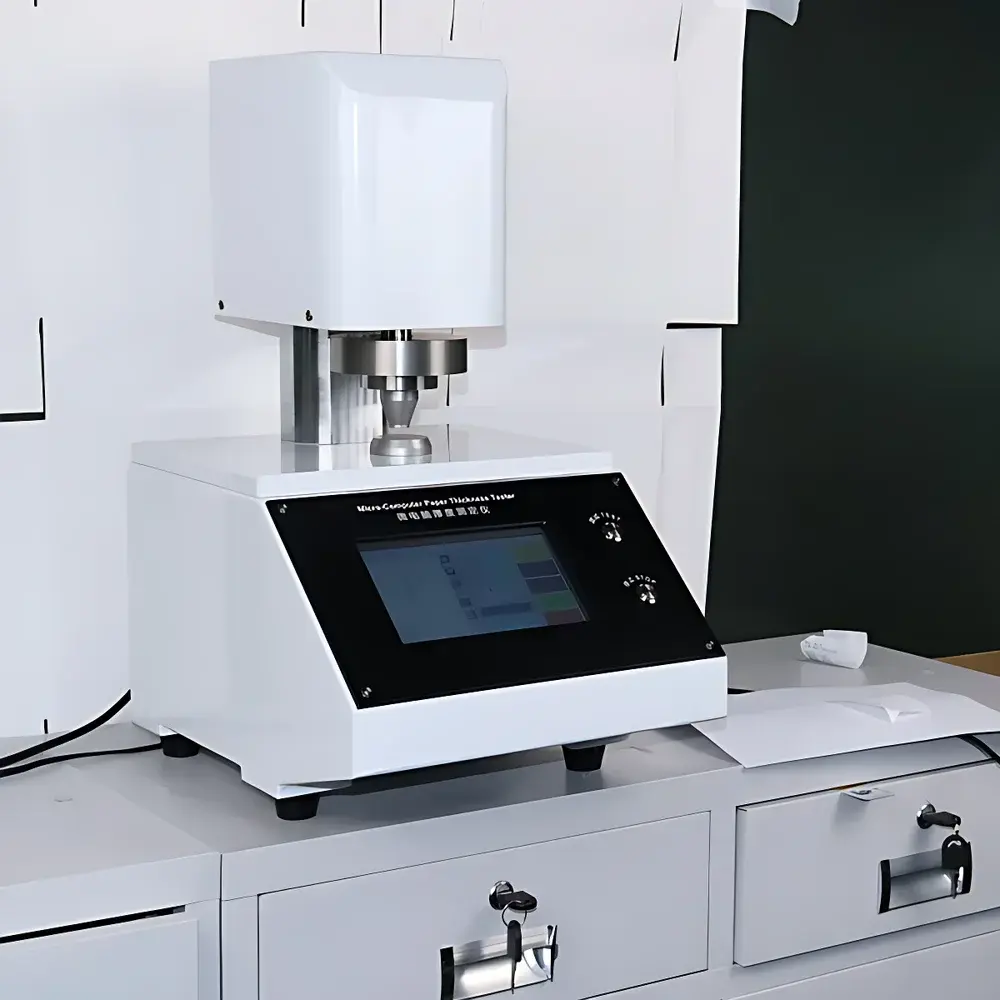
Yuelian PW-TCK-T03 Fully Automated Thickness Tester for Paper, Board, and Thin Films
| Brand | Yuelian / PW |
|---|---|
| Origin | Guangdong, China |
| Manufacturer Type | Authorized Distributor |
| Country of Origin | China |
| Model | PW-TCK-T03 |
| Power Supply | AC 220 V ±10%, 2 A, 50 Hz |
| Accuracy | ±0.5% FS |
| Repeatability | ≤0.3% FS |
| Measurement Range | 0–5 mm |
| Resolution | 0.001 mm |
| Parallelism of Measuring Surfaces | ≤0.002 mm |
| Contact Area | 200 ±5 mm² (paper/board) or 50 ±1 mm² (film) |
| Nominal Contact Pressure | 100 ±10 kPa (paper/board) |
| Descent Speed | 0.5–10 mm/s (adjustable) |
| Display | 7-inch capacitive touch HMI |
| Data Output | Integrated thermal printer (modular design) |
| PC Connectivity | Optional software interface via USB/RS232 |
| Weight | ~25 kg |
| Dimensions (W×D×H) | 320 × 310 × 380 mm |
Overview
The Yuelian PW-TCK-T03 Fully Automated Thickness Tester is a precision metrology instrument engineered for high-reproducibility thickness measurement of planar soft materials—including paper, corrugated board, nonwovens, polymer films, foils, and coated substrates. It operates on the principle of controlled-force mechanical compression between two parallel, temperature-stabilized platens, with displacement transduction performed by a calibrated linear variable differential transformer (LVDT) or high-resolution capacitive sensor (depending on configuration). The system complies with fundamental dimensional metrology requirements defined in ISO/IEC 17025—specifically traceable calibration, environmental stability control (±1 °C), and platen parallelism verification—and is validated for use in GLP- and GMP-aligned quality control laboratories. Its design adheres to human-centered ergonomics and modular mechanical architecture, enabling consistent sample loading, repeatable force application, and minimal operator-induced variability across sequential measurements.
Key Features
- Automated platen descent with programmable speed (0.5–10 mm/s), ensuring controlled contact initiation and eliminating impact-induced deformation artifacts.
- Dual-standard contact area configuration: 200 ±5 mm² for paper and board (per ISO 534 & QB/T 1035), and 50 ±1 mm² for thin films (per ISO 438 & QB/T 451.3), selectable via mechanical adapter plate.
- Precisely regulated pneumatic or electromechanical pressure delivery: 100 ±10 kPa (standard for paper), 17.5 ±1 kPa (standard for films), with optional custom pressure modules (e.g., 20–200 kPa range) available upon request.
- High-stability measuring head featuring hardened stainless-steel platens, surface flatness ≤0.002 mm over full contact zone, and thermal mass optimization to minimize drift during extended operation.
- 7-inch industrial-grade capacitive touchscreen HMI with intuitive icon-driven workflow navigation, real-time measurement visualization, and on-device data storage (≥10,000 test records).
- Integrated thermal printer supporting direct output of test ID, date/time stamp, mean/thickness distribution statistics (n ≥ 10), and compliance flagging per selected standard.
Sample Compatibility & Compliance
The PW-TCK-T03 is validated for specimens with nominal thickness up to 5.000 mm and compressive modulus below 500 MPa—covering uncoated and coated papers (60–400 g/m²), linerboard, kraft board, PET/PVC/PE films (12–250 µm), aluminum foil (6–100 µm), and laminated composites. It meets all mechanical and procedural requirements of ISO 534 (single-sheet thickness), ISO 438 (bulk and density calculation), QB/T 1035, QB/T 451.3, and QB/T 1055. Calibration certificates are issued against NIST-traceable gauge blocks, with annual recalibration intervals recommended per ISO 9001:2015 Clause 7.1.5. Instrument validation documentation supports FDA 21 CFR Part 11 audit readiness when used with optional PC software featuring electronic signatures and immutable audit trails.
Software & Data Management
An optional Windows-based software suite (Yuelian Thickness Suite v3.2) enables advanced statistical process control (SPC), trend analysis, and automated report generation compliant with ISO/IEC 17025 Annex A.5. Data export formats include CSV, PDF, and XML; raw measurement time-series logs (including platen position vs. time) are archived for root-cause analysis of compression anomalies. Software enforces user role-based access control (operator, supervisor, administrator), enforces mandatory calibration expiry alerts, and maintains full ALCOA+ compliant metadata: who, what, when, where, and why for every recorded measurement.
Applications
- QC/QA labs in pulp & paper mills verifying conformity to TAPPI T411 and ISO 534 thickness tolerances across production rolls.
- Flexible packaging R&D evaluating caliper uniformity of coextruded barrier films under standardized pressure profiles.
- Regulatory testing laboratories performing third-party certification per GB/T 451.3 and ASTM D645 (equivalent scope).
- Academic research on compressibility behavior of nanocellulose aerogels and hydrogel sheets, leveraging programmable descent speed and multi-pressure protocols.
- Supplier qualification audits requiring documented traceability from measurement to certified reference material.
FAQ
What standards does the PW-TCK-T03 fully support out-of-the-box?
It is factory-configured and validated for ISO 534, ISO 438, QB/T 1035, QB/T 451.3, and QB/T 1055. Custom firmware patches for ASTM D645 or JIS P 8118 are available upon request.
Can the instrument measure wet or humid samples?
No—it is designed exclusively for ambient-condition, dry-state measurement. Relative humidity control (<50% RH) and temperature stabilization (23 ±1 °C) are required per ISO 187 for valid results.
Is the contact pressure adjustable during a test sequence?
Pressure is fixed per test method selection; however, multiple preconfigured pressure profiles (e.g., “Paper-100kPa”, “Film-17.5kPa”, “Custom-50kPa”) can be stored and recalled via HMI or PC software.
Does the thermal printer support barcode label printing?
No—the integrated module prints only alphanumeric test reports. Barcode-enabled external printers may be connected via USB using the optional PC software.
What is the recommended calibration interval?
Annual calibration is advised per ISO/IEC 17025; interim verification using certified thickness standards (e.g., NIST SRM 2133) should be performed daily prior to first use.



