
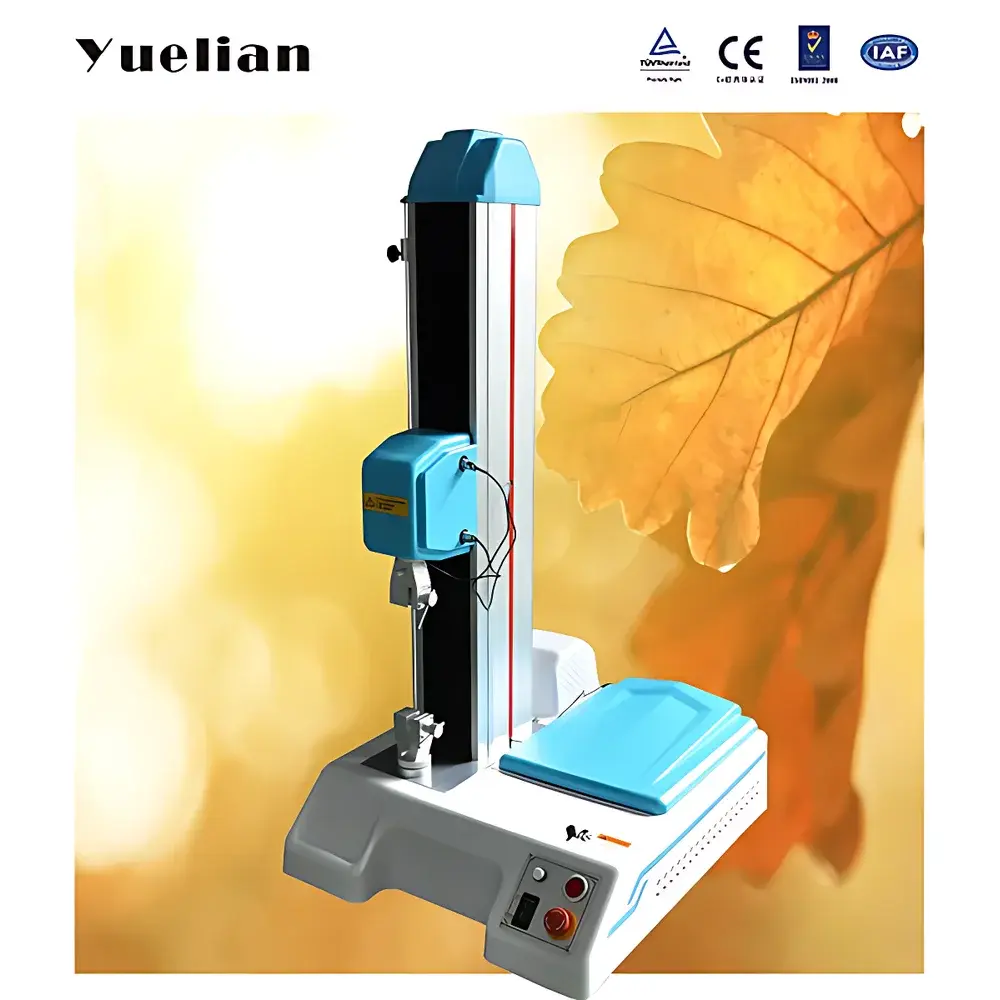
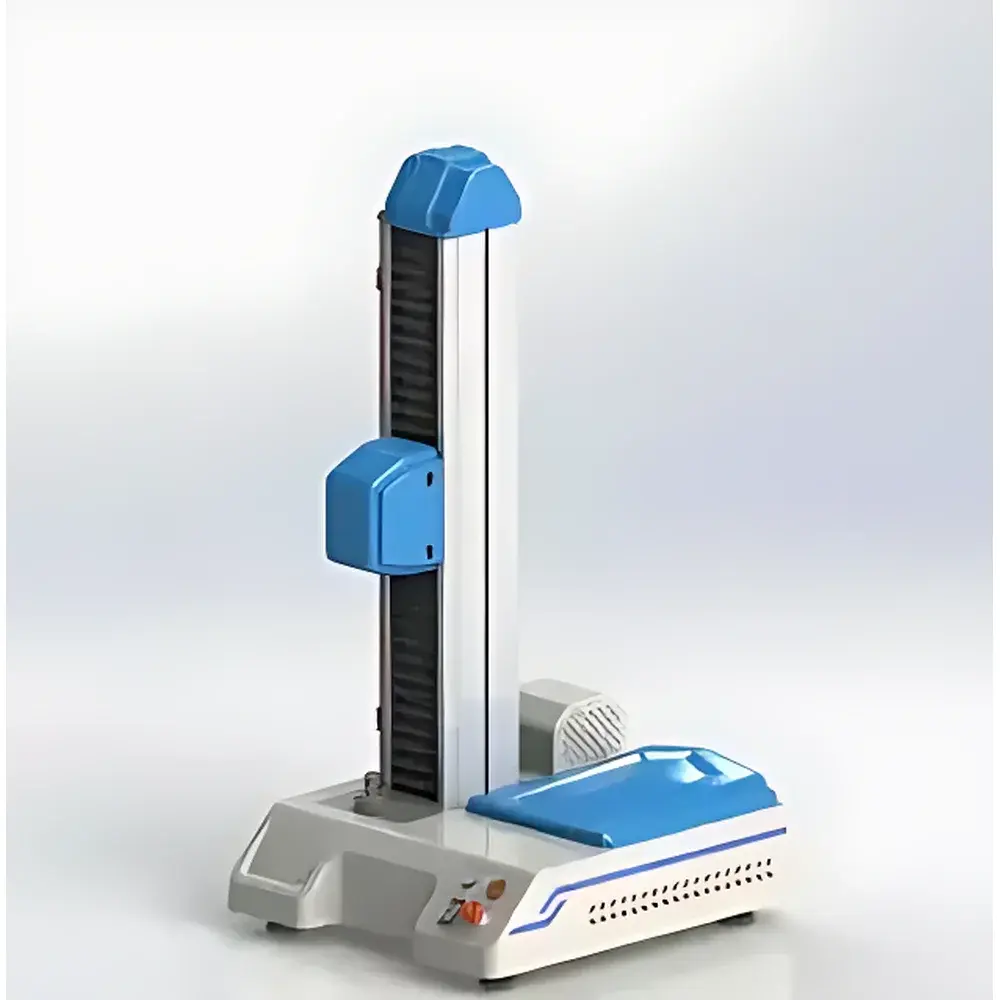
Yuelian YL-S70 Adhesive Release Force Tester for Release Liners
| Brand | Yuelian |
|---|---|
| Origin | Guangdong, China |
| Model | YL-S70 |
| Instrument Type | Electronic Tensile Testing Machine |
| Maximum Test Load | 5 kN |
| Load Measurement Range | 1%–100% FS |
| Load Accuracy | ±0.1% of reading |
| Stroke | 450 mm |
| Displacement Resolution | 0.01 mm |
| Load Resolution | 1/500,000 full scale |
| Sampling Rate | 2000 Hz |
| Speed Range | 0.001–500 mm/min (adjustable) |
| Effective Test Width | 140 mm |
| Power Supply | 220 V, 50–60 Hz |
| Net Weight | 66 kg |
| Dimensions (W×D×H) | 650 × 260 × 1050 mm |
Overview
The Yuelian YL-S70 Adhesive Release Force Tester is a precision-engineered electronic tensile testing system designed specifically for quantitative evaluation of peel adhesion performance in release liner materials—critical components in pressure-sensitive adhesive (PSA) manufacturing, label production, medical tape development, and flexible electronics lamination processes. Operating on the principle of controlled uniaxial tension under standardized angular peel geometry (e.g., 90° or 180° per ASTM D3330, ISO 8510-2, and GB/T 2792), the YL-S70 delivers repeatable, traceable force-displacement data essential for QC/QA compliance and R&D validation. Its modular architecture supports dual-capacity load cell configurations (ranging from 10 N to 5 kN), enabling seamless transition between low-force liner delamination tests and high-force substrate integrity verification—all within a single platform calibrated to ISO 7500-1 Class 0.5 accuracy requirements.
Key Features
- High-fidelity servo-motor-driven actuation with precision ball-screw transmission ensures smooth, jitter-free motion across the full speed range (0.001–500 mm/min), critical for capturing transient peel initiation and steady-state propagation phases.
- Dual-mode load cell support allows rapid interchange between low-range (e.g., 10–200 N) and high-range (1–5 kN) configurations without recalibration—ideal for labs handling diverse release liner grades (silicone-coated PET, fluoropolymer-treated papers, polyolefin films).
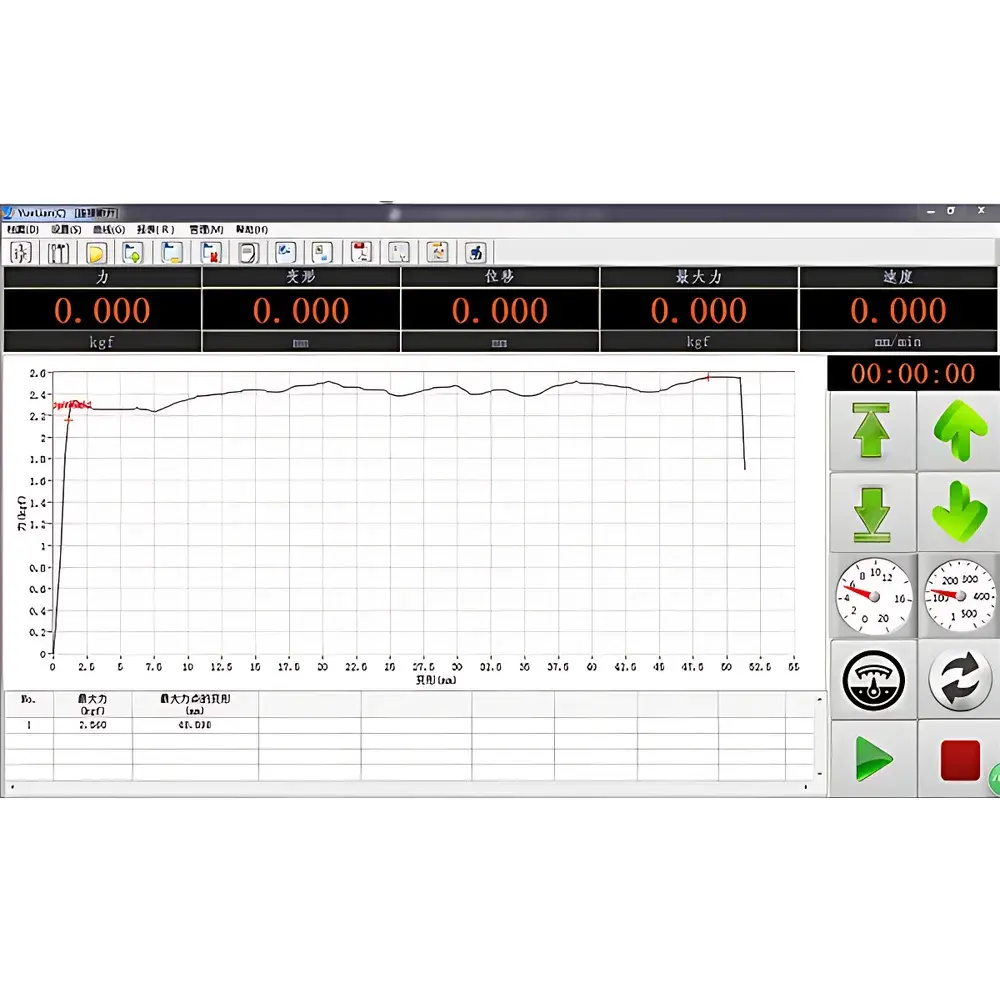
- Real-time multi-curve visualization: Simultaneous display of force vs. displacement, force vs. time, displacement vs. time, and stress vs. strain plots during active testing—with dynamic zoom, crosshair cursor, and point extraction tools.
- Advanced test sequence programming: Supports up to 7 user-defined test segments with nested control modes—including constant-speed, constant-load, constant-strain-rate, and auto-return-to-start—enabling complex peel protocols such as cyclic peel fatigue or dwell-and-peel sequences.
- Comprehensive safety architecture: Integrated overload cutoff, mechanical end-stop limit switches, emergency stop button, programmable upper/lower displacement bounds, and bidirectional load cell polarity switching for tensile/compression versatility.
- Industrial-grade enclosure: Anodized aluminum beam guard, ABS polymer housing with electrostatic spray finish, quick-release fixture couplings, and micro-adjustable vertical travel controls ensure long-term dimensional stability and operator ergonomics.
Sample Compatibility & Compliance
The YL-S70 accommodates standard release liner specimens per ASTM D3330 Method A (90° peel) and Method F (180° peel), as well as custom geometries up to 140 mm wide. Fixture compatibility includes pneumatic, wedge-grip, and roller-clamp configurations for consistent sample alignment and minimal slippage. All hardware and firmware comply with ISO/IEC 17025 documentation standards for calibration traceability. Data acquisition meets GLP audit requirements through built-in timestamped event logging, user-access-level permissions, and optional 21 CFR Part 11-compliant electronic signature modules (available via software upgrade). Test reports are exportable in PDF, CSV, and XML formats—fully compatible with LIMS integration and internal QA archival systems.
Software & Data Management
The proprietary YL-ControlSuite v4.x software provides an intuitive Windows-based interface with multilingual support (English, German, Japanese, Simplified Chinese). It features statistical post-processing functions including mean peel force, standard deviation, CPK capability analysis, outlier rejection (high/low average), median calculation, and histogram generation. Up to 120 automatic sampling points and 40 manual annotation markers can be assigned per test; historical datasets may be overlaid for comparative trend analysis. Raw data streams are stored in binary-encoded .yld files with embedded metadata (operator ID, timestamp, environmental conditions, calibration certificate ID), ensuring full data integrity and chain-of-custody compliance.
Applications
- Quantification of silicone release coating efficacy on PET, paper, and PP substrates
- Validation of liner-to-adhesive interfacial stability under accelerated aging (thermal/humidity cycling)
- Comparative assessment of fluorosilicone vs. acrylate-based release systems
- Quality gate testing for roll-to-roll converted labels and medical device backing liners
- Root-cause analysis of liner curl, blocking, or premature delamination in high-speed converting lines
- Supporting ISO 20563 (adhesive tape durability) and PSTC-107 (release liner classification) certification workflows
FAQ
What peel angles does the YL-S70 support?
The system is configured for both 90° and 180° peel geometries per ASTM D3330 and ISO 8510-2. Custom angular fixtures (e.g., 45°) are available upon request.
Is the load cell factory-calibrated and NIST-traceable?
Yes—each unit ships with a certified calibration report traceable to national metrology institutes (CNAS-accredited lab), valid for 12 months under normal operating conditions.
Can the YL-S70 perform cyclic peel fatigue testing?
Yes—via programmable multi-step sequences with dwell periods, directional reversals, and conditional break detection logic.
Does the software support automated report generation with company branding?
Yes—customizable templates allow insertion of logos, disclaimers, QA stamps, and regulatory compliance statements prior to PDF export.
What is the recommended maintenance interval?
Biannual inspection of ball-screw lubrication, encoder alignment, and load cell zero drift is advised; full recalibration every 12 months or after 5,000 test cycles.
Related Products



