
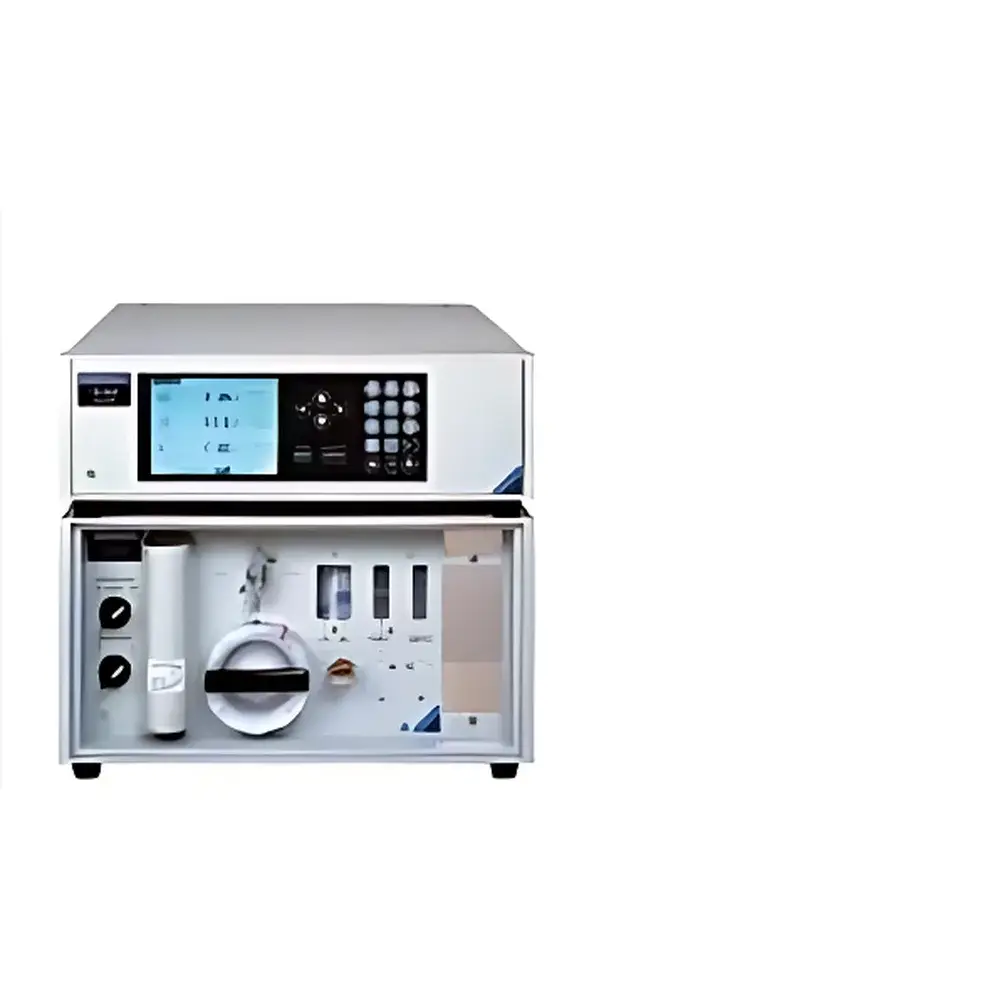
HORIBA VA-3000/VS-3000 Series NDIR & CLA Multi-Gas Analyzer
| Brand | HORIBA |
|---|---|
| Origin | Japan |
| Model | VA-3000/VS-3000 |
| Instrument Type | Online Gas Analyzer |
| Detection Principle | Non-Dispersive Infrared (NDIR) and Chemiluminescence (CLA) |
| Measurable Gases | CO, CO₂, NOₓ, SO₂, CH₄, N₂O, C₂H₄, O₂ |
| Minimum Range | 1–5 ppm |
| Repeatability | ±0.5% F.S. |
| Linearity | ±1.0% F.S. (±1.5% F.S. beyond 10× range) |
| Zero Drift | ±2.0% F.S./week (±1.0% F.S./day for electrochemical O₂) |
| Span Drift | ±2.0% F.S./week |
| Response Time | T₉₀ ≤ 30 s (single-component mode) |
| Resolution | 0.1 ppm |
| Warm-up Time | 20–60 min (dependent on sensor type) |
| Analog Output | DC 0–1 V or 4–20 mA (optional) |
| Digital Interface | RS-232C |
| Sample Flow Rate | 0.5 L/min |
| Operating Environment | 0–40 °C, ≤90% RH |
| Power Supply | AC 100–120 V or 200–240 V, 50/60 Hz |
| Weight | ~20 kg (VA-3000), ~14–20 kg (VS-3001–VS-3004) |
Overview
The HORIBA VA-3000/VS-3000 Series is a modular, online multi-gas analyzer engineered for high-precision, real-time monitoring of trace and major gas components in environmental, industrial emission, and research applications. It integrates two core analytical technologies: Non-Dispersive Infrared (NDIR) spectroscopy for CO, CO₂, CH₄, N₂O, SO₂, and C₂H₄; and Chemiluminescence Analysis (CLA) for NOₓ detection with sub-ppm sensitivity. The system architecture separates the analytical unit (VA-3000) from the sample conditioning module (VS-3000 series), enabling flexible configuration for diverse sampling environments — including stack gas, ambient air, biogas, and laboratory effluent streams. Designed to meet stringent regulatory requirements, the VA-3000/VS-3000 complies with ISO 12039 (CO/CO₂ in flue gas), ISO 11566 (NOₓ measurement), and supports audit-ready data acquisition under GLP and EPA Method 6C/7E frameworks. Its compact 19-inch rack-mount form factor accommodates up to three interchangeable sensor modules per VA-3000 chassis, eliminating the need for multiple standalone analyzers and reducing footprint and operational complexity.
Key Features
- Modular sensor architecture: Supports simultaneous installation of up to three independent NDIR, CLA, paramagnetic (MPA), electrochemical (fuel cell), or zirconia-based O₂ modules within a single VA-3000 chassis.
- Wide dynamic range capability: Configurable multi-range spans — e.g., CO: 0–100 ppm to 0–100 vol%; NOₓ: 0–20 ppm to 0–5000 ppm — with optional extended-range configurations (up to 20× span ratio for NDIR, 100× for CLA).
- High metrological stability: Zero drift ≤ ±2.0% F.S./week (≤ ±1.0% F.S./day for electrochemical O₂); repeatability ±0.5% F.S.; linearity ±1.0% F.S. across 10× range (±1.5% F.S. beyond).
- Rugged sample handling: VS-3000 series sampling units feature corrosion-resistant wetted materials (SUS316, PTFE, PVDF, FKM), heated/dried sample lines (5 °C dew point control), and precise flow regulation (0.5 L/min nominal).
- Standardized digital and analog interfaces: RS-232C serial communication for remote configuration and diagnostics; isolated or non-isolated 4–20 mA and 0–1 V analog outputs compliant with IEC 61000-4 EMC standards.
- Regulatory-ready operation: Firmware supports automatic zero/span calibration scheduling, event logging with timestamps, and data export compatible with EPA CDX, EU MRV, and ISO 50001 energy management systems.
Sample Compatibility & Compliance
The VA-3000/VS-3000 system requires conditioned sample gas meeting strict physical and chemical specifications: particulate load 50 ppm, NO₂ > 6 ppm), explosive, or highly reactive species. For CLA-based NOₓ analysis, sample matrix must be free of hydrocarbons and ammonia unless catalytic converters are installed. NDIR measurements of CO₂ or N₂O require absence of interfering cross-sensitivities — e.g., CO > 10 ppm necessitates optional catalyst integration for N₂O quantification. Zirconia O₂ sensors mandate coexistence of H₂O and O₂ when measuring reducing gas matrices (per stoichiometric constraint: CO + H₂ + THC < H₂O + O₂). All configurations comply with IEC 61010-1 (safety), EN 61326-1 (EMC), and support validation per ASTM D6522 (NOₓ), ASTM D6216 (CO), and USP (pharmaceutical ambient monitoring).
Software & Data Management
The VA-3000 operates with HORIBA’s proprietary Gas Monitoring Software (GMS), providing full instrument control, real-time concentration trending, alarm thresholding (high/low, rate-of-change), and automated calibration sequence execution. Data is timestamped and stored locally with ≥30 days of buffered history (expandable via external USB storage). GMS exports CSV and XML formats compatible with SCADA platforms (e.g., Ignition, Siemens Desigo) and regulatory reporting tools (e.g., EnviroData, Triad). Audit trails record all parameter changes, calibration events, and user logins — satisfying FDA 21 CFR Part 11 requirements when paired with network authentication and electronic signature modules. Remote firmware updates and diagnostic telemetry are supported over TCP/IP via optional Ethernet gateway.
Applications
- Continuous Emission Monitoring Systems (CEMS) for thermal power plants, cement kilns, and waste incinerators — compliant with EU BREF, U.S. 40 CFR Part 60, and China GB 13223.
- Biogas quality control in anaerobic digestion facilities (CH₄, CO₂, H₂S*, O₂, H₂), where optional H₂S detection modules integrate via third-party electrochemical sensors.
- Ambient air quality networks (AAQNs) measuring urban CO, NO₂, and greenhouse gases (CO₂, CH₄, N₂O) per WHO and EEA guidelines.
- Automotive R&D laboratories performing exhaust gas analysis during engine dynamometer testing (transient NOₓ, CO, CO₂, O₂).
- Pharmaceutical cleanroom environmental monitoring (CO₂ for occupancy assessment, O₂ for inerting verification) under ISO 14644-2 and EU GMP Annex 1.
- Carbon capture and utilization (CCU) pilot plants requiring high-accuracy CO₂ purity verification (0–100 vol%) and trace impurity detection (CO, SO₂, NOₓ).
FAQ
What gas detection technologies are integrated into the VA-3000/VS-3000 platform?
The system combines NDIR for CO, CO₂, CH₄, N₂O, SO₂, and C₂H₄; CLA for NOₓ; paramagnetic (MPA) and electrochemical/fuel-cell or zirconia-based methods for O₂ quantification.
Can the analyzer measure NH₃ or H₂S?
NH₃ and H₂S are not supported natively by NDIR or CLA modules; however, HORIBA offers validated third-party electrochemical sensor integrations for these species upon consultation.
How is calibration performed and how often is it required?
Zero/span calibration uses certified standard gases introduced via dedicated RC1/8 inlet; frequency depends on application — typically daily for CEMS, weekly for ambient monitoring — with automated scheduling available in GMS.
Is the system suitable for explosive atmospheres?
The VA-3000/VS-3000 is rated for general-purpose indoor use (IEC 60079-0); intrinsic safety or explosion-proof enclosures require custom engineering and are available under separate certification (ATEX/IECEx).
Does the system support 21 CFR Part 11 compliance?
Yes — with enabled user access controls, electronic signatures, and immutable audit logs, the GMS software meets FDA 21 CFR Part 11 requirements for electronic records and signatures in regulated environments.







